By: Andrew Vespa
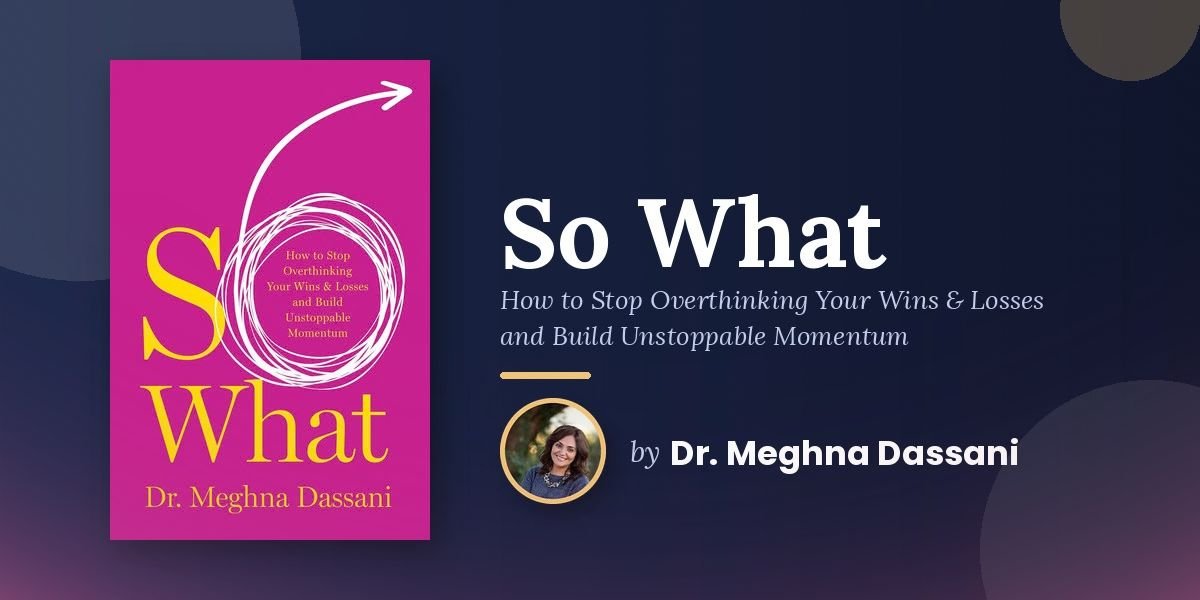
There is a particular kind of professional frustration that Dr. Meghna Dassani describes with uncomfortable accuracy: watching highly talented, highly motivated people stay frozen by overthinking while their potential quietly slips past. She built a thriving dental practice and a career that has produced multiple books on sleep health and airway science while observing exactly this pattern in the peers around her, the ones who had every capability required for success and kept stopping to analyze what the last win or loss meant before allowing themselves to move to the next thing. So What is the book that finally names what she observed and offers the specific framework she developed for avoiding the trap herself.
The central insight is both simple and genuinely liberating: you cannot think your way into momentum. Momentum is built through movement, through the accumulated weight of forward decisions made without the pause that over-analysis creates, through the specific practice of asking so what’s next rather than what does this mean. The So What Sequence that Dassani introduces as the book’s practical core is organized around exactly that practice, giving readers a concrete and repeatable method for acknowledging what happened, releasing the need to fully understand it before moving forward, and redirecting energy toward the next action rather than the previous result.
What distinguishes So What from the crowded field of anti-overthinking literature is the specificity of Dassani’s focus on momentum as the actual target. Most books about overthinking are organized around the problem of excessive thinking itself, treating the thought loops as the primary issue to be addressed. Dassani is more interested in what the thought loops cost in terms of forward motion, and she frames the solution accordingly: not the elimination of analysis but the discipline of not allowing analysis to become the pause that kills momentum. That reframe is practically significant because it changes what success looks like from having fewer thoughts to moving forward regardless of the thoughts, which turns out to be considerably more achievable.
The book applies the So What Sequence across an unusually broad range of contexts, from relationships and parenting through health and leadership and career and personal growth, reflecting Dassani’s understanding that the momentum problem is not domain-specific but a pattern of mind that shows up wherever we allow the weight of what just happened to delay our engagement with what comes next. That breadth of application, paired with the 30-Day So What Challenge that accompanies the launch, gives readers both the framework and the structured practice required to actually build the habit the book is advocating.
So What is explicitly positioned as the opposite of manifestation culture, and that positioning reflects something important about its tone and its underlying values. It is not asking readers to believe their way to results or to align their energy with their desires. It is asking them to move, specifically and repeatedly and without waiting for the previous result to be fully processed, which is both less romantic and considerably more effective.
If you have been watching momentum slip through the pause that over-analysis creates and are ready for a concrete, practical framework for building the habit of forward movement regardless of what just happened, So What by Dr. Meghna Dassani is exactly the book you need. Grab your copy on Amazon today and discover that momentum is not something you think your way into but something you move your way toward.