By: Matthew Davis
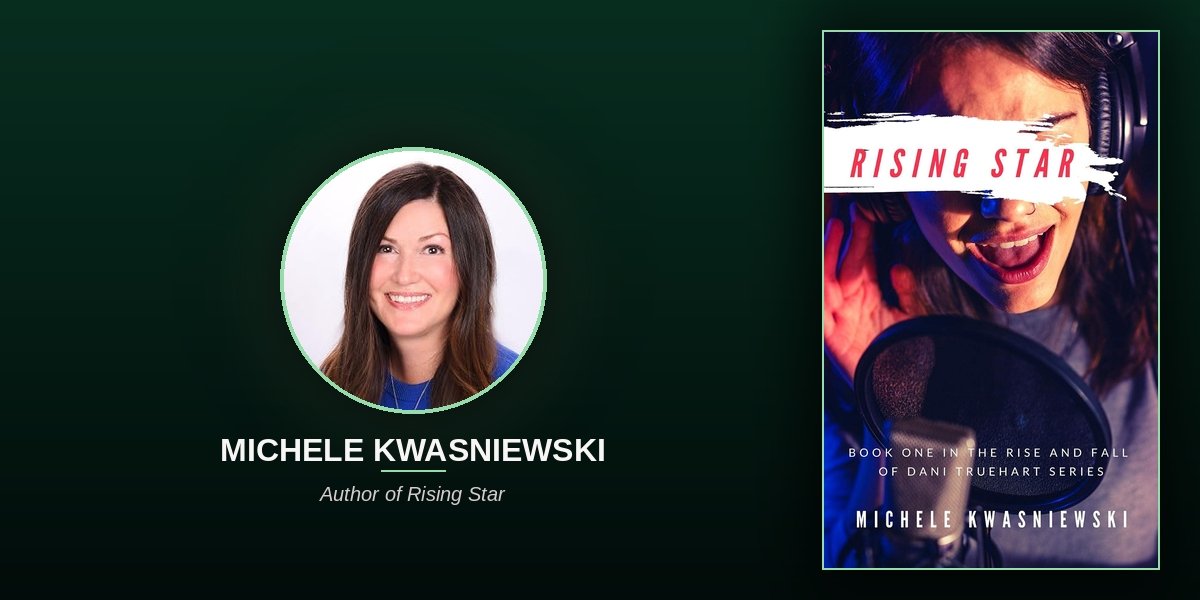
Most people who follow pop music careers see the finished product, the polished performances and the carefully managed public image and the chart positions and the fan base, and have little sense of the specific, often messy, frequently complicated human process that produced them. Michele Kwasniewski’s more than fifteen years in film and television production gave her an unusually complete view of that process, and Rising Star is her attempt to make it visible to a YA audience through the lens of Dani Truehart’s entry into the professional music world. What she makes visible is not a simple story of talent meeting opportunity. It is a more honest account of how a fifteen-year-old with real talent, genuine training, and a complicated family background gets caught up in a set of professional arrangements that are simultaneously her available path forward and a system in which her interests are not the primary concern of anyone other than herself.
The audition that changes Dani’s life is rendered with the specific texture of someone who has been present for many such moments in entertainment careers and knows how they actually feel from the inside rather than from the outside. Music producer Redman hears her first performance, and his amazement is immediate and genuine and also not uncomplicated, and the contract he offers represents real opportunity and real constraint in proportions that Dani is still developing the experience to evaluate clearly. Her dance/vocal coachMartin’s guardianship, which creates the conditions for the audition and for everything that follows, is an arrangement that serves his interests and Dani’s in ways that are genuinely aligned and also in ways that are not, and Kwasniewski maintains the ambiguity of that arrangement throughout rather than resolving it in either direction.
The character work surrounding all of this is what makes the novel more than an industry exposé in fiction form. Dani’s relationship with Sean is the emotional core of the book, the thing most entirely her own that the career is steadily working to displace. Her complicated feelings about her father, her bonds with her friends and her sister, her self-critical inner voice after performances, her genuine joy in her own talent, all of these give her the depth and the specificity that transforms a narrative about an industry into a story about a person who matters to the reader independently of the career she is pursuing.
Kwasniewski’s first-person narration for Dani is one of the novel’s most consistently impressive achievements. Dani sounds fifteen, thinks fifteen, processes the world with the specific sensitivities and the specific gaps in understanding of a fifteen-year-old who is intelligent and perceptive and still in the process of developing the experience that would allow her to read every adult situation she finds herself inside with the clarity she will eventually need. That authenticity of voice is the quality that holds everything else together, and that makes the reader’s investment in Dani’s ongoing story feel genuinely earned rather than simply claimed.
Kwasniewski has written a novel that earns its authenticity and its emotional weight in equal measure, and Rising Star is a genuinely accomplished beginning for a series that has every reason to matter.
If you want to understand what it actually feels like to be at the beginning of a pop music career and to be fifteen while that career is happening to you, Rising Star by Michele Kwasniewski is the most honest and most authentic account currently available in YA fiction. Head over to Amazon and get your copy today.