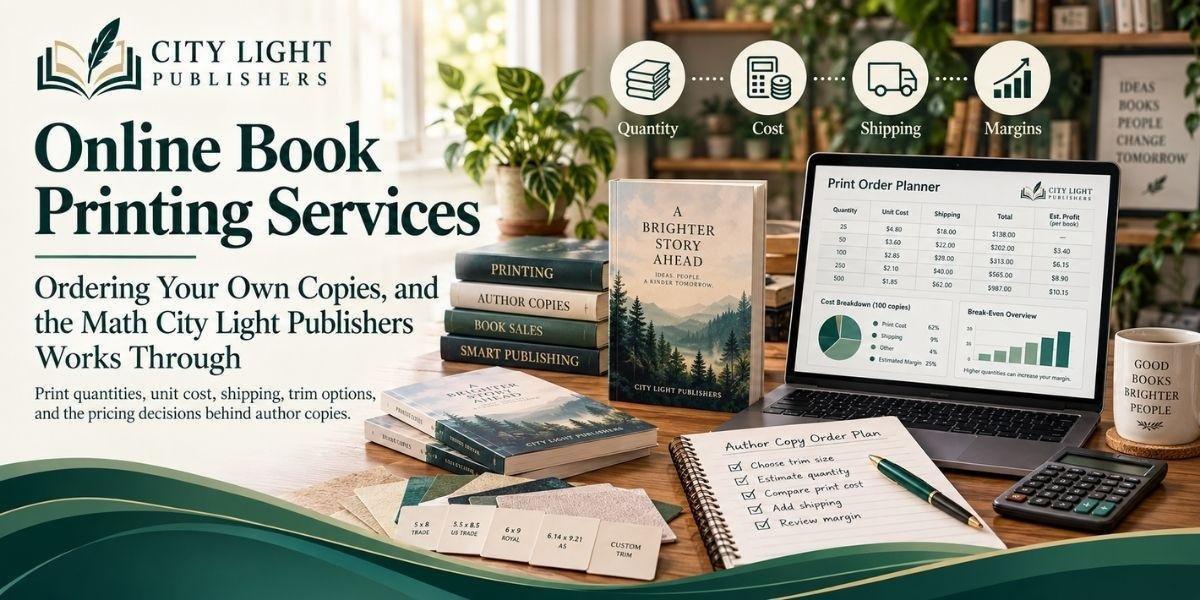
Most writing about print-on-demand covers how readers buy books. Authors have a second, separate set of print needs that nobody explains: the copies you order yourself.
Copies for events. Copies for reviewers. Copies for the shelf behind you on video calls. A box for a client who wants to give the book to their team. Signed editions for the people who backed the project. These orders are where a lot of an independent author’s actual revenue and goodwill lives, and the mechanics differ enough from retail that they are worth setting out.
Author Copies Versus Buying Your Own Book
The first thing to know is that there are two prices.
Ordering through the author copy channel that online book printing services provide typically means paying close to manufacturing cost plus shipping, considerably less than the retail price, because no retailer margin and no royalty are involved.
Buying your own book through a retailer means paying full retail. You receive your royalty back eventually, but you have paid the retailer’s margin for the privilege, and the transaction may or may not count as a sale depending on the platform’s rules.
For anything beyond a couple of copies, author copies are the correct route. The exception is when you deliberately want the purchase to register as a retail sale, which is a narrow and mostly overrated tactic.
What a Printed Copy Actually Costs
Manufacturing cost is driven by four variables, and understanding them explains most of the pricing decisions in print publishing.
Page count is the dominant factor. More pages, more paper, more cost, which is why interior design decisions have a direct financial consequence.
Trim size affects paper usage.
Colour is the cliff edge. Black-and-white interiors are inexpensive. Full-colour interiors cost several times more, which is why illustrated books and children’s titles sit in a different economic bracket entirely.
Binding and finish — paperback versus hardcover, matte versus gloss add smaller but real amounts.
Shipping is then a separate cost, and it is where bulk orders are won or lost.
The Bulk Order Math
For events and client orders, the arithmetic is straightforward and worth doing before you commit to anything.
Per-unit manufacturing cost falls slightly at volume with most print-on-demand providers, but not dramatically; the model is designed around single copies. Shipping, by contrast, falls sharply per unit: one box of forty is far cheaper per book than forty single shipments.
So the economics favour ordering in consolidated batches to a single address, well ahead of when you need them.
Two practical cautions. Lead time is longer than retail delivery, because the books are manufactured to order; ordering event stock a week out is how authors end up at events with no books. And quality variance exists colour and trim vary slightly between print runs, so an order split across two runs may not match exactly.
Selling at Events
If you sell copies in person, the numbers are better than retail by a wide margin: you pay manufacturing cost and keep the difference, with no retailer share.
The practical requirements are mundane. A way to take card payments. A price that is a round number, because making change is friction. Enough copies that you do not sell out early, and not so many that you are shipping a box home. A pen that works on the paper stock you chose; glossy covers resist some inks, which is a small thing that becomes a visible problem in a signing queue.
Bulk and Corporate Orders
The largest single orders many independent authors receive come from organizations: a company buying copies for a team, a conference ordering for attendees, a client giving the book to their customers.
These are worth being ready for. That means being able to quote a per-unit price at volume, knowing your lead times, and being able to ship to a single address. It also means the book must be available in print at all an author with only a digital edition cannot accept these orders, which is the clearest commercial argument for producing a paperback even in a digitally dominated category.
Special editions are possible here too: a custom foreword, a client’s logo on a sticker rather than the cover, a signed bookplate. All of these depend on holding the rights to your own work, which City Light Publishers addresses in stating that authors “retain 100% ownership, rights, and royalties.”
Proof Copies, Which Are Not Optional
Order a physical proof before you approve the book for sale. Every time, including for a revised edition.
Things visible only on paper: how the cover finish actually looks, whether the spine text is centred, whether the gutter margin is adequate once the book is bound, whether images are dark or muddy in print, whether the paper is too thin and the reverse side shows through.
Approving a print book from a screen preview is how authors discover problems after the first fifty copies have shipped to readers.
Where the Files Come From
Print quality depends entirely on the files, and the requirements are unforgiving: bleed on any element reaching the trimmed edge, gutter margins scaled to page count, high image resolution, embedded fonts, and a cover wrap whose spine width matches the final page count.
City Light Publishers offers book printing alongside formatting, cover design, and distribution across Amazon KDP, Barnes & Noble, Kobo, Apple Books, Google Books, IngramSpark, and Draft2Digital, which matters because the print file is the most dependency-heavy deliverable in the project and the one most often rejected on first submission.
The Summary
Use the author copy channel rather than buying retail. Consolidate bulk orders to one address and order early. Know your per-unit cost before quoting anyone. Order a proof, always. And keep a printed edition available even if most of your sales are digital, because the orders that arrive unexpectedly are almost always for physical books.
City Light Publishers describes its printing and publishing services at City Light Publishers