
Business financing is full of terms that sound nearly identical but mean very different things. Confusing them is easy, and the consequences can be expensive: comparing offers incorrectly, signing terms you misunderstood, or choosing the wrong product altogether.
This guide takes twelve commonly confused pairs and untangles each one with a short answer and a note on why the difference matters to your business.
1. Interest Rate vs. APR
The short answer: The interest rate is the cost of borrowing the principal. The annual percentage rate (APR) folds in many fees as well, expressing the total yearly cost as a percentage.
Why it matters: Two loans with the same interest rate can have very different APRs if one carries heavy origination or closing fees. When comparing offers, APR or total repayment cost tells you more than the interest rate alone. For instance, a $100,000 loan at 9 percent with a 4 percent origination fee can cost more over a short term than a loan at 10 percent with no fees.
2. Factor Rate vs. Interest Rate
The short answer: A factor rate, such as 1.25, is a multiplier applied once to the amount funded to determine the total payback. An interest rate accrues over time on the outstanding balance.
Why it matters: A factor rate of 1.25 does not mean 25 percent per year. If the payback happens in six months, the annualized cost is much higher. Always convert factor-rate offers into an annualized figure or total dollar cost before comparing.
3. Secured vs. Unsecured
The short answer: A secured loan is backed by specific collateral, such as equipment or real estate. An unsecured loan has no specific collateral pledged.
Why it matters: “Unsecured” does not mean “no risk to you.” Many unsecured business loans still require a personal guarantee and may include a general lien on business assets. Read the guarantee and lien language carefully.
4. Personal Guarantee vs. Collateral
The short answer: Collateral is a specific asset a lender can claim. A personal guarantee is your promise to repay personally if the business cannot.
Why it matters: A personal guarantee can expose your personal savings, home, or other assets, depending on its terms. Understand whether a guarantee is limited or unlimited before signing.
5. Soft Inquiry vs. Hard Inquiry
The short answer: A soft inquiry lets a lender preview your credit without affecting your score. A hard inquiry occurs with a formal application and can lower your score temporarily.
Why it matters: Prequalification often uses a soft inquiry, but full applications usually trigger hard ones. Several hard inquiries in quick succession can noticeably reduce your score and make future lenders cautious. This is one of the strongest reasons to research thoroughly and then apply with just one well-chosen lender, rather than submitting applications across the market.
6. Line of Credit vs. Term Loan
The short answer: A line of credit lets you borrow, repay, and borrow again up to a limit, paying interest only on what you use. A term loan provides a lump sum repaid on a fixed schedule.
Why it matters: Lines suit recurring or unpredictable needs. Term loans suit specific, one-time investments. Using a term loan for ongoing gaps can mean paying interest on money you are not using, while using a line of credit for a long-term purchase can leave you without flexibility when a real short-term need arises.
7. Merchant Cash Advance vs. Business Loan
The short answer: A business loan is borrowed money repaid with interest. A merchant cash advance is typically structured as a purchase of future sales, repaid through a percentage of receipts or fixed debits.
Why it matters: The legal structure affects disclosures, regulation, and remedies. Advances often cost more and collect more frequently. Know which product you are signing.
8. Factoring vs. Invoice Financing
The short answer: Factoring sells your invoices to a third party, which usually collects from your customers. Invoice financing uses invoices as collateral for a loan or credit line, and you typically keep collecting.
Why it matters: Factoring may involve your customers directly, while invoice financing may not. Costs, contracts, and customer experience differ, so consider how your clients would feel about hearing from a third party before you choose.
9. Fixed Rate vs. Variable Rate
The short answer: A fixed rate stays the same for the life of the loan. A variable rate can change, usually tracking a benchmark.
Why it matters: Variable rates may start lower but can rise, increasing payments. Fixed rates offer predictability, which helps with budgeting. Check how often a variable rate can adjust and whether it has any cap.
10. Term vs. Amortization
The short answer: The term is how long until the loan must be fully repaid. Amortization is the schedule used to calculate payments.
Why it matters: A loan amortized over 20 years with a 5-year term will have modest payments but a large balloon payment due at year five. Plan for that balance from the beginning, either by setting aside funds or by preparing to refinance well before the due date.
11. Prequalification vs. Approval
The short answer: Prequalification is a preliminary estimate of what you might receive. Approval follows full underwriting and verification.
Why it matters: Prequalified amounts and rates can change after a lender reviews your documents. Do not make commitments based on a prequalification alone, such as signing a lease or placing a large order, until you have a final approval in writing.
12. Broker vs. Direct Lender
The short answer: A direct lender funds the loan itself. A broker connects you with lenders and is often paid a commission.
Why it matters: Good brokers add value by matching you with suitable lenders. Less careful ones may send your information to many lenders at once, triggering multiple inquiries and a flood of calls. Ask any broker how they are compensated and whether they will submit your application to a single, carefully selected lender with your permission.
Quick Reference Table
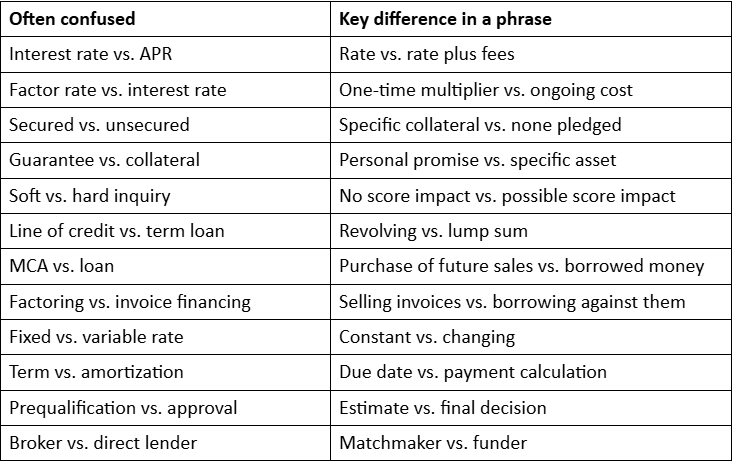
Putting It Together: Reading an Offer
Imagine you receive this summary: “Approved for $60,000. Factor rate 1.28. Daily remittance. Unsecured with personal guarantee. Prequalified pending verification.”
Using the pairs above, you can decode it quickly. The factor rate means a total payback of $76,800, regardless of how fast you repay. Daily remittance suggests a merchant cash advance or similar product, not a traditional loan. “Unsecured” still comes with a personal guarantee, so your personal assets may be at risk. And “prequalified” means the amount could change after review.
With that understanding, you can ask the right follow-up questions: What is the expected term, and what does that imply as an annualized cost? Is there a reconciliation provision? What exactly does the guarantee cover? Clarity turns a confusing offer into an informed decision.
Turning Clarity Into Better Decisions
Understanding these distinctions transforms how you research financing. You can compare offers accurately, ask sharper questions, and spot when a product does not fit your needs.
Use educational resources to deepen your knowledge. Business Loans Blog covers practical financing topics in plain language. Business Loans Engine helps clarify eligibility for different products. Compare Business Loans Online lets you view product types side by side, and Merchant Guidance offers perspective on how financing choices affect daily cash flow.
Once your research points to the right product and provider, apply with that single lender or platform. Spreading applications across many lenders can lead to multiple hard inquiries, lower scores, and a confusing pile of offers that are difficult to compare, even for someone who knows every term on this list. A focused approach keeps your credit clean and your decision clear.
Final Thoughts
Vocabulary may seem like a small thing, but in financing, small misunderstandings can carry large price tags. Learn the differences, ask questions whenever terms are unclear, research carefully, and choose your lender deliberately. Clarity is one of the most valuable assets any borrower can bring to the table, and unlike most assets, it costs nothing but attention.