
Credit is the quiet force behind almost every financing decision. It influences whether you are approved, how much you can borrow, what you pay, and how flexible your terms will be. Yet many owners only think about credit when an application is already underway, which is far too late to improve it.
This workbook is designed to be used, not just read. Grab a notepad or open a spreadsheet. Work through each exercise honestly, and you will finish with a clear picture of where you stand and a practical plan for getting stronger.
Part One: Understand the Two Credit Profiles
Most small business owners have two separate credit identities that lenders may review.
Personal credit reflects your individual borrowing history, including mortgages, car loans, credit cards, and student loans. Scores are commonly reported on a scale of 300 to 850. For small and young businesses, lenders frequently weigh personal credit heavily because the owner and the business are so closely linked.
Business credit reflects the borrowing and payment history of the company itself. It is tracked by commercial reporting agencies and is tied to your business name, address, and federal employer identification number. Business scores use different scales and models depending on the agency.
Strong businesses build both profiles deliberately. Over time, a robust business credit history can reduce reliance on the owner’s personal credit and personal guarantees.
The factors that shape each profile overlap. Payment history carries the most weight almost everywhere. Utilization, meaning how much of your available credit you are using, matters a great deal for revolving accounts. The age of your accounts, the mix of credit types, and the number of recent inquiries also play a role.
Exercise 1: Your Credit Readiness Scorecard
Give yourself points for each statement that is true today. Be honest; this is for you.
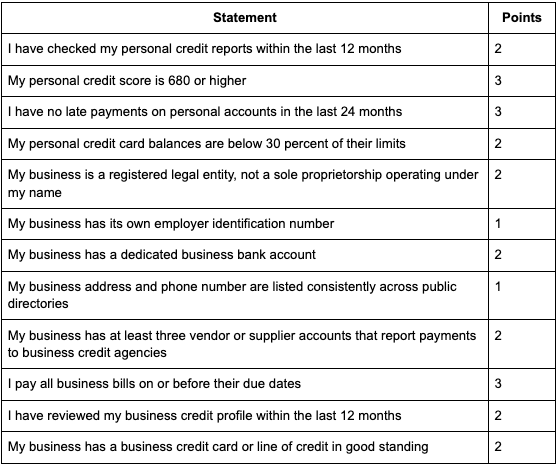
Total possible: 25 points
Interpreting your score:
- 20 to 25: Strong foundation. You are likely positioned for competitive financing. Focus on maintenance and monitoring.
- 13 to 19: Solid progress with clear gaps. Address the missing items over the next three to six months before seeking significant financing.
- 0 to 12: Early stage. Prioritize the fundamentals in Part Two before applying, unless the need is urgent.
Part Two: Build Your Foundation
Use the items you did not score on as your to-do list. The steps below follow a logical order.
Step 1: Establish the business as its own entity. Register as an LLC or corporation, obtain an employer identification number, and make sure the legal name is consistent everywhere it appears.
Step 2: Separate finances completely. Open a business bank account and run every business transaction through it. Mixing personal and business funds confuses lenders and weakens your business credit picture.
Step 3: Create a consistent public presence. Use the same business name, address, and phone number on your website, directory listings, licenses, and financial accounts. Inconsistencies can cause reporting errors.
Step 4: Open trade accounts that report. Some suppliers extend net-30 terms and report your payment history to business credit agencies. Paying these accounts on time is one of the most effective ways to start a business credit file.
Step 5: Add a business credit card. Use it for regular expenses and pay the balance in full each month. Responsible use demonstrates reliability.
Step 6: Pay early when you can. Some business scoring models reward payments made before the due date, not just on time.
Exercise 2: Map Your Current Obligations
List every debt your business currently carries in a simple table: lender name, type of financing, original amount, current balance, monthly payment, and payoff date. Then add up your total monthly debt payments.
Now compare that total with your average monthly net cash flow. If debt payments consume a large share of available cash, lenders will notice, and you should too. Reducing or consolidating existing obligations may improve your profile more than any other single step.
Part Three: Repair What Needs Fixing
If your scorecard revealed problems, take these steps:
- Dispute errors. Request your reports, identify inaccuracies, and file disputes with the reporting agencies. Keep copies of everything you send.
- Bring past-due accounts current. Late payments hurt less over time, but ongoing delinquencies do continuous damage.
- Lower utilization. Pay down revolving balances strategically, starting with cards closest to their limits.
- Avoid new inquiries. Each hard inquiry can temporarily reduce your score. Space out applications and avoid opening accounts you do not need.
- Communicate with creditors. If you are struggling, contacting lenders before a payment is missed often leads to better outcomes than silence.
Part Four: Protect Your Credit When You Seek Financing
The moment you decide to borrow is the moment your credit is most exposed. This is where many owners undo months of careful work.
Research before applying anywhere. Learn which products suit your situation and which lenders work with businesses at your credit level. Educational resources such as Business Loans Blog explain how credit affects different financing types. If you are weighing fast-funding options, Same Day Business Loans Online describes how expedited products evaluate applicants, and Best MCA Loans explains why merchant cash advances often place less weight on credit scores, along with the costs that come with that flexibility. Broader eligibility information is available through platforms like Business Loans Engine.
Apply with one lender that fits best. After researching, choose the single lender or platform most aligned with your needs and credit profile. Applying with many lenders at once can trigger a series of hard inquiries that lower your score at the very moment it matters most. Underwriters who see a cluster of recent inquiries may assume financial distress and respond with declines, smaller offers, or higher costs. A single focused application protects your profile and keeps the process manageable.
Ask about the credit check. Some lenders use a soft inquiry for prequalification, which does not affect your score. Ask before submitting.
Read the guarantee terms. Many business loans require a personal guarantee, linking the debt to your personal credit. Understand what you are signing.
Part Five: Maintain and Monitor
Building credit is not a one-time project. Once your profiles are healthy, keep them that way.
- Set up alerts with credit monitoring services so you are notified of new inquiries or accounts
- Review personal and business reports at least annually, and before any major application
- Keep old accounts open when practical, since account age supports your score
- Watch for signs of identity theft, such as unfamiliar accounts or address changes
- Update your business information promptly whenever you move or change phone numbers
Consistent monitoring catches small problems before they become expensive ones.
Exercise 3: Your 90-Day Credit Action Plan
Write down three specific actions you will take in each of the next three months. For example:
Month 1:
- Pull all personal and business credit reports
- Dispute any errors found
- Open a dedicated business bank account if you do not have one
Month 2:
- Apply for one net-30 vendor account that reports to business credit agencies
- Pay down the highest-utilization credit card
- Update business listings so information is consistent
Month 3:
- Rescore yourself using Exercise 1
- Review progress on balances and payment history
- Decide whether you are ready to research financing options
Revisit this workbook every quarter. Small, consistent actions compound over time, and a score that improves by even a few points can open doors to lower-cost financing.
Closing Thoughts
Credit is not a fixed label; it is a record you write every month through the decisions you make. Owners who understand both personal and business credit, build their profiles intentionally, and protect them by researching carefully and applying with one well-chosen lender give themselves a lasting advantage. When the next opportunity arrives, they are ready to act on the best possible terms.
Disclaimer: This article is intended for informational and educational purposes only and should not be considered professional financial, legal, or credit advice. Credit scores, lending requirements, financing terms, and eligibility criteria vary by lender and individual business circumstances. The strategies discussed do not guarantee credit score improvements, loan approval, or favorable financing terms. Readers are encouraged to consult a qualified financial advisor or credit professional before making financial decisions or applying for business financing.