Women's Journal

This, Not That: 12 Pairs of Business Funding Terms Owners Mix Up Most Often


Business financing is full of terms that sound nearly identical but mean very different things. Confusing them is easy, and the consequences can be expensive: comparing offers incorrectly, signing terms you misunderstood, or choosing the wrong product altogether.

This guide takes twelve commonly confused pairs and untangles each one with a short answer and a note on why the difference matters to your business.

1. Interest Rate vs. APR

The short answer: The interest rate is the cost of borrowing the principal. The annual percentage rate (APR) folds in many fees as well, expressing the total yearly cost as a percentage.

Why it matters: Two loans with the same interest rate can have very different APRs if one carries heavy origination or closing fees. When comparing offers, APR or total repayment cost tells you more than the interest rate alone. For instance, a $100,000 loan at 9 percent with a 4 percent origination fee can cost more over a short term than a loan at 10 percent with no fees.

2. Factor Rate vs. Interest Rate

The short answer: A factor rate, such as 1.25, is a multiplier applied once to the amount funded to determine the total payback. An interest rate accrues over time on the outstanding balance.

Why it matters: A factor rate of 1.25 does not mean 25 percent per year. If the payback happens in six months, the annualized cost is much higher. Always convert factor-rate offers into an annualized figure or total dollar cost before comparing.

3. Secured vs. Unsecured

The short answer: A secured loan is backed by specific collateral, such as equipment or real estate. An unsecured loan has no specific collateral pledged.

Why it matters: “Unsecured” does not mean “no risk to you.” Many unsecured business loans still require a personal guarantee and may include a general lien on business assets. Read the guarantee and lien language carefully.

4. Personal Guarantee vs. Collateral

The short answer: Collateral is a specific asset a lender can claim. A personal guarantee is your promise to repay personally if the business cannot.

Why it matters: A personal guarantee can expose your personal savings, home, or other assets, depending on its terms. Understand whether a guarantee is limited or unlimited before signing.

5. Soft Inquiry vs. Hard Inquiry

The short answer: A soft inquiry lets a lender preview your credit without affecting your score. A hard inquiry occurs with a formal application and can lower your score temporarily.

Why it matters: Prequalification often uses a soft inquiry, but full applications usually trigger hard ones. Several hard inquiries in quick succession can noticeably reduce your score and make future lenders cautious. This is one of the strongest reasons to research thoroughly and then apply with just one well-chosen lender, rather than submitting applications across the market.

6. Line of Credit vs. Term Loan

The short answer: A line of credit lets you borrow, repay, and borrow again up to a limit, paying interest only on what you use. A term loan provides a lump sum repaid on a fixed schedule.

Why it matters: Lines suit recurring or unpredictable needs. Term loans suit specific, one-time investments. Using a term loan for ongoing gaps can mean paying interest on money you are not using, while using a line of credit for a long-term purchase can leave you without flexibility when a real short-term need arises.

7. Merchant Cash Advance vs. Business Loan

The short answer: A business loan is borrowed money repaid with interest. A merchant cash advance is typically structured as a purchase of future sales, repaid through a percentage of receipts or fixed debits.

Why it matters: The legal structure affects disclosures, regulation, and remedies. Advances often cost more and collect more frequently. Know which product you are signing.

8. Factoring vs. Invoice Financing

The short answer: Factoring sells your invoices to a third party, which usually collects from your customers. Invoice financing uses invoices as collateral for a loan or credit line, and you typically keep collecting.

Why it matters: Factoring may involve your customers directly, while invoice financing may not. Costs, contracts, and customer experience differ, so consider how your clients would feel about hearing from a third party before you choose.

9. Fixed Rate vs. Variable Rate

The short answer: A fixed rate stays the same for the life of the loan. A variable rate can change, usually tracking a benchmark.

Why it matters: Variable rates may start lower but can rise, increasing payments. Fixed rates offer predictability, which helps with budgeting. Check how often a variable rate can adjust and whether it has any cap.

10. Term vs. Amortization

The short answer: The term is how long until the loan must be fully repaid. Amortization is the schedule used to calculate payments.

Why it matters: A loan amortized over 20 years with a 5-year term will have modest payments but a large balloon payment due at year five. Plan for that balance from the beginning, either by setting aside funds or by preparing to refinance well before the due date.

11. Prequalification vs. Approval

The short answer: Prequalification is a preliminary estimate of what you might receive. Approval follows full underwriting and verification.

Why it matters: Prequalified amounts and rates can change after a lender reviews your documents. Do not make commitments based on a prequalification alone, such as signing a lease or placing a large order, until you have a final approval in writing.

12. Broker vs. Direct Lender

The short answer: A direct lender funds the loan itself. A broker connects you with lenders and is often paid a commission.

Why it matters: Good brokers add value by matching you with suitable lenders. Less careful ones may send your information to many lenders at once, triggering multiple inquiries and a flood of calls. Ask any broker how they are compensated and whether they will submit your application to a single, carefully selected lender with your permission.

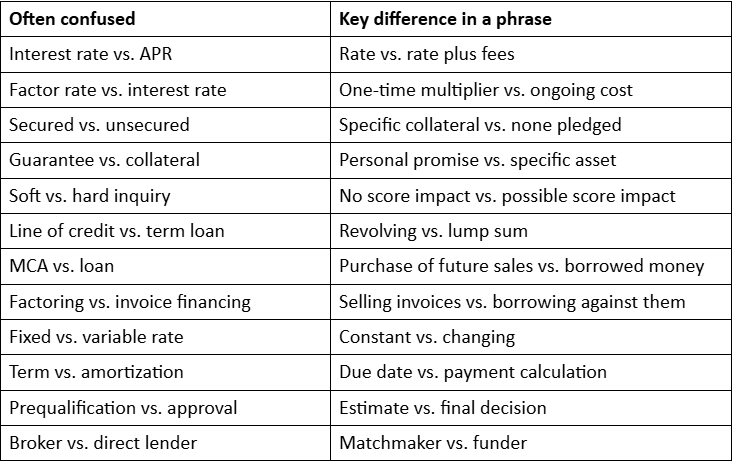
Quick Reference Table
Putting It Together: Reading an Offer

Imagine you receive this summary: “Approved for $60,000. Factor rate 1.28. Daily remittance. Unsecured with personal guarantee. Prequalified pending verification.”

Using the pairs above, you can decode it quickly. The factor rate means a total payback of $76,800, regardless of how fast you repay. Daily remittance suggests a merchant cash advance or similar product, not a traditional loan. “Unsecured” still comes with a personal guarantee, so your personal assets may be at risk. And “prequalified” means the amount could change after review.

With that understanding, you can ask the right follow-up questions: What is the expected term, and what does that imply as an annualized cost? Is there a reconciliation provision? What exactly does the guarantee cover? Clarity turns a confusing offer into an informed decision.

Turning Clarity Into Better Decisions

Understanding these distinctions transforms how you research financing. You can compare offers accurately, ask sharper questions, and spot when a product does not fit your needs.

Use educational resources to deepen your knowledge. Business Loans Blog covers practical financing topics in plain language. Business Loans Engine helps clarify eligibility for different products. Compare Business Loans Online lets you view product types side by side, and Merchant Guidance offers perspective on how financing choices affect daily cash flow.

Once your research points to the right product and provider, apply with that single lender or platform. Spreading applications across many lenders can lead to multiple hard inquiries, lower scores, and a confusing pile of offers that are difficult to compare, even for someone who knows every term on this list. A focused approach keeps your credit clean and your decision clear.

Final Thoughts

Vocabulary may seem like a small thing, but in financing, small misunderstandings can carry large price tags. Learn the differences, ask questions whenever terms are unclear, research carefully, and choose your lender deliberately. Clarity is one of the most valuable assets any borrower can bring to the table, and unlike most assets, it costs nothing but attention.


Pam Ross Finds Sin, Salvation and a Live Wire in “Lost in Heaven”

By: Marcus Vale

There is a moment in every great night when caution leaves the building. The music gets louder, the temperature rises, and whatever respectable intentions you carried through the door disappear beneath the nearest table. Pam Ross lives inside that moment on “Lost in Heaven,” her September 11 single, a hot-blooded collision of country, Americana and Southern rock that treats desire as both temptation and deliverance.

Ross wastes no time setting the controls. “Singing loud, turning up the volume,” she begins, before admitting that her companion gets her “hotter than a day in late June.” It is hardly coded language, and thank God for that. Too many modern country songs approach attraction like a marketing exercise, assembling pickup trucks, denim and moonlight into something technically romantic but emotionally embalmed. Ross uses some of those familiar props, yet she makes them feel inhabited. The faded jeans belong to someone who can actually turn her head. The heat has consequences. The night is not decorative scenery; it is an accomplice.

That distinction matters. “Lost in Heaven” is not about a songwriter dutifully checking the boxes of a country love song. It is about surrender, the second when wanting someone becomes more persuasive than every reason not to.

The setting is appropriately removed from polite society. Hidden by the pines, the lovers find themselves inside a night that feels “open wide.” Nobody is watching, except perhaps the stars and a full moon sworn to secrecy. Ross understands the old power of this landscape. The woods have always represented the place beyond rules, from fairy tales to blues mythology to the darkest corners of rock ’n’ roll. Step past the tree line and civilization’s promises become negotiable.

Then the chorus arrives, lifting the encounter out of the dirt and toward the divine: “Lost in heaven with you / The prayer that’s coming true.” Here lies the song’s central spark. Ross refuses to choose between the sacred and the carnal. The kiss is temptation, but it is also an answered prayer. Angels sing on cue, only to blush at what they witness. Heaven, in other words, is not presented as the reward for resisting earthly desire. Heaven is the desire itself.

That could easily become ridiculous. Rock and country history are littered with songs that mistake overheated imagery for passion. Ross avoids the trap through conviction. She does not sound embarrassed by the size of the metaphor, nor does she hide behind irony. She sings as if pleasure really can be a form of revelation, and for the duration of the chorus, you believe her.

The music’s implied blend of country storytelling and rock muscle suits that argument. “Lost in Heaven” wants volume. Its language is physical: singing, dancing, moving, touching, staying awake until morning. Yet the song never becomes merely swaggering. Ross brings an adult awareness to the fantasy. “Take my hand and we’ll take it slow,” she sings, a line that changes the emotional temperature without cooling it. The invitation is mutual. The intimacy is chosen. This is not some adolescent conquest anthem dressed in cowboy boots; it is a grown woman articulating exactly what she wants.

That perspective gives the record an edge sharper than its easy imagery initially suggests. Country music has traditionally granted men endless room to roam, drink, desire and misbehave, while women are often asked to wait, forgive or serve as moral instruction. Ross has no interest in accepting that arrangement. Her narrator is neither victim nor distant object of admiration. She initiates, responds, fantasizes and decides. When her inhibitions disappear, the song treats the change not as a fall from grace but as an entrance into freedom.

The smartest turn comes with Sunday morning. The secret midnight world does not evaporate at dawn. Instead, Ross imagines waking to find the lover still there, lying beside her. This small detail gives the song a tenderness its more feverish lines only hint at. Saturday night supplies the combustion; Sunday morning reveals whether anything remains after the smoke clears. For Ross, the answer appears to be yes.

“Lost in Heaven” succeeds because it knows pleasure is rarely one clean emotion. It can feel reckless and reassuring, sinful and sacred, fleeting and strangely permanent. Ross holds those contradictions together without trying to solve them. Her heaven has sweat on its collar, pine needles on the ground and the volume turned high enough to annoy the neighbors.

The result is not a revolution in songwriting, nor does it pretend to be. It is something more useful: a familiar kind of song delivered with enough personality to make the familiar burn again. Ross takes moonlight, faded denim, angels and forbidden kisses, the battered furniture of a thousand country records, and rearranges them into a room that feels like her own.

By the final chorus, “Lost in Heaven” no longer sounds like an escape from reality. It sounds like a demand for a reality worth getting lost in.

How Visionary Book Publishers’ Children Book Illustration Services Bring Picture Books to Life

In a picture book, the illustrations are not decoration. They are half of the storytelling. Children often study the pictures long before they can read the words, discovering hidden details, reading emotions on characters’ faces, and following the action from page to page. That is why the art in a children’s book matters so much. Children book illustration services pair your story with artwork that captures its heart, humor, and imagination. At Visionary Book Publishers, we help authors bring their picture books to life through thoughtful illustration planning and collaborative creative development, as part of our book publishing services. This article explains how the process works.

Why Illustration Matters in Children’s Books

Young readers experience books visually. Illustrations help them understand the story, connect with characters, build vocabulary, and develop a love of reading. For adults reading aloud, beautiful art makes the experience more enjoyable and encourages repeat readings.

Strong illustrations also influence how a book is perceived. Parents, teachers and gift-givers often choose children’s books based on the cover and a quick flip through the pages. Professional picture book illustrations signal quality and make your book stand out. Investing in children book illustration services is therefore one of the most important decisions a picture book author makes.

What Children Book Illustration Services Include

Every illustration project is tailored to the book, but a typical process may include:

  • Manuscript review: understanding the story, characters, setting, and tone.
  • Page planning: dividing the text across pages and spreads.
  • Character development: creating sketches of the main characters for your approval.
  • Style selection: choosing an art style that suits the story and audience.
  • Rough sketches: drafting each page layout to show composition and action.
  • Final artwork: completing illustrations in full color or the agreed style.
  • Cover illustration: creating artwork that introduces the book and works for both print and digital formats.

The number of illustrations, revision rounds, and deliverables is defined in a written proposal before work begins.

Working with a Children’s Book Illustrator

A skilled children’s book illustrator brings more than artistic talent. They understand how to pace a story visually, how to create expressive characters and how to leave space for text. They also know how to add visual details that reward repeat readings, such as a small pet appearing on every page or a background story that unfolds alongside the main plot.

Collaboration is key. Your children’s book illustrator will ask about your vision, your characters, and any references you have. At the same time, they bring their own creative perspective, often suggesting visual ideas that enhance the story in ways the text alone cannot.

Developing Characters

Characters are the heart of most children’s books. Before illustrating the full book, we develop character sketches that define each character’s appearance, personality, and expressions. You review these early sketches and provide feedback, ensuring the characters match your vision before the illustrator moves on to complete pages.

Consistency is important. Characters must look the same throughout the book, with recognizable features, clothing, and proportions, even as they move, change expressions, and appear in different settings.

Planning Page Layouts

Most picture books follow standard page counts, often 32 pages, which include front matter and the story itself. Illustrators plan how the text and art will flow across these pages, deciding which moments deserve a full spread, which pages need multiple smaller images and where page turns can create surprise or suspense.

Thoughtful layout planning ensures the story’s pacing works visually, keeping young readers engaged from beginning to end.

Choosing an Art Style

Children’s book illustration styles vary widely, from soft watercolor and bold digital art to whimsical cartoons and realistic painting. The right style depends on your story’s tone, your target age group, and your personal preferences. A gentle bedtime story may suit soft, dreamy colors, while an adventurous tale might call for bold, energetic artwork.

We help you explore styles and choose one that best supports your story.

Text and Image Working Together

In the best picture books, words and pictures complement each other without repeating the same information. The text might say a character is ready for school, while the illustration shows that their shoes are on the wrong feet. This interplay adds humor and depth.

As illustrations develop, we may suggest small text adjustments to avoid redundancy and let the art carry more of the storytelling, always with your approval.

Preparing Illustrations for Publishing

Once the illustrations are complete, they must be prepared for layout and printing. This includes setting the correct resolution, color profiles, trim size, and bleed so the artwork prints accurately. Our team integrates the illustrations with your text in a professional layout, creating print-ready files and digital editions where appropriate.

Timelines and Planning

Illustration is usually the longest stage of producing a picture book, because each spread requires sketching, feedback, refinement, and final rendering. Planning ahead gives everyone room to do their best work. We agree on milestones at the start, such as character approval, rough sketches, and final art, so you know when to expect each stage and when your feedback is needed. Clear timelines are one of the quiet strengths of professional children book illustration services, helping your project reach completion without rushed decisions or last-minute surprises.

Ownership and Usage

Before starting, it is important to clarify how the illustrations can be used, such as in your book, marketing materials, merchandise, or future editions. These terms should be set out clearly in your written proposal, so you understand your rights from the beginning.

Bring Your Picture Book to Life

Your story deserves illustrations that delight young readers and the adults who share books with them. Our children book illustration services connect your manuscript with a talented children’s book illustrator to create picture book illustrations that capture your vision. If your story still needs polishing, our ghostwriting services can help, or you can contact Visionary Book Publishers to discuss your illustration project and request a written proposal.

UN Women Calls for Greater Recognition of Unpaid Care Work

UN Women renewed its call to recognize unpaid care work on October 29, citing an estimate that 708 million women were outside the global labor force because of caregiving. The statement, alongside recent U.S. time-use figures, shows how the numbers were calculated and what they reveal about family responsibilities and paid employment.

Key Takeaways

  • UN Women’s October 29, 2026, statement cited International Labour Organization estimates based on 2023 data
  • The ILO counted 708 million women and 40 million men outside the labor force due to caregiving responsibilities
  • In 2025, 87% of U.S. women and 75% of men performed household activities on an average day
  • A separate October 22 analysis found 66 of 190 economies guaranteed no paid leave for fathers

UN Women marked the International Day of Care and Support on Thursday, October 29, with a statement calling for greater recognition of unpaid caregivers and improved conditions for people employed in care occupations. It also highlighted parental leave and accessible childcare as factors affecting how families divide responsibilities.

At the center of the statement is a figure that requires context. The estimate of 708 million women is drawn from 2023 labor-force data published by the International Labour Organization (ILO) in October 2024. It is not a new 2026 count or a measure of how many women left jobs this year.

Unpaid Care Work Explains the 708 Million Estimate

The ILO estimated that 748 million people age 15 and older were outside the labor force because of care responsibilities in 2023. Women accounted for 708 million of them, compared with 40 million men. The estimates drew on information from 125 countries.

Among approximately 1.6 billion women outside the labor force worldwide, 45% cited care as the reason, compared with 5% of roughly 800 million men. Among women ages 25 to 54 who were outside the labor force, about two-thirds, or 379 million, identified caregiving responsibilities.

Those responsibilities can involve children, older relatives, family members with disabilities and household tasks. The data identify a reported reason for not participating in the labor force. They do not measure each person’s care hours or establish whether every respondent wanted a paid position.

UN Women separately stated that women perform more than three-quarters of unpaid care work worldwide and spend more than three times as long on it as men. Those global comparisons do not describe the division of work in every country or household.

U.S. Time-Use Data Show Differences in Household Responsibilities

The U.S. Bureau of Labor Statistics released its 2025 American Time Use Survey on June 25, 2026. It found that 87% of women and 75% of men age 15 and older performed household activities on an average day. Among those who did these activities, women spent 2.8 hours on them, compared with 2.1 hours for men.

Household activities include cooking, cleaning, household management and lawn care. The category is broader than direct care for children or relatives, so its totals should not be presented as a precise measure of unpaid caregiving.

Childcare figures show another difference. Among adults living in households with children under six, women spent an average of 2.8 hours daily providing primary childcare, compared with 1.7 hours for men. The measure covers childcare performed as the main activity, including feeding, bathing and reading.

For adults living with children under 13, the survey also recorded secondary childcare, when an adult remains responsible for a child while doing something else. Women averaged 5.74 hours of secondary care daily, compared with 4.27 hours for men in those households.

These findings describe time use rather than proving why someone does or does not hold a job. Research on workplace flexibility for mothers likewise considers childcare access and scheduling alongside remote-work arrangements.

Paid Leave Differences Put Family Care Arrangements in Focus

A joint UN Women and World Bank Group policy brief released October 22 examined parental leave across 190 economies. It found that 66 offered no legally guaranteed paid leave for fathers. Of the remaining 124 economies, half provided less than two weeks.

UN Women Calls for Greater Recognition of Unpaid Care Work (1)

Photo Credit: Unsplash.com

The same analysis found that six economies guaranteed no paid leave for mothers, while 61 did not meet the ILO standard of at least 14 weeks of paid maternity leave. It reported that mothers were entitled to nearly eight times as much paid leave as fathers, on average.

These figures concern national legal guarantees, not the benefits every employer provides. They also should not be read as a description of U.S. parental leave rules. UN Women referenced the findings in its October 29 call for more accessible childcare and a more even division of care within families.

Separate research into women’s workplace advancement has examined family-friendly policies alongside career opportunities and organizational conditions. The evidence addresses related questions, but neither study establishes that a single policy determines an individual woman’s employment decisions.

Paid Care Workers Face a Different Set of Workplace Issues

UN Women also drew attention to care provided as paid employment. It reported that women make up approximately 65% of paid care workers worldwide, a group distinct from people carrying out care responsibilities without compensation at home.

The organization stated, “Care work must be fairly paid, with safe working conditions, social protection, and decent work for all.”

Its statement called for stronger recognition of care workers and described the TransformCare Global Initiative as part of its work with partner organizations on care policies.

The announcement did not introduce a new U.S. program or provide an updated count of unpaid caregivers. Its central figures remain tied to previously published international estimates and recent research on parental leave.

Frequently Asked Questions

What counts as unpaid care work?

Unpaid care work can include caring for children, supporting older relatives or people with disabilities, and managing household responsibilities without pay. The ILO’s estimate concerns respondents who identified care responsibilities as the reason they were outside the labor force.

Is the figure of 708 million women new for 2026?

No. UN Women cited an ILO estimate based on 2023 labor-force data and released in October 2024, rather than a new count for 2026.

How much time do U.S. women spend on household activities?

In 2025, women who performed household activities spent an average of 2.8 hours on them, compared with 2.1 hours for men who participated. The figures cover a broader range of tasks than direct caregiving.

What did the parental leave analysis find?

The October 22 UN Women and World Bank Group analysis found that 66 of 190 economies provided no legal guarantee of paid leave for fathers. Half of the 124 economies that provided such leave offered less than two weeks.

What You Can Learn From Women Leaders Who Stopped Waiting to Feel Ready

By: Christina Salerno, Chief Dreamer of Dreamers & Doers, a curated community and PR Hype Machine® for extraordinary women entrepreneurs

Most career advice treats confidence as the price of admission. Build enough of it, the thinking goes, and you’ll finally be ready to make the move. For many women who have made big moves, it happened in the opposite order. They took the job, left the industry, or started the company first, and the confidence showed up later.

That pattern came through clearly in conversations with leaders from the Dreamers & Doers community. Some changed industries with no network to fall back on. Others were pushed into leadership by forces outside of their control. Here, they explain what those leaps taught them about readiness.

Saying Yes Before the Plan Was Clear

For many leaders, the turning point was a yes said before there was a plan to back it up.

Sometimes, those are big swings, like when Soraya Barrera said yes to the VP of Operations role at Translate.One before she had a playbook for how she would actually do the job of helping organizations communicate across borders, languages, and cultures. She built the plan as she went, staying visible in every decision instead of managing from a distance.

“Confidence doesn’t come from already knowing how to do the job, it’s built by saying yes anyway and closing the gap in real time,” Barrera says.

Michelle Bernier made a similar bet when she left law for venture capital with zero industry ties. She reached out cold, showed up in each and every room she could, and learned the business in real time.

“That experience taught me to trust my ability to figure things out rather than wait for permission to start,” Bernier says, adding that this mindset helped her in founding The Right Room, which designs gatherings that connect investors, founders, and leaders. “I wish I’d understood sooner that competence follows courage, not the other way around.”

But for those who are still working on their confidence, the bets can start smaller and add up. About a year ago, Janelle Ryan took a pay cut and went from working five days a week to four, without a mapped-out plan for the extra day. She used it to co-found Mass Pike Plumbing & Heating with her brother.

“Seeing what I could create with just one day a week gave me the confidence to recently quit my job and launch my own consulting business, The Disruption HQ,” Ryan says.

Whether you’re taking a major leap or trying a small experiment, the message here is clear: Do it before you feel ready. “Confidence became practical for me when I stopped measuring my readiness by how certain I felt,” explains Catharine Montgomery, who had to push past uncertainty when founding her communications and marketing agency, Better Together Agency.

Her advice to other women waiting to take a leap: “Make an informed choice you have been postponing, own the result, and let your track record become evidence you can trust.”

When Circumstances Force the Leap

Not all leaps are chosen. Sometimes the plan falls apart, and the only real option is to find a way to keep going.

Take the chaos so many business owners had to deal with during the pandemic. Sydney de Arenas watched her multiple businesses collapse, leaving her with significant debt and forcing her to take on several jobs.

“My confidence was decimated, but I kept taking opportunities, making decisions, building, and putting myself in rooms before I felt remotely ready,” de Arenas says. That resilience paid off when she founded The Hive, a growth engine for small businesses. “I learned how to keep leading even when I did not feel like the version of myself I had always relied on.”

When Hurricane Sandy put Red Hook underwater in 2012, Victoria Alexander was a broker and historic preservation grad student, not an organizer. “Nobody was coming with a plan, so I started showing up at meetings, asking the questions no one else would,” she says. She became a founding member of Resilient Red Hook, founded the Red Hook Business Alliance with Susan Povich, and started testifying in rooms where she had “no credential except that I lived and worked there.”

Today, Alexander runs Realty Collective, a women-owned boutique brokerage in Red Hook. “I wish I’d known earlier that ‘not ready’ is usually just code for ‘not invited,’” she adds, “and you don’t need the invitation.”

But sometimes the circumstances that force change can be more internal. Karen Hennessy Coles hit her turning point when she realized she was stuck and needed a different approach to working within her circumstances. “I wish I’d known I had ADHD and that my ‘struggles’ weren’t my fault, and I’d have leaned into my natural strengths and passions rather than pushing to prove I could do what was hard,” she says.

That mindset shift, along with regular yoga and support from a therapist and doctors, helped her build her own consultancy, Promovere People.

Training for Uncertainty

Many founders share that confidence in their ability to handle anything came through practice that made them feel more prepared.

“I developed the habit of becoming comfortable with pivots, listening to the data, accepting reality even when it was difficult, and being willing to change direction rather than treating a shift as failure,” explains Mathangi Swaminathan. Though it was far from linear, those pivots eventually led her to found social enterprise Parity Lab and grow it globally.

For Jen Blum, founder of JenAI Group, the pace of working in the constantly shifting fields of AI and cybersecurity taught her to get comfortable saying, “I don’t know yet, but I know how to figure it out.”

“Confidence isn’t certainty,” Blum adds. “It’s trusting yourself to move forward when you don’t have every answer, knowing you can learn, adapt, and figure out what comes next.”

If training for uncertainty within your work feels scary, look for opportunities to grow the muscle in your free time. Linda Du, co-founder and CEO of personal finance platform Moola, found the answer in long-distance cycling. Days of pushing through exhaustion, bad weather, mechanical problems, and uncertainty taught her to trust herself to figure things out as she goes, “which is exactly how I now approach building a company,” she says.

“You build confidence by repeatedly proving to yourself that when things go wrong, you’ll find a way forward,” Du adds.

For Melissa Withorn, the proving ground was moving her family from the U.S. to Portugal, where she now builds her American company, CAST Creative, a visual CRM for creative teams.

“Not only did we survive the big, scary move, but we thrived and grew inside the uncertainty,” Withorn says. “Now instead of second-guessing, I lead with the attitude of ‘what’s the worst that could happen’ and go for it.”

Ultimately, these women share that confidence is a muscle you have to keep working again and again throughout your life. “Confidence isn’t something you accumulate and keep; it’s something you have to keep re-earning,” shares Laura Meyer, who started Envision Horizons at 25, with no MBA and no decade of executive experience, and has found that success can actually erode confidence.

“The discomfort doesn’t go away as you move throughout life,” she explains. “It just shows up in bigger rooms, with higher stakes”, meaning you have to stay ready for it.

The Next Right Decision

It’s clear from these stories that confidence isn’t so much a character trait but a method: make the best decision you can in the moment, learn from it, and make the next one.

“I learned to stop confusing ‘I haven’t done this before’ with ‘I’m not capable of doing it,’” explains Kylee McGrane-Zarnoch, who founded A Moment of Magic Foundation in 2014 without a roadmap for building a national nonprofit. “I wish I’d understood earlier that you don’t need to have all the answers to lead well; you need to trust your ability to learn, adapt, and make the next right decision.”

Yéwándé Faloyin, CEO and founder of OTITỌ Leadership & People Development, has taken the fear out of mistakes by treating every outcome as useful. When something strikes a chord with a client, she uses it to sharpen her message. When something misses, she gets curious about what she misunderstood.

“Nothing is wasted; it’s all information,” Faloyin says. “I’m no longer afraid of making a ‘mistake’; I either win now or learn so that I can win later!”

Their circumstances could hardly be more different, but these women describe the same order of events. They moved first. The readiness caught up later.

All individuals featured in this article are members of Dreamers & Doers, a highly curated community and PR Hype Machine® amplifying extraordinary women entrepreneurs and leaders through authentic connections, credibility-boosting visibility, and opportunities that accelerate big dreams. (Learn more about membership here.)