Women's Journal

Study Finds Women with Autism Face More Severe Menopause Symptoms


Research from Bournemouth University found that adults with autism, most of them women, reported more severe menopause symptoms and poorer mental health than participants without autism. The five-week study followed 901 adults and examined how perceptions of menopause were associated with symptom severity, raising questions about communication and support in midlife care.

Key Takeaways

  • Bournemouth University announced the findings on October 28, 2026.
  • Researchers collected five weeks of responses from 476 adults with autism and 425 without autism, ages 40 to 60.
  • Participants with autism reported more severe menopause symptoms, greater anxiety and depression, and lower quality of life.
  • Feelings of reduced control and difficulty understanding menopause were associated with poorer outcomes, but causation was not established.

Women with autism reported more severe menopause symptoms, greater anxiety and depression, and lower quality of life than participants without autism in research announced October 28, 2026, by Bournemouth University in England. The differences appeared across five weekly assessments involving 901 adults ages 40 to 60.

The researchers also identified a link between symptom severity and how participants understood changes happening during menopause. Those findings may help explain some reported differences, but they do not establish that autism causes more severe symptoms or that changing a person’s perceptions would resolve them.

Five Weeks of Surveys Show Differences in Symptom Severity

Doctoral researcher Eunhee Kim led the study, which included 476 participants with autism and 425 without autism. Most participants were cisgender women. The research team asked participants to complete standardized self-report questionnaires over five consecutive weeks, rather than assessing symptoms at a single appointment.

The questionnaires covered perceived menopause symptom severity, depression, anxiety, quality of life and beliefs about menopause. By comparing responses at multiple points, the researchers could examine whether the reported group differences continued throughout the monitoring period.

The results showed consistently higher symptom severity among participants with autism. They also reported poorer mental health and quality-of-life scores than those without autism. These were patterns in participants’ responses, not outcomes confirmed by separate clinical examinations.

Although most participants were cisgender women, the sample was not exclusively female. The findings describe the adults who participated and should not be treated as a prediction for every woman with autism.

The paper has been accepted for publication in Autism in Adulthood, according to Bournemouth University’s research repository. Because the project was observational and relied on self-reported experiences, it cannot identify a medical cause for the differences. Its five-week duration also does not capture the full course of perimenopause or menopause for individual participants.

In the United States, menopause is generally defined as the point reached after 12 consecutive months without a menstrual period. The transition before that point, called perimenopause, can bring irregular periods, hot flashes, night sweats and changes in sleep or mood. Symptoms differ in their timing and intensity.

Cognitive complaints can also arise during the transition. Separate research on menopause brain fog symptoms has examined reported changes in concentration and memory. That UCLA research involved a different group of women and cannot establish why participants with autism reported greater difficulties in the Bournemouth study.

Anxiety and Physical Health Conditions Add Important Context

Alongside menopause symptoms, participants with autism reported higher anxiety and depression scores across the five weeks. They also recorded lower quality-of-life scores. The researchers found that these outcomes were associated with menopause symptom severity, although the direction of those relationships remains uncertain.

Bournemouth University reported additional differences in participants’ physical health histories. Adults with autism were almost twice as likely to report one or more cardiovascular conditions and more than four times as likely to report a musculoskeletal condition compared with participants without autism. The comparisons describe conditions within this sample, not the prevalence of those diagnoses among all women with autism.

These findings require care in interpretation. A reported cardiovascular or musculoskeletal condition may predate menopause, and the study did not establish that hormonal changes caused it. Chronic pain, disturbed sleep or other medical concerns can also complicate a patient’s description of symptoms during midlife.

Separate coverage of heart health during perimenopause examines cardiovascular changes that may occur during the menopausal transition. The Bournemouth study addressed a different question: whether participants reported existing health conditions alongside their menopause experiences. It did not test whether menopause caused cardiovascular disease.

The National Institute on Aging also identifies sleep problems, mood changes and difficulty concentrating as possible concerns around menopause. Such symptoms are not specific to the transition, which makes a review of medical history and other possible explanations important when they disrupt daily life.

Understanding Menopause Changes Emerges as a Key Factor

A central part of the study concerned what the researchers called “menopause representations,” meaning participants’ beliefs, thoughts and feelings about the transition. The team examined whether these perceptions were associated with reported symptoms, psychological well-being and quality of life.

Study Finds Women with Autism Face More Severe Menopause Symptoms

Photo Credit: Unsplash.com

Participants who felt less in control or found menopause difficult to understand tended to report poorer outcomes. Statistical analyses suggested that these perceptions partly accounted for the relationship between autism status and the outcomes measured. The authors cautioned that other mechanisms may also contribute and called for replication under more controlled conditions.

Rachel Moseley, a Bournemouth University researcher and study coauthor, said difficulties obtaining support can arise when a person’s outward expression does not match the level of distress they describe.

“It’s so important to believe any person who tells you they are struggling,” she said in the university’s announcement.

Coauthor Julie Gamble-Turner also emphasized the role of clearer, more tailored information about menopause. The researchers suggested that helping patients understand bodily changes may reduce uncertainty, although this study did not test educational resources, counseling or any treatment approach.

The findings offer a reason for clinicians to ask specific questions about symptoms, daily functioning and a patient’s understanding of menopause rather than relying only on outward appearance. They do not support a single approach for everyone with autism, whose symptoms and healthcare needs may differ widely.

The Menopause Society advises that treatment decisions account for symptoms, personal medical history and individual circumstances. Options for some menopause symptoms include hormone and nonhormonal therapies, but this study did not compare their effectiveness in participants with autism. Its contribution is the documented association between reported symptom burden, mental health and perceived understanding of menopause.

Frequently Asked Questions

What did the study find about autism and menopause?

The autism and menopause study found that participants with autism reported more severe symptoms, higher anxiety and depression scores, and lower quality of life. These findings do not prove that autism caused those outcomes.

How many people participated in the study?

Researchers followed 901 adults ages 40 to 60, including 476 with autism and 425 without autism. Most were cisgender women, and questionnaires were completed over five weeks.

Did researchers identify why symptoms were more severe?

They identified associations involving reduced feelings of control and difficulty understanding menopause. The observational study could not establish causation or rule out other contributing factors.

Does the study recommend a particular treatment?

No. The researchers did not test treatments, and people with troubling symptoms should discuss assessment and care options with a qualified healthcare professional.

Disclaimer:

This article is for informational purposes only and does not provide medical advice, diagnosis or treatment. Individual symptoms and healthcare needs vary. A qualified healthcare professional can assess persistent or severe concerns.


What Did the Church Lose When God Became Exclusively Male?

By: Media at Game Changer Publishing

Most Christians know that God is not biologically male. We say that both men and women were created in His image. Yet much of the Western Church speaks of God almost exclusively through masculine roles: Father, King, Lord, Judge, and Warrior. Something has gone missing.

Scripture has not lost the mothering nature of God. We have lost the ability, or perhaps the permission, to recognize it.

In More Than a Shepherd: Psalm 23 as a Leadership Strategy for Community Transformation, Patricia Tice argues that this loss affects far more than our language for God. When the Church loses sight of how God, specifically in the form of the Holy Spirit, mothers Her children, it also loses part of its understanding of how people learn to hear God and receive directly from all of the Trinity.

It may also help explain an uncomfortable pattern: the parts of the Church most likely to suppress feminine voices are often the same parts most suspicious of the immediate, experiential work of the Holy Spirit. That may not be a coincidence. Is it possible that the barrenness in our churches is because the Holy Spirit is responding to our rules, avoiding the places where Her distinctly feminine voice wouldn’t be welcomed?

A Shepherd’s Mothering in Psalm 23

Psalm 23 is usually read as a promise of comfort. But Tice sees something more deliberate in its sequence. Shepherding was the original equal-opportunity job. Shepherds and Shepherdesses first supply what the sheep cannot provide for themselves. They create rest, nourish, restore, communicate direction, and establish safe boundaries. Those are mothering tasks. Only then does the Shepherd lead them through danger toward the identity, authority, conflict, abundance, and covenant represented later in the Psalm.

This is formation.

Healthy mothering creates the security from which exploration becomes possible. A child recognizes a familiar voice, ventures outward, makes mistakes, and returns for reassurance or correction. Their newfound competence builds confidence. The goal is a mature, independent person, capable of relationship, discernment, and responsibility.

Psalm 23 follows that same movement. The Shepherd comforts His sheep, but He does not intend to leave them as sheep. He is developing people who can sit at His table to get the strategy they need to deal with the enemies they are about to face on the battlefield, and then carry His authority into the world.

The movement is from sheep to kings, and it begins with mothering.

Ruach: The Breath That Teaches Us to Breathe

Tice’s argument begins in the Hebrew language of Scripture. In Genesis 1:2, the word translated “Spirit” is ruach, a grammatically feminine Hebrew noun that can mean spirit, wind, or breath. The Spirit is described as merachefet over the waters, a form of rachaph, meaning to hover, flutter, or brood. The same verb appears in Deuteronomy 32:11 for a bird hovering over its young.

Before creation has recognizable shape, the Spirit broods over unrealized potential and prepares life to emerge. That is mothering imagery, all captured in feminine words.

It is also breath imagery.

A newborn’s first independent act is to draw breath, and for a new believer, our spiritual breath comes from the Holy Spirit. That brings a new perspective on being filled. Why would anyone settle for a seal or a sip when they could fill their lungs and breathe deeply?

The Holy Spirit awakens our capacity to receive life from God directly, to recognize His presence, respond to His voice, and draw from an atmosphere that surrounded us before we received new life and learned how to breathe it in.

Too many Christians survive on shallow spiritual breathing, receiving small, mediated sips of air through a sermon, teacher, or weekly gathering. Those sources are valuable, but they were never intended to replace the believer’s developing capacity to receive deeply from God for themselves.

Early Christians Remembered the Holy Spirit as Mother

The Hebrew makes the feminine difficult to ignore. Genesis says humanity was created in God’s image and immediately clarifies: “male and female He created them.” If both bear God’s image, the feminine must be a part of His nature.

This does not make God biologically female or male. God is Spirit. Masculine and feminine reveal distinct, but unmixed characteristics of His nature without reducing Him to human anatomy.

The Greek New Testament uses the neuter pneuma for spirit and the masculine paraklētos for Helper or Advocate. But in Aramaic, the day-to-day language Jesus and the disciples used, the word for spirit, ruha, is feminine, and that’s what’s recorded in the Aramaic versions of that text.

Grammar alone does not prove that the Holy Spirit is a woman. It does prove that the exclusively masculine language for the Spirit is not the only language Christianity inherited, and probably not the language in which Jesus’ Galilean disciples first heard Him speak about the Spirit.

Early Christian testimony goes well beyond grammar. Origen preserved a saying from the Gospel According to the Hebrews in which Jesus declares, “My Mother, the Holy Spirit,” took Him and carried Him to Mount Tabor. Jerome preserved the same tradition and explained that among the Hebrews, Spirit was expressed with a feminine name. First and second century texts like the Acts of Thomas and the Odes of Solomon often use maternal imagery for God and the Spirit. Early Jewish-Christian traditions recorded by Hippolytus and Epiphanius also portray the Spirit as a feminine figure alongside Christ. Even Count Von Zinzendorf, who led the Moravian missionary movement, spoke extensively about the Holy Spirit as birthing and mothering the church.

These were not modern feminists revising Christianity. They were ancient Christians working within the Semitic languages God chose for the earliest texts, and the words spoken from Christ’s own mouth, in addition to the witness of the Holy Spirit in their own hearts.

As Christianity moved away from its Semitic roots, the feminine ruach and ruha became the neuter pneuma in Greek and masculine spiritus in Latin. An entire dimension of God’s self-revelation gradually faded from Western Christian imagination. Seventeen centuries of habit can feel like orthodoxy even when the earlier testimony is more complicated.

Recovering the mothering nature of God is not an attempt to replace the Father or declare the Holy Spirit biologically female. It is an attempt to recover something Scripture and early Christianity once expressed more freely.

Christian Leaders Must Shepherd in a Mothering Key

If Psalm 23 reveals how God develops people, it gives Christian leaders a pattern they are responsible to follow. Pastors, teachers, and ministry leaders must learn to shepherd in a mothering key of music.

Mothering leadership notices what is struggling to breathe. It creates space for people to receive from God before demanding that they produce for Him. It provides nourishment, restoration, and boundaries while people develop. Most importantly, it teaches them to recognize God’s voice for themselves.

The purpose of spiritual leadership is not to make leaders permanent intermediaries between God and His people. A healthy mother does not bottle-feed her child forever. Christian leadership has failed when people can repeat their leader’s conclusions but cannot recognize the voice of God.

This brings us to the more dangerous question:

Why Are Feminine Voices and the Holy Spirit Suppressed Together?

Why do Christian traditions that restrict feminine voices so often distrust prophecy, spiritual gifts, and personal experience with the Holy Spirit? The positions are defended separately, but share underlying fears: how can we assure the legitimacy of what is spoken?

Feminine voices can reveal dimensions of God that a male-only authority structure does not naturally perceive. The Holy Spirit can, and has, spoken directly to people who possess no title, platform, or institutional permission, even children. Both disrupt systems in which access to God is mediated from the top down, through human control systems. A Church organized around control will struggle with a Spirit who “blows wherever He wishes.”

That does not mean every church that restricts women is consciously trying to suppress the Holy Spirit. The same underlying instinct, the need to contain and control spiritual authority, will produce both outcomes. A Church that requires revelation to move through authorized channels will naturally distrust both a woman who speaks and a Spirit who refuses to ask permission first.

When feminine voices disappear, the Church loses part of its ability to recognize the mothering character of God. When the Spirit’s mothering work disappears, believers lose the environment in which they learn to hear God directly. People can know doctrine without learning to breathe, but that creates zombies that don’t represent Christ well.

The Shepherd Does Not Leave Us as Sheep

The wider culture has not stopped wanting supernatural encounters. Witchcraft, divination, and alternative spiritual practices promise personal access to an unseen world that notices and responds. The Church cannot merely condemn the counterfeit while withholding experience of the real.

People need to learn how to encounter the Holy Spirit, who clothes us with power, without abandoning discernment. Scripture’s answer is to “test the spirits.” Testing assumes something valid can be received.

This is also a challenge to Christian leaders. We cannot call ourselves shepherds while refusing to shepherd as God does. We say we want people to have a personal relationship with God, but treat them with suspicion when they do. We must create environments in which people can breathe, receive, develop discernment, and grow into direct reliance upon Him.

God’s mothering is not sentimental. It is how dependent children become discerning adults, people capable of hearing Him, testing what they hear, and carrying His authority into the world. The Holy Spirit gives us breath. We were never meant to survive on shallow sips.

Learn More and Connect with Patricia C. Tice

Website: More Than a Shepherd

Book: More Than a Shepherd: Psalm 23 as a Leadership Strategy for Community Transformation

LinkedIn: Patricia C. Tice on LinkedIn

Substack: Jesus Geeks

Facebook: ProFound Jesus Geeks

Instagram: ChangeShepherd_JesusGeeks

Disclaimer: The views and opinions expressed in this article are those of the author and do not necessarily reflect the views of this publication. The content is provided for informational and educational purposes only. Readers are encouraged to conduct their own research and form their own conclusions.

The Business Credit Workbook: Assess, Build, and Protect Your Borrowing Power

Credit is the quiet force behind almost every financing decision. It influences whether you are approved, how much you can borrow, what you pay, and how flexible your terms will be. Yet many owners only think about credit when an application is already underway, which is far too late to improve it.

This workbook is designed to be used, not just read. Grab a notepad or open a spreadsheet. Work through each exercise honestly, and you will finish with a clear picture of where you stand and a practical plan for getting stronger.

Part One: Understand the Two Credit Profiles

Most small business owners have two separate credit identities that lenders may review.

Personal credit reflects your individual borrowing history, including mortgages, car loans, credit cards, and student loans. Scores are commonly reported on a scale of 300 to 850. For small and young businesses, lenders frequently weigh personal credit heavily because the owner and the business are so closely linked.

Business credit reflects the borrowing and payment history of the company itself. It is tracked by commercial reporting agencies and is tied to your business name, address, and federal employer identification number. Business scores use different scales and models depending on the agency.

Strong businesses build both profiles deliberately. Over time, a robust business credit history can reduce reliance on the owner’s personal credit and personal guarantees.

The factors that shape each profile overlap. Payment history carries the most weight almost everywhere. Utilization, meaning how much of your available credit you are using, matters a great deal for revolving accounts. The age of your accounts, the mix of credit types, and the number of recent inquiries also play a role.

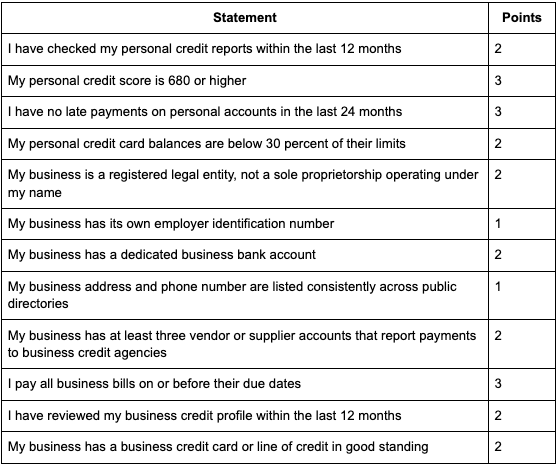
Exercise 1: Your Credit Readiness Scorecard

Give yourself points for each statement that is true today. Be honest; this is for you.

Photo Courtesy: Unsplash.com

Total possible: 25 points

Interpreting your score:

  • 20 to 25: Strong foundation. You are likely positioned for competitive financing. Focus on maintenance and monitoring.
  • 13 to 19: Solid progress with clear gaps. Address the missing items over the next three to six months before seeking significant financing.
  • 0 to 12: Early stage. Prioritize the fundamentals in Part Two before applying, unless the need is urgent.

Part Two: Build Your Foundation

Use the items you did not score on as your to-do list. The steps below follow a logical order.

Step 1: Establish the business as its own entity. Register as an LLC or corporation, obtain an employer identification number, and make sure the legal name is consistent everywhere it appears.

Step 2: Separate finances completely. Open a business bank account and run every business transaction through it. Mixing personal and business funds confuses lenders and weakens your business credit picture.

Step 3: Create a consistent public presence. Use the same business name, address, and phone number on your website, directory listings, licenses, and financial accounts. Inconsistencies can cause reporting errors.

Step 4: Open trade accounts that report. Some suppliers extend net-30 terms and report your payment history to business credit agencies. Paying these accounts on time is one of the most effective ways to start a business credit file.

Step 5: Add a business credit card. Use it for regular expenses and pay the balance in full each month. Responsible use demonstrates reliability.

Step 6: Pay early when you can. Some business scoring models reward payments made before the due date, not just on time.

Exercise 2: Map Your Current Obligations

List every debt your business currently carries in a simple table: lender name, type of financing, original amount, current balance, monthly payment, and payoff date. Then add up your total monthly debt payments.

Now compare that total with your average monthly net cash flow. If debt payments consume a large share of available cash, lenders will notice, and you should too. Reducing or consolidating existing obligations may improve your profile more than any other single step.

Part Three: Repair What Needs Fixing

If your scorecard revealed problems, take these steps:

  • Dispute errors. Request your reports, identify inaccuracies, and file disputes with the reporting agencies. Keep copies of everything you send.
  • Bring past-due accounts current. Late payments hurt less over time, but ongoing delinquencies do continuous damage.
  • Lower utilization. Pay down revolving balances strategically, starting with cards closest to their limits.
  • Avoid new inquiries. Each hard inquiry can temporarily reduce your score. Space out applications and avoid opening accounts you do not need.
  • Communicate with creditors. If you are struggling, contacting lenders before a payment is missed often leads to better outcomes than silence.

Part Four: Protect Your Credit When You Seek Financing

The moment you decide to borrow is the moment your credit is most exposed. This is where many owners undo months of careful work.

Research before applying anywhere. Learn which products suit your situation and which lenders work with businesses at your credit level. Educational resources such as Business Loans Blog explain how credit affects different financing types. If you are weighing fast-funding options, Same Day Business Loans Online describes how expedited products evaluate applicants, and Best MCA Loans explains why merchant cash advances often place less weight on credit scores, along with the costs that come with that flexibility. Broader eligibility information is available through platforms like Business Loans Engine.

Apply with one lender that fits best. After researching, choose the single lender or platform most aligned with your needs and credit profile. Applying with many lenders at once can trigger a series of hard inquiries that lower your score at the very moment it matters most. Underwriters who see a cluster of recent inquiries may assume financial distress and respond with declines, smaller offers, or higher costs. A single focused application protects your profile and keeps the process manageable.

Ask about the credit check. Some lenders use a soft inquiry for prequalification, which does not affect your score. Ask before submitting.

Read the guarantee terms. Many business loans require a personal guarantee, linking the debt to your personal credit. Understand what you are signing.

Part Five: Maintain and Monitor

Building credit is not a one-time project. Once your profiles are healthy, keep them that way.

  • Set up alerts with credit monitoring services so you are notified of new inquiries or accounts
  • Review personal and business reports at least annually, and before any major application
  • Keep old accounts open when practical, since account age supports your score
  • Watch for signs of identity theft, such as unfamiliar accounts or address changes
  • Update your business information promptly whenever you move or change phone numbers

Consistent monitoring catches small problems before they become expensive ones.

Exercise 3: Your 90-Day Credit Action Plan

Write down three specific actions you will take in each of the next three months. For example:

Month 1:

  • Pull all personal and business credit reports
  • Dispute any errors found
  • Open a dedicated business bank account if you do not have one

Month 2:

  • Apply for one net-30 vendor account that reports to business credit agencies
  • Pay down the highest-utilization credit card
  • Update business listings so information is consistent

Month 3:

  • Rescore yourself using Exercise 1
  • Review progress on balances and payment history
  • Decide whether you are ready to research financing options

Revisit this workbook every quarter. Small, consistent actions compound over time, and a score that improves by even a few points can open doors to lower-cost financing.

Closing Thoughts

Credit is not a fixed label; it is a record you write every month through the decisions you make. Owners who understand both personal and business credit, build their profiles intentionally, and protect them by researching carefully and applying with one well-chosen lender give themselves a lasting advantage. When the next opportunity arrives, they are ready to act on the best possible terms.

Disclaimer: This article is intended for informational and educational purposes only and should not be considered professional financial, legal, or credit advice. Credit scores, lending requirements, financing terms, and eligibility criteria vary by lender and individual business circumstances. The strategies discussed do not guarantee credit score improvements, loan approval, or favorable financing terms. Readers are encouraged to consult a qualified financial advisor or credit professional before making financial decisions or applying for business financing.

Lead with the Power of Reflection: Dr. Nika Coleman’s Elevate Journal

After more than 30 years in education and civic leadership, the founder of New Elevation Consulting has created a 30-day guided journal for women who want to lead with greater presence, clarity, and confidence.

Key Takeaways

  • Dr. Tunjarnika L. Coleman is the founder of New Elevation Consulting and the creator of the Elevate™ Series.
  • The first release in the series, Elevate: The Executive Presence Journal, is a 30-day guided journal for women in leadership.
  • The journal is built around Coleman’s three-part framework: Reflect. Realign. Lead.™
  • Her career spans more than 30 years, from a Broward County middle school classroom to vice president of academic affairs.
  • Coleman plans future Elevate releases for men and other executives.

Dr. Tunjarnika L. Coleman has held leadership roles for more than three decades, from a middle school classroom in Broward County to the senior ranks of academic administration. Her newest project is built on a much smaller scale. It is a guided journal, meant to be worked through one day at a time over 30 days.

Coleman is the founder of New Elevation Consulting, which provides executive coaching, leadership development, strategic planning, and organizational transformation for executives, boards, and organizations in education, healthcare, nonprofit, and corporate settings. With Elevate: The Executive Presence Journal, the first release in her Elevate™ Series, she has taken the questions she works through with executives and put them in a format that any woman can use, including women who have never had access to an executive coach.

Why Coleman Created a Journal Instead of Another Program

Coleman’s reasoning begins with a pattern she saw again and again. Women would leave a leadership program energized, then return to work and slip back into old habits. A conference or a weekend workshop can supply motivation, but motivation rarely holds up once the usual pressures of the job return.

A journal asks for something different. It requires a small amount of attention every day, and it places the reflection in the reader’s own hands rather than a facilitator’s. Over 30 days, the repetition is the point.

“Women carry so much,” Coleman says. “I hope this journal gives you a quiet moment to pause, reflect, hear your own voice, and discover parts of yourself you never knew were there, so you can begin creating what comes next.”

In Coleman’s view, presence is not something a leader receives along with a promotion. It is built gradually, in difficult moments and in daily decisions that most colleagues never see.

The journal guides readers through the areas Coleman considers central to that work: developing presence and mindset, finding and using her voice, handling hard conversations, leading as herself, and building a legacy that outlasts any one job.

A Three-Part Framework Behind the Daily Pages

Each section of the journal draws on the framework Coleman uses with her executive clients, and with herself: Reflect. Realign. Lead.™

Reflection comes first. In her approach, effective leadership starts with an honest look at what a leader thinks, what she values, and what drives her.

Realignment follows, because that awareness only matters once it shows up in a leader’s decisions and behavior.

The final step, leading, is about moving forward with intention rather than reacting quickly or performing a title. For Coleman, it also means creating the conditions for others to rise alongside the leader.

Three Decades of Leadership Behind the Prompts

The journal’s prompts grew out of a long career in education and public life. After starting as a middle school teacher in Broward County, Coleman went on to serve as a professor, department chair, dean, provost, and vice president of academic affairs.

She is a former president of the Association of Florida Colleges, which represents 28 institutions, a member of the Aspen Rising Presidents Fellowship, and a member of Leadership Florida’s Cornerstone Class 41. She has served on the boards of chambers of commerce and municipal organizations, and she was named Woman of the Year by one of the largest chambers of commerce in Florida.

Those titles, she found, did not fully prepare her for the daily realities of leadership. She could manage people and deliver results. Commanding a room, delivering hard truths with both courage and grace, and holding on to her integrity under pressure were skills she had to learn through experience. Many of the journal’s prompts come from those lessons.

Known to many as “Dr. Nika,” Coleman has spent much of her career amplifying voices that go unheard and opening doors for others.

“Leadership is ultimately about serving others,” Coleman says. “It is about creating opportunities for women and others to lead boldly, championing those whose potential has yet to be fully recognized, and helping leaders become the very best version of themselves.”

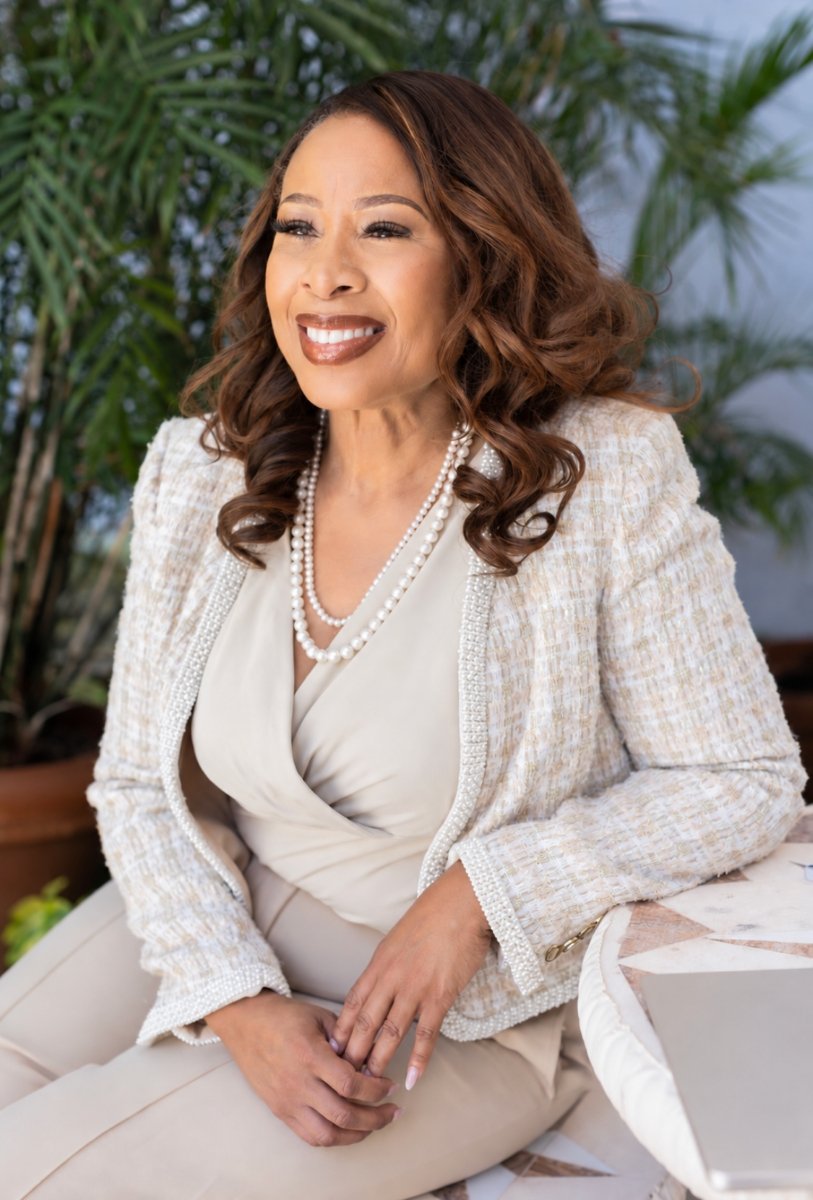
Photo Courtesy: Elina Krivulets / Elina’s Dream Photography

Moving From Operator to Strategist

One transition comes up often in Coleman’s work. She has a name for it, the Executive Shift, and it describes a leader’s move from operator to strategist.

Many women are promoted because they excel at execution. They are the people handed a difficult assignment who deliver it on deadline. That ability earns them a seat at the table, but it does not carry them indefinitely.

An operator focuses on what has to happen today. A strategist considers where the organization is heading, what it will need 18 months from now, and what it should be doing now to prepare.

In Coleman’s experience, the strategic thinking itself is rarely the obstacle. The harder adjustment is personal. Leaders who have been valued for their output throughout their careers have to accept that their value now rests on something else. That something else, their secret sauce, is their ability to translate executive experiences into strategic direction, empower future leaders, and build sustainable success that lasts beyond their tenure.

What Comes Next for the Elevate Series

The first edition of Elevate is written for women in leadership. Coleman plans future releases in the series for men and other executives, each shaped around the specific pressures those readers face at work and at home.

Across the series and her consulting work, her aim stays the same.

“I want my work to leave people, organizations, and communities better than I found them,” Coleman says.

Dr. Tunjarnika L. Coleman is President and CEO of New Elevation Consulting, creator of the Elevate™ Series, and author of Elevate: The Executive Presence Journal: A 30-Day Experience for Women Who Lead. The journal is available on Amazon. Learn more at newelevationconsulting.com or connect with her on LinkedIn.

The Women Behind What’s Next: Shaping the Future of Land, Energy, and Infrastructure

As the land, energy, and infrastructure sectors evolve, three women at Volta draw on decades of experience, industry relationships, and distinct leadership approaches to navigate an increasingly complex landscape.

Long before an energy project breaks ground, its success can hinge on a decades-old property record, a difficult conversation with a landowner, or a relationship that brings the right people to the table. For Volta, a land services firm supporting energy and infrastructure development, navigating these complexities is central to helping projects move forward.

These are the less visible but essential forces behind land, energy, and infrastructure development. As projects grow more complex and the industry enters new markets, the ability to navigate uncertainty, solve problems, and earn trust has never been more important.

At Volta, Leslie Zackery, Janice Redmond, and Dani Harton bring different strengths to that challenge. Leslie delivers the technical precision and leadership behind complex title and due diligence work. Janice draws on decades of industry experience to connect people, strengthen partnerships, and create opportunities. Dani bridges business development and the realities of land work, turning conversations into relationships and opportunities into practical progress.

Together, they represent the formidable influence of women shaping the land, energy, and infrastructure sectors. Their careers reflect different paths to leadership, but a shared ability to drive meaningful progress through expertise, resilience, and relationships built over time. Their impact is measured not simply by the positions they hold, but by the challenges they overcome, the trust they earn, and the future they are helping build.

Leslie Zackery: Decades of Expertise, a Legacy of Leadership

Before an energy or infrastructure project can advance, a fundamental question must be answered: Who holds the rights to the land, and what obligations or limitations come with them?

The answer is rarely simple. Title examination requires tracing ownership histories, interpreting legal records, identifying competing interests, and establishing the rights attached to a property. Decades-old conveyances, fragmented mineral ownership, easements, and unresolved defects can all affect a project’s timeline, financing, or ability to proceed. Even one overlooked detail can have significant consequences.

As Vice President of Title at Volta, Leslie Zackery has spent decades navigating those complexities. Her career has spanned the changing demands of oil and gas development, the growth of renewable energy, and expanding transmission and infrastructure markets. Each shift has brought new expectations for the professionals responsible for verifying land rights. The work now stretches across projects with different technologies, stakeholders, and development timelines, yet the need for reliable answers about ownership and access remains constant. Leslie has built her career on providing those answers when the records are anything but straightforward.

Leslie’s value extends beyond a command of records. She understands how title issues intersect with project risk and development strategy. When an ownership history is unclear or a discrepancy surfaces, she can distinguish what matters most, identify where further investigation is needed, and help find a workable path forward.

That judgment has earned the confidence of colleagues and clients who rely on her to bring clarity to difficult assignments. Her approach combines accuracy with accountability and the ability to communicate complex issues without losing sight of the larger project. That balance is crucial when a title question requires additional research but the development team needs a clear sense of risk and next steps. Experience helps her know when to dig deeper and when the facts support a decision.

One of Volta’s earliest team members, Leslie, has also helped build the company’s capacity to deliver that work. Under her leadership, the Title, Due Diligence & Document Services division has grown from three professionals to more than twenty.

Scaling a team that handles demanding assignments requires more than hiring. It means developing talent, setting clear standards, and creating a culture where people take responsibility for the quality of their work. Leslie has emphasized precision and responsiveness while equipping others to take on increasingly complex projects. The division’s growth reflects her ability to translate individual expertise into a dependable team, without losing the attention to detail its work depends on.

As land transactions and development models evolve, that combination of institutional knowledge and team leadership matters. Leslie’s legacy is not only the problems she has helped solve, but the expertise she is building in others to solve what comes next.

Janice Redmond: Building Relationships, Advancing the Industry, and Creating Opportunity

In land and energy development, relationships can influence a project’s direction as much as technical expertise. Janice Redmond understands that trust is earned over time and sustained through consistent follow-through.

As Director of Business Development at Volta, Janice brings more than 20 years of experience across project administration, operations, negotiations, stakeholder relations, corporate development, and business development. That range gives her insight into both the challenges clients face and the partnerships needed to address them.

Her strength is not simply knowing people throughout the industry. It’s understanding their priorities, anticipating needs, and connecting them with the right expertise. Rather than treating business development as a series of transactions, she invests in relationships that continue as projects and markets change.

That approach begins with listening. By taking time to understand clients’ objectives and the pressures behind them, Janice can identify opportunities for collaboration that might not be obvious at first. Her long-term view also allows her to remain a resource as individual assignments end and new challenges emerge.

That perspective has also made Janice an active voice in the profession. She serves on the Board of Directors of the American Association of Professional Landmen (AAPL) and leads a chapter of Women in Renewable Energy (WiRE). Through these roles, she supports industry collaboration and helps create opportunities for the next generation of professionals. Whether participating in industry conversations or connecting leaders across organizations, she draws on an understanding of the sector’s history and the forces reshaping its future.

In 2026, Janice received the Canadian Association of Land and Energy Professionals’ (CALEP) Herb Hughes Memorial Award, the association’s highest honor. The award recognizes outstanding leadership, professional achievement, and significant contributions to the profession, reflecting her longstanding service to the industry.

Mentorship is another part of that commitment. Janice shares her experience, perspective, and professional connections with emerging land and energy professionals, helping them navigate a field whose demands keep changing. Her work supports opportunities for others to contribute and lead, extending the value of the network she has built.

At Volta, those same qualities help her recognize opportunities, understand what clients are trying to accomplish, and bring together the people and capabilities needed to support them. As conventional and renewable energy projects intersect with new infrastructure demands, her broad experience helps bridge different parts of the industry.

For Janice, opening a door is only the beginning. The real work is earning the confidence to be invited back, and using those relationships to create opportunities for others.

Dani Harton: Turning Conversations into Connections and Challenges into Opportunities

For Dani Harton, Senior Manager of Land & Business Development at Volta, important work often begins with a conversation. What sets her apart is knowing what it takes to turn that conversation into progress.

Dani is known for her energy, determination, and ability to connect with people. But behind that approachable style is extensive land-sector experience, including direct work with landowners and stakeholders and the practical challenges that arise during development. She’s comfortable entering an unfamiliar room, finding common ground, and starting the kind of candid conversation that land work often requires. That ability matters when a project involves multiple parties whose priorities and concerns do not always align.

That background shapes how she approaches business development. She understands not just the potential of a new opportunity but also the steps, obstacles, and relationships involved in bringing it to life. She can connect a client’s broader goals with the on-the-ground realities of land work, and flag problems before they grow.

As the industry expands into new markets, Dani has continued building her technical understanding through professional education in renewable energy and electric interconnection. That knowledge adds to her ability to connect traditional land services with emerging infrastructure needs. It also reflects her willingness to keep learning as projects become more interconnected and the questions clients bring to land professionals become more demanding.

Colleagues and clients know her for persistence, loyalty, and a willingness to follow through when projects become difficult. She builds credibility through action, approaching challenging conversations with respect and staying engaged long after an initial introduction. Her leadership follows the same pattern: showing up, doing the work, and treating people with respect throughout the process.

Dani’s strength is seeing both sides of the business: the opportunities ahead and the work required to make them happen. By bringing a land professional’s perspective into business development, she helps Volta pursue growth with a clearer understanding of what clients and communities need.

Different Paths, Shared Purpose

Leslie, Janice, and Dani lead from different vantage points, but their work rests on the same foundation: expertise, accountability, and relationships built to last.

Leslie brings clarity to complex land rights and builds a team capable of delivering it. Janice connects people, priorities, and opportunities across the industry. Dani bridges business development and the practical realities of work on the ground.

Together, they show that progress depends on more than identifying the next project. It requires getting the details right, earning trust, and building the capacity to deliver.

As the energy and infrastructure landscape changes, their influence will be felt not only in the projects they advance, but in the colleagues they develop, the partnerships they strengthen, and the standards they help carry forward.

Long before the next project breaks ground, someone must untangle a title issue, build trust across organizations, or turn a difficult land conversation into a way forward. That is where the next chapter begins.

About Volta

Volta is a full-cycle land and regulatory services company supporting the development of energy and infrastructure projects. With integrated expertise spanning land management and acquisition, title and due diligence, right-of-way, permitting, project management, and stakeholder engagement, Volta helps clients navigate complex development challenges from initial planning through project execution and long-term land management. Serving industries including renewable energy, transmission, oil and gas, data centers, and emerging infrastructure, Volta combines deep industry experience with a collaborative, solutions-driven approach to moving projects forward.

Learn more at www.voltagroupglobal.com

The Systems That Consistently Keep Women Leaders Confident

By: Christina Salerno, Chief Dreamer of Dreamers & Doers, a curated community and PR Hype Machine® for extraordinary women entrepreneurs

People often describe confidence as a personality trait: something a leader either has or lacks. Many women who run companies describe it differently. In their experience, confidence depends on what surrounds them: how they start the day, who they lean on, what they refuse to carry, and whether they keep track of what’s working.

Below, leaders from the Dreamers & Doers community shared the practices, people, and boundaries that keep their confidence steady, especially in the seasons that test it.

Change the Conditions

Low confidence is easy to read as a personal flaw, but often it’s just a sign that the circumstances need to change. For years, Stephanie Lemek treated her lack of confidence as a personal deficit to fix with more preparation and more proving. The real shift, says the founder and CEO of consultancy The Wounded Workforce, was realizing that much of what she had labeled inadequacy “was a rational response to conditions that weren’t built for the way I led.”

“Once I stopped trying to fix myself and started changing what surrounded me, I led from clarity instead of apology,” Lemek says.

Lorena Wade spent years as a senior healthcare executive leading complex, multi-state operations. She was used to being the person who could push through, until her body made her stop. Now the founder of Stewarded Path, a coaching and leadership development practice, she asks herself a different question.

“I shifted from asking, ‘Can I handle this?’ to ‘Should I have to?’” Wade says. “I no longer measure my leadership by how much I can personally absorb, but by what I can build, empower, and sustain.”

Kristine Frost, founder of executive advisory Shattered Glass Advisory, relies on a list of non-negotiables for home and work. At home, that means a four-step morning routine she doesn’t deviate from. At work, her non-negotiables center on integrity, ethics, and reputation, and when they’re tested, she has learned to walk away.

“It’s tough to say ‘no’ to a boss or CEO,” Frost says. “But it’s much more difficult to live with the turmoil of having your non-negotiables go by the wayside.”

Make Room for Stillness

Being busy can feel like progress, but many of the leaders we spoke with found that confidence grew once they stopped filling every minute.

Almost two years ago, Stacie Sussman, founder of RevUp Advisory, committed to a quiet morning practice: before the school carpool, before the inbox, before anyone needs anything from her, she moves her body, breathes, and lets her mind settle.

“I stopped reacting and started leading,” Sussman says. “I show up to hard conversations clearer. I make decisions faster. I know my ‘hell yes’ from my ‘hard no’ and I don’t second-guess either one anymore.”

Erin Hines, founder of Darn Good Business Coach, builds small pockets of time with no agenda and no outside input into her days, like sitting outside for 20 minutes to watch nature. At first, her mind would immediately start cataloging everything she should be doing, but now, she reaps the confidence benefits.

“Some of my clearest leadership has come from trusting the slow, quiet moments long enough for the noise to settle,” Hines says.

Sya Warfield, founder and executive director of arts-based wellness organization Upward Together, finds that presence through movement. She deliberately seeks out disciplines like Capoeira, dance, boxing, and kickboxing that make her a beginner again and again. “That practice taught me confidence isn’t something you need before you start; it’s built by staying present through not knowing,” she says.

The physical work of building confidence can also be much quieter. When Ariana Friedlander, founder and principal of somatic leadership coaching practice Rosabella Consulting, dealt with a trauma response that left her anxious and doubt-filled for a few years, a breathwork practice is what brought her confidence back.

“It gave me a safe container to feel what was actually there,” explains Friedlander. “Learning to sit with the darkness was what finally let me feel into my strength instead of shrinking it.”

Don’t Do It Alone

The girlboss-era image of the founder who handles everything solo is still very present in our cultural lexicon, but it’s rarely sustainable in practice. Community is more valuable than isolation.

Rochelle Sonnenberg, founder of Her Tech Community, intentionally surrounded herself with women leaders building careers with clarity and integrity, not just speed. Their honesty and support helped her see her own leadership more clearly and trust her instincts.

“Confidence grows faster in community,” Sonnenberg says. “Being witnessed by other women made it easier to recognize the power I already had.”

For Cat Castellanos, founder of post-sweat apparel brand Glow Theory, growing her confidence meant hiring for it. She was overwhelmed by the idea of producing a clothing product, unsure whether to start with a local sewist or how to find a trustworthy factory. Bringing on a product coordinator “gave me the support to grow my company and my confidence,” she says. “Just because you’re a solo entrepreneur does not mean you have to do it alone!”

Nathalie Molina Niño, co-founder of Built, Fund as a Service, doesn’t just look for collaborators who fill her skill gaps, but who help her tap into more confidence.

“Confidence, like any other important resource, can be depleted,” Molina Niño says. “Finding people to partner with who recharge your supply is the single most important criterion when deciding who to work with, and who to leave behind.”

Finally, remember it’s okay to call your mom (or any other support system you’ve leaned on your whole life) when the going gets tough and your confidence runs low. When Avital Eusgeld set up her branding agency, HiPitched, she was scared people wouldn’t take her seriously. “I remember calling my mum and she said, ‘Think about how much you have already achieved. You can do this and, if it fails, then you’ll move on to something else.’” That gave her the boost she needed to go for it.

Keep the Evidence

If all else fails, these women say to look for proof of your abilities to bolster your confidence in them.

When trying to believe in her impact, Myra Deshmukh, founder and CEO of Leadership Lab, tried what she calls a “Strength Text” exercise. She asked people who had worked closely with her to text her what they saw as her unique strengths and the impact she’d had on them. Seeing herself through someone else’s eyes helped her show up with more confidence in the value she brings.

“We often take for granted the impact we have on other people because we’re too close to our own work,” Deshmukh says.

Lis Best, founder of Girls Club Collective, keeps a collection of kind emails, screenshots, and client love to return to whenever she feels uncertain about the next big thing she’s pursuing.

“As humans, we have a bias toward the negative,” Best shares. “It’s not our fault, but we can combat it with evidence.”

Lakeya Cherry, CEO and founder of Lakeya Cherry LLC, has facilitated Brené Brown’s Dare to Lead™ courage-building work since 2019, which has required her to practice the same courage she helps others develop. Confronting her own shame, insecurities, and fear taught her to step into the arena before she felt fully ready.

“Each time I act while fear is present, I build evidence that I can trust myself,” Cherry says. “Courage is teachable, measurable, and observable. Confidence grows when we are willing to practice it.”

None of these practices is dramatic: a morning routine, a few texts from colleagues, a folder of kind emails. That’s what makes them useful. They’re still there on the days confidence isn’t.

About Dreamers & Doers

All individuals featured in this article are members of Dreamers & Doers, a highly curated community and PR Hype Machine® amplifying extraordinary women entrepreneurs and leaders through authentic connections, credibility-boosting visibility, and opportunities that accelerate big dreams. (Learn more about membership here.)

How Women Leaders Learned to Trust Their Own Judgment

By: Christina Salerno, Chief Dreamer of Dreamers & Doers, a curated community and PR Hype Machine® for extraordinary women entrepreneurs

Women in leadership rarely lack input. Coaches and consultants, mentors and managers, and an endless stream of advice and feedback. But for many successful women in the Dreamers & Doers community, confidence grew when they turned the volume down on everything else.

The leaders we spoke with kept describing the same internal shift: as soon as they stopped listening to the judgment of other people, they could start more deeply believing in themselves. Here, they describe how they learned to let go of approval, quit over-explaining, and trust the decisions they already knew were right.

Letting Go of Approval

For many of these women, the first step was simply noticing how much weight other people’s opinions carry.

“As a woman, and a woman of color in particular, I had internalized the belief that other people’s opinions were more valid than my own,” says Amber Banks, founder and CEO of the Center for Trust and Transformation. She made a deliberate practice of noticing when she was seeking outside validation for a decision she already knew was right, and choosing to trust herself first. That practice took time to build, she says, and it became critical to her work helping others navigate trust.

Alejandra Graf, founder of the food media platform Piloncillo y Vainilla, felt like she was constantly trying to explain herself as a Mexican living in the U.S., and it wasn’t getting her anywhere. So she stopped.

“The moment I stopped explaining and just showed up as myself, everything shifted,” Graf says. “Real confidence came from dropping the need to be understood on someone else’s terms and trusting that being fully me was more than enough.”

“I wish I’d understood that confidence isn’t certainty or universal approval; it’s self-trust,” agrees Olivia Mead, founder and CEO of Yoga For First Responders®. “I practiced speaking from my own expertise without over-explaining, which allowed me to stop managing perception and fully occupy my space as a leader.”

“Real leadership is not about keeping everyone happy; it is about setting clear priorities, making thoughtful choices, and being honest about what we can and cannot commit to,” agrees Allison Wyatt, founder and CEO of Edgility Talent Partners. Shifting from trying to meet every expectation to leading with clarity about what she is building and the impact she wants to make made all the difference for her.

Hearing Their Own Voice Again

Advice is easy to find, but the trouble starts when there’s so much of it that a leader can no longer hear her own instincts.

Emily Dick, a brand strategist at Unbuttoned Brands, started by making time actually to listen to herself. That meant turning down the “right way to do it” advice from others and lifting off the social conditioning she had taken on.

“It felt risky at first to build my business and my brand my way instead of the way I’d been taught, but leaning into my own strengths made me magnetic,” Dick says, adding that she found her confidence was already there under all the noise.

Catalina Parker agrees that she had to learn to stop looking outside of herself for answers as she built her consulting business Relatable Nonprofit.

“I had invested in coaches, consultants, books, and podcasts, and at some point I realized I was taking in so much advice that I could barely hear my own instincts,” Parker says. “The shift was learning to use outside support as input, while trusting myself to decide what was actually right for me and my business.”

As a matchmaker and the founder of SYS, Julie Nguyen spends much of her time helping people trust what they already know about love. Offering herself that same trust changed the way she leads. She stopped people-pleasing and got comfortable saying no when something wasn’t aligned.

“I used to think confidence came from being certain or being liked,” Nguyen says. “I’ve learned that it comes from trusting yourself enough to make the choice that feels true, even when someone else may not understand it.”

Enoma Osakue, CEO of Stackrie, learned early not to assume a title meant someone had something to teach her, after being targeted by a boss she was outperforming. “That moved me into operating with greater confidence in my work and convictions, rather than receiving all feedback neutrally, and I’ve led that way ever since,” she says.

For Peri Finkelstein, founder and CEO of Team Peri Foundation, the decision to tap more deeply into her voice was literal. She started writing her memoir two years ago, but worry about judgment kept her from sharing her words. Realizing she was writing the story for herself gave her the confidence to launch a Substack and finally release her book, The Velvet Bow (And Other Dark Sh*t).

“This experience taught me that my story matters, my words matter, and I don’t need anyone else’s permission to share them,” Finkelstein says.

Deciding Without Perfect Certainty

Waiting for perfect information can pass for caution. Often, it’s self-doubt by another name.

Domonique Worship, CEO and founder of The Institute of Exceptional Alignment, spent years putting enormous pressure on herself to show up flawlessly and prove she belonged in the room. Loosening her hold on perfectionism taught her to trust her own judgment and move more decisively.

“Every time I made a thoughtful decision without waiting for perfect certainty, I gave myself more evidence that I could handle whatever came next,” Worship says.

That is often rooted in the belief that a confident founder always knows the “right” decision. Natalie De Vincenzi let that go, now trusting herself to make the best decision she can with the information she has.

“I wish I’d understood earlier that confidence doesn’t come from eliminating uncertainty; it comes from finding and building evidence that you can trust yourself to navigate it,” adds the founder of the mental health apparel brand You Are Enough Co.

When Natasha “Tash” Durkins’ sales coach gave her some unconventional advice, to stop forcing her sales, she wasn’t totally convinced but decided to listen to her gut. “I checked in with myself, asked if I actually believed she was right, and the answer was yes, so I pushed myself to let go,” she says, and within days, two major contracts she never saw coming rolled in for her coaching and advisory company, Fiercely Joyful,

“The proof showed up after I followed my gut, not before,” she adds. “Stop confusing confidence with certainty.”

For Lona Vincent, founder of WOW Health (World of Women’s Health), success came from giving herself permission to stop overthinking and just start building. “I stopped waiting for the right moment and started doing the work,” she says. “I wish I had understood earlier that building the thing teaches you more than thinking about it ever will.”

Proudly Owning What Makes Them Different

Self-trust can also mean no longer apologizing for the parts of a career that don’t fit neatly in one box.

For years, Allison McMillan downplayed either her engineering leadership or her facilitation background, depending on the room. When she built Tavlin Consulting, she stopped choosing and deliberately set up shop between technical and non-technical teams.

“Owning that combination means I now show up as a peer with CTOs and a translator with everyone else, without needing to prove I belong in either room,” McMillan says. “The things that make you hard to categorize are often exactly what makes you valuable.”

Lisa Friscia, CEO and founder of Franca Consulting, stopped trying to be all things to all people and got much clearer on her own strengths. That clarity made her more intentional about the tables she sits at, the work she takes on, and when she isn’t the right person for the job.

“Confidence isn’t believing you can do everything,” Friscia says. “It’s knowing what you do exceptionally well, trusting that, and being equally clear about where someone else is better suited to lead.”

Other people’s opinions still matter to these leaders. They just no longer get the final word. And that turns out to be what made all the difference.

Disclaimer: All individuals featured in this article are members of Dreamers & Doers, a highly curated community and PR Hype Machine® amplifying extraordinary women entrepreneurs and leaders through authentic connections, credibility-boosting visibility, and opportunities that accelerate big dreams. (Learn more about membership here.)

How Women Founders Can Get More Comfortable With Being Seen

By: Christina Salerno, Chief Dreamer of Dreamers & Doers, a curated community and PR Hype Machine® for extraordinary women entrepreneurs

Ask founders which moments tested their confidence most, and many will point to the ones with an audience: naming a price, pitching an idea, launching something unfinished, or speaking up in a room full of longer résumés.

Leaders from the Dreamers & Doers community say those exposed moments are also where their confidence increased. Here, they share how they learned to ask for more, walk into rooms before anyone invited them, and let people see their work before it felt finished.

I Practiced Naming My Value

For many leaders, the first real test of confidence is whether they can stand behind the value they provide.

Hope Alcocer, owner and consultant of Wonder Woman Media, had to fight the all-too-common drive to lowball herself to win clients. She rebuilt her business around retainers, priced at what the work is actually worth.

She’s honest that it still takes practice. “If asking for what you are worth still gives you a nervous stomach or clammy hands, it’s okay… same! It’s like a muscle; the more you work it, the stronger it gets.”

Natanya Wachtel took a more inventive route. She built a game for her company New Solutions Network, using poker chips and index cards, where everyone gets to share what they’re carrying and the value it’s providing. One rule encourages players to round up after they estimate their contribution.

“I wrote that rule, in part, because I was the one who kept dramatically shorting myself in every dimension from effort, output, and financial outlay,” Wachtel says. “When you make the work look easy, nobody counts it, including you. Confidence turned out to be the willingness to say the number out loud and let the table agree to it.”

Faith Morris, an operations and scale strategist at Faith Morris LLC, worked on what she calls stepping into her expert energy: “Not ‘I can help with this’ but ‘I’m the best person for this job.’”

“I kept waiting to feel ready enough to say ‘I’m the best person for this’, but that feeling doesn’t show up first,” Morris says. “You decide it, you act like it, and the confidence follows.”

I Made the Scary Ask

Every ask carries the risk of a no, which is exactly why so many people avoid making them. Confident leaders are the ones who become comfortable with that risk.

“I started treating embarrassment as a business expense,” explains Naomi Wynter, co-founder and CEO of The Two Do List, a couples planning platform. She made a habit of doing the things that made her cringe a little, like sending ambitious emails and talking about her work before she knew how people would respond.

“Confidence isn’t believing you’ll always get a yes; it’s knowing you’ll be fine when you don’t,” Wynter says.

Founder Julie Zhu agrees that a small but steady practice can grow confidence. “You don’t have to make a huge move,” she explains. “Sometimes confidence grows from taking one small step forward and seeing what happens next.”

Over the years, she has deliberately strengthened her habit of taking the lead, whether that means inviting someone for coffee, organizing a panel, or sending the email, helping her grow her marketing strategy business, Julie Zhu LLC.

And sometimes, it’s less about practice and more about a gentle mindset shift. Tianna Soto, the keynote speaker and journalist behind Stories With Heart, had to rethink her feelings on self-promotion when starting her business.

“Promoting my ideas and offerings isn’t cringe; it’s crucial for connecting with others in the spirit of service,” Soto says. “Once I adopted that mindset, it became much easier to have fun with outreach and speaking at events.”

I Walked Into Rooms Before I Felt Ready

Ready or not, some leaders share that confidence is grown simply by putting yourself in rooms that feel a little too big for you.

For instance, Nicole Leon, founder of L Leon Virtual Assistance, began pitching herself and pursuing opportunities before she had the credentials, recognition, or outside validation to prove she belonged.

“Every time I did, I collected more evidence that I was far more capable than I had given myself credit for,” Leon says. “The most powerful shift was realizing I could decide I belonged before anyone else had the opportunity to validate it for me.”

Lian Abad was forced by the pandemic to walk into rooms she felt she had no business being in. When COVID-19 shut down the hospitality industry overnight, she pivoted into B2B SaaS with no traditional tech background, betting that a decade of running hotel and food and beverage operations would translate. It did. “Once I proved that to myself, I left the corporate safety net behind entirely and went fractional, building my own business and working with clients on my own terms,” she says, which includes her work as Director of Operations at The Hive. “The skills that make you extraordinary in one room will absolutely translate to the next one, but only if you’re willing to walk through the door before anyone’s officially invited you.” She didn’t start until she was 42, after years as a full-time parent. Even before she felt like she was an expert, she was pushing herself to host master classes in communities where she had no built-in authority, building her public speaking skills on the fly.

“I wish I’d understood earlier that you don’t need to feel like the expert in the room to step up and contribute like one,” agrees Grace Tabib. While building DUPAY, she started hosting master classes before she felt like an expert and in communities where she had no built-in authority. “It forced me to realize I knew more than I gave myself credit for,” she explains.

Olivia Dufour, founder of Olivia Dufour Consulting, changed the question she asked herself. “My influence grew the moment I stopped asking ‘am I qualified for this?’ and started asking ‘what quality idea can I contribute?’” she says.

Working in global firms, she trained herself by observing high-stakes meetings with ambassadors from Japan, Italy, and the UK. One habit stayed the same in every setting: she made sure to contribute before the meeting ended, whether by raising her pen to signal a suggestion, passing a note to the strategist in charge, or unmuting as soon as she could.

For some, the room had to be rehearsed first. Lara Grant had to get comfortable being seen. Her pivot from travel editor to meditation and wellbeing coach at Lara Grant Wellness required facing her fear of public speaking, so she signed up for a cardio dance instructor training that required her to lead classes “in my best fitness instructor personality.”

“It helped me learn how to use my voice, lead despite nerves, and perhaps most importantly, have fun doing it,” Grant adds.

I Launched Before It Was Perfect

Some of the most uncomfortable moments leaders described came from putting unfinished work in front of the public. Those moments also taught them the most.

Kimberly Tara, CEO of The Tara CPA Firm, wanted to get the new tax strategy software she was building for small business owners exactly right before releasing it. A fellow CPA in her mastermind pod pushed back, telling her that holding TaxMove back until it was perfect was selfish. By putting it out there sooner, she was able to improve the product based on real feedback.

“The confidence showed up after I shared something imperfect, got parts of it wrong, and got to fix it with real people instead of guessing,” Tara says. Samantha Black, founder of AI-powered homework coach Methodwise, agrees that releasing her “unfinished” products ended up being one of the most confidence-boosting things she could do.

“I spent years waiting to feel qualified, when what I needed was one public thing with my name on it,” Black says. “Now, I talk openly about what I’m making while it’s still rough, which has brought me collaborators and opportunities that a polished launch never would have.”

“Confidence is usually the result of doing the thing, not the prerequisite for doing it,” agrees Amanda Riso, co-founder of divorce preparation platform McBeal AI. “Taking action earlier forced me to get comfortable learning in public, asking better questions, and making decisions with imperfect information, which ultimately made me much more confident as a leader.”

All individuals featured in this article are members of Dreamers & Doers, a highly curated community and PR Hype Machine® amplifying extraordinary women entrepreneurs and leaders through authentic connections, credibility-boosting visibility, and opportunities that accelerate big dreams. (Learn more about membership here.)