By: MR Dowling
There’s a particular kind of blind spot that only becomes visible in hindsight. Michelle A. Hardwick is a practitioner with more than two decades of experience walking alongside people through grief, loss, major transitions, and the kind of emotional weight that doesn’t have a clean resolution. She is, by any measure, someone who pays attention to what people are going through.
And yet, for the entire decade she spent moving through menopause, it never once occurred to her to ask her husband how he was doing.
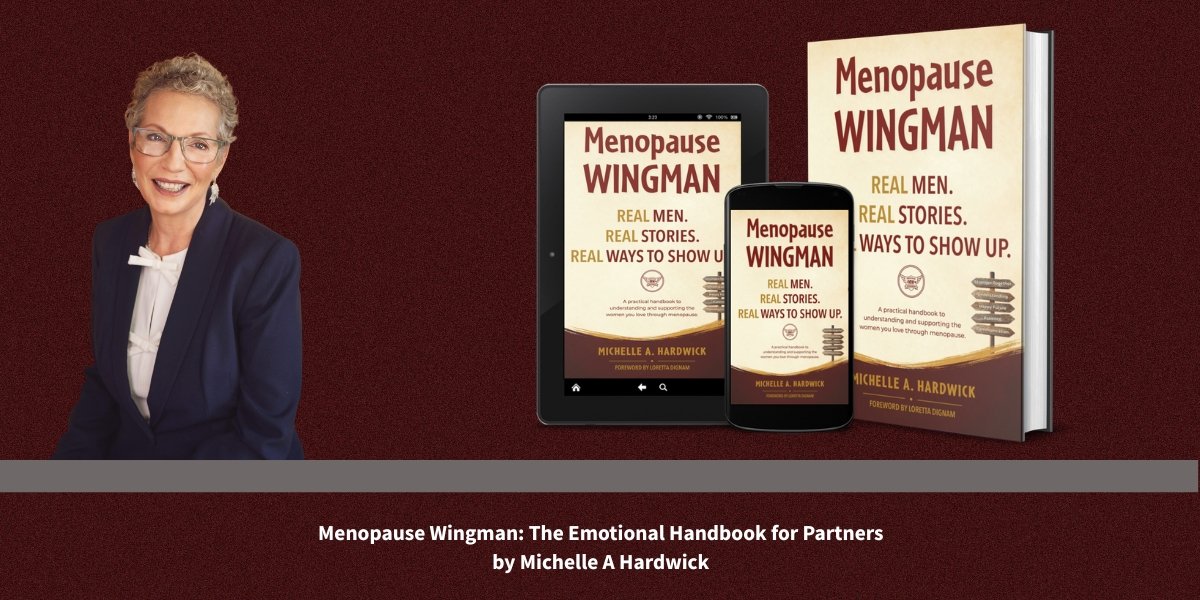
That realization, which arrived not in a therapy room but in a Zoom networking call, became the seed of Menopause Wingman: The Emotional Handbook for Partners, a book that is doing something the menopause conversation has almost entirely failed to do. It pulls the partner out of the shadows and actually includes them.
The Zoom Call That Changed Everything
Michelle A. Hardwick was on a networking call discussing her work supporting women emotionally through menopause when a man named Richard interrupted her. His marriage, he said, might have survived if he’d known more about what his wife was going through. One sentence. That was all it took.
What followed was a profound awakening, a constellation of emotions that arrived all at once. Shock. Sadness. A little bit of shame and sudden piercing clarity. Because in the time it took Richard to say those words, she saw her own husband clearly for the first time. The man who had quietly lived alongside every mood shift, every sleepless night, every dark moment. The man whose needs she had never once asked about. The man she had, without realizing it, was completely shut out of the experience.
Also on that call was Heather, a publisher. By the end of the conversation, the book existed in principle. What followed was the research, the real voices of men from multiple countries, and a reckoning with how thoroughly partners have been left out of a conversation that affects them, too.
Why Partners Have Been Left Out for So Long
Michelle A. Hardwick is direct about why this gap exists and has existed for so long. Menopause was, for generations, framed as something women endured privately. Quietly. Without making a fuss. And because it was framed that way, men were naturally excluded. It simply wasn’t considered their territory.
From North Wales, half Swiss (her mother was born in Zurich), and now living with her husband in County Cork, Ireland, she grew up in a household where menopause was never discussed. She lived through the consequences of her mother’s emotional upheaval without anyone naming what was happening, and her father wasn’t part of it either. Nobody was. And without realizing it, she carried that exact same unconscious pattern straight into her own experience decades later.
And there is something else Michelle A. Hardwick is keen to make clear, something she feels can often be misunderstood. The reason so many women don’t consider their partner during menopause isn’t indifference. It isn’t selfishness. It’s that menopause is utterly consuming. The sheer volume of physical symptoms, emotional upheaval, hormonal chaos and psychological change leaves almost no room to look outward. It is one of the most potent and demanding journeys a woman will ever make. Simply getting through each day can take everything she has. Understanding that, really understanding it, changes everything about how a partner could approach this time.
What that created, in relationship after relationship across generations, was a particular kind of silence. Men who wanted to help but didn’t know how. Women so consumed by their own experience that they couldn’t see the person standing right beside them.
What the Men Actually Said
The real voices woven throughout Menopause Wingman came from men across multiple countries who answered honestly and openly about what it was like. Michelle A. Hardwick approached them with genuine curiosity, no assumptions, no agenda, simply wanting to know what men would collectively say when finally given the space to say it.
What she found was complex and honest. There was confusion. There was frustration. For some, there was genuine resentment. But underneath all of that was something far more tender. What do I do? How do I help the woman I love when I don’t even understand what she’s going through?
These men were deeply in the dark. They didn’t want their partners to suffer. They just had no information, no language, and no one to turn to. They were holding on, trying not to take the hard moments personally, trying to stay steady when everything around them felt unpredictable.
Some of those marriages hadn’t survived. That is the sad reality. But what stayed with Michelle A. Hardwick was the love that existed even inside the confusion, and how much of that could have been preserved with the right tools and the right conversation at the right time.
From Confusion to Connection
The structure of the book is deliberately mapped as a journey. Michelle A. Hardwick describes what typically happens when a partner reads it. What arrives first is a sense of recognition. The realization that what they’ve been feeling is normal. That their confusion isn’t a personal failing. That they are not alone in any of this.
From there, the understanding deepens. Not through medical jargon but through plain English that actually makes the biology land. And once that understanding settles in, something shifts in how partners interpret what’s happening around them. The mood is no longer a reflection of the relationship. It’s a symptom of significant hormonal change. Men stop taking things personally. They stop reacting from confusion and start responding from knowledge.
Hardwick’s intention in the final chapter is for the partner to feel more equipped, more connected, and more genuinely present than they may have in years. Not just surviving menopause together but emerging from it with something stronger than what existed before.
Because of that, she believes, is what’s actually possible when both people are included in the conversation.
The book has already been drawing significant attention. Loretta Dignam, Founder of The Menopause Hub and Forbes Top 50 Over 50 honouree, and Ireland’s leading menopause advocate, describes it as giving partners “the tools, language and confidence to become allies rather than bystanders.” That endorsement speaks to exactly what Michelle A. Hardwick set out to create. Not a book about menopause, but a book about love, presence and showing up.
Alongside the book, Michelle A. Hardwick works one-to-one with women experiencing the emotional complexity of menopause (the anxiety, panic, fear and overwhelm that can arise during this profound life transition) as well as with partners who want to show up more fully for the person they love.
She didn’t write this book because she had all the answers. She wrote it because she was the practitioner who missed her own husband, and she wasn’t willing to let that happen to anyone else.
Menopause Wingman: The Emotional Handbook for Partners by Michelle A. Hardwick is available now as a paperback on Amazon and (soon) as an audiobook at MenopauseWingman.com. Because no woman should go through this alone, and no partner should either.