Women's Journal

Why Dr. Tracy Latz Thinks People Misunderstand Confidence

Confidence has become one of the most sought-after qualities in modern life.

People want to feel more confident at work, in relationships, during presentations, when making decisions, and when pursuing opportunities that matter to them. Entire industries have emerged around helping people become more confident, often promising quick mindset shifts, affirmations, or strategies designed to eliminate self-doubt.

Dr. Tracy Latz is not convinced that’s how confidence actually works.

After decades of working with patients, professionals, entrepreneurs, and leaders, she has reached a conclusion that surprises many people: confidence is rarely the starting point.

More often, confidence is the result.

“People tend to wait until they feel confident before they take action,” she says. “In reality, confidence usually develops after you’ve taken action enough times to create evidence that you can handle what happens.”

Photo Courtesy: Krystina Brown Photography

That distinction may seem small, but it changes the entire conversation.

Much of the advice people receive about confidence focuses on changing how they feel. The assumption is that if someone can improve their mindset, the confidence will follow. While mindset certainly matters, Dr. Latz believes many people become trapped waiting for a feeling that was never supposed to arrive first.

They tell themselves they’ll speak up when they’re more confident.

They’ll apply for the opportunity when they’re more confident.

They’ll start the business when they’re more confident.

They’ll make the change when they’re more confident.

Years can pass in that waiting period.

What often gets overlooked is that many of the people we perceive as confident did not begin that way. They developed confidence through repetition, experience, mistakes, and recovery. Their confidence wasn’t built because they avoided fear. It was built because they learned they could function despite it.

According to Dr. Latz, fear and confidence are not opposites.

Many highly successful people experience both simultaneously.

The executive giving a keynote presentation may still feel nervous before walking on stage. The entrepreneur launching a new venture may still question whether it will work. The physician making an important decision may still recognize uncertainty.

Confidence does not eliminate discomfort.

It changes someone’s relationship with it.

This perspective has become increasingly relevant in a culture where comparison is constant. Social media allows people to observe the polished highlights of other people’s lives while privately experiencing their own doubts and insecurities. The result is a distorted perception of confidence, where many assume they are the only ones struggling internally.

Dr. Latz frequently encounters this misconception in her work.

People often believe everyone else has figured something out that they haven’t. They assume successful individuals possess a level of certainty that they themselves are missing. Yet behind closed doors, many high achievers are wrestling with the same questions, fears, and uncertainties.

The difference is not necessarily confidence.

The difference is often willingness.

A willingness to act before certainty exists.

A willingness to be imperfect.

A willingness to learn publicly rather than waiting to become flawless privately.

That idea extends beyond professional success.

It influences relationships, leadership, personal growth, and mental health. Individuals who require certainty before taking action often find themselves stuck. Not because they lack capability, but because they have unintentionally made confidence a prerequisite rather than an outcome.

Dr. Latz believes this is particularly important for people who identify as perfectionists. Perfectionism often disguises itself as high standards, but underneath it is frequently a fear of making mistakes, being judged, or falling short of expectations.

When perfection becomes the goal, confidence becomes difficult to achieve.

After all, there is always another standard to meet.

Another improvement to make.

Another reason to wait.

By contrast, confidence tends to grow when people become comfortable being learners. Learners expect mistakes. Learners expect challenges. Learners understand that growth requires periods of uncertainty.

In many ways, confidence is less about believing everything will go well and more about trusting yourself to handle what happens if it doesn’t.

That is why Dr. Latz often encourages people to stop asking whether they feel confident enough and start asking a different question.

What evidence are they willing to create?

Because confidence, in her experience, is rarely found.

It’s built.

One decision, one attempt, one uncomfortable conversation, and one small act of courage at a time.

For speaking engagements, media inquiries, podcast interviews, and event bookings, contact:

Ni’ Nava & Associates
Website: https://ninavafirm.com
Email: kelsha@ninavafirm.comPhone: 404-410-0200

A Conversation with Dr. Virginia Wells on Working in the Weeds

By: Stephen Wilkins

Some high-performing professionals become so essential to day-to-day execution that leadership stops viewing them as candidates for high-impact influence.

According to leadership advisor Dr. Virginia Wells, that pattern is more common than many organizations realize.

After more than 25 years advising executives and leadership teams in high-pressure environments, Dr. Wells says many professionals stay buried in execution for so long that leadership stops viewing them as ready for higher-impact leadership opportunities.

Dr. Wells, founder of the Thinking House™ System, has spent more than 25 years advising executives and leadership teams in complex organizations including Johns Hopkins University, Oracle and the Pentagon. In this conversation, she explains why many professionals become trapped in operational roles, what senior leaders evaluate behind closed doors and how strategic thinking shapes long-term leadership growth.

Why do so many high performers get stuck working in the weeds?

Dr. Virginia Wells: Because those behaviors are rewarded early on. The people who solve problems quickly, handle pressure and keep operations moving become incredibly valuable to organizations. Over time, though, many professionals become known primarily as the person who handles everything operationally. They stay deeply involved in every issue, every escalation and every detail.

Eventually, leadership starts viewing them as someone maintaining execution instead of someone shaping direction. That’s where frustration often starts. Many professionals begin overworking, overchecking and mentally redoing everything in an effort to prevent mistakes and prove their value. They believe strong performance alone will naturally lead to advancement.

But at senior levels, leaders are evaluating something broader. They’re asking whether someone can think at the whole organization level, work through complexity and make decisions confidently without second-guessing themselves.

That requires enough distance from constant reaction and day-to-day urgency to see the larger picture clearly.

What changes when someone starts thinking more strategically?

Dr. Virginia Wells: Communication changes first. A tactical leader gives updates. A strategic leader explains implications. They connect decisions across departments, priorities and long-term outcomes.

Instead of simply identifying a problem, they begin discussing potential impact, trade-offs and downstream consequences. They are also able to reduce complex problems to their simplest terms when evaluating possible solutions. Senior leaders pay attention to that shift because they are constantly evaluating judgment.

They notice who can stay steady under pressure, who can recognize patterns and who understands the broader organizational impacts attached to decisions. That’s where trust starts getting built.

A lot of professionals think promotions happen because leadership finally notices how hard they work. At senior levels, leaders are usually evaluating whether they trust your thinking under pressure. The Thinking House™ System was designed to help leaders strengthen and communicate that capability more clearly.

What do senior leaders see that professionals themselves miss?

Dr. Virginia Wells: Patterns and interconnected consequences. Strategic leaders are constantly evaluating timing, stakeholder impact, organizational pressure points and the second- or third-order impacts of their decisions. While one person focuses on solving the immediate issue, another leader is already considering what that decision creates six months from now.

Organizations today are highly interconnected. Decisions rarely stay isolated to one department or one outcome anymore. That’s also why experienced leaders often appear calm during high-pressure situations. It’s because they’ve trained themselves to think systemically instead of reactively.

Leadership today requires leaders who can manage complexity while leading with precision, control and confidence without getting lost in the details.

What would you say to someone who feels trapped in execution mode?

Dr. Virginia Wells: I would ask whether they’ve become too valuable operationally.

Being dependable feels rewarding. People trust you. They rely on you to stabilize difficult situations. But if every hour becomes reactive, eventually there’s very little space left for strategic thinking.

Execution absolutely matters. Organizations need strong operators. But leadership growth eventually requires enough separation from the noise to evaluate the larger system clearly.

The leaders who continue advancing are usually the ones who learn how to zoom out while pressure is still happening around them. They can absorb complexity without getting trapped inside every moving piece operationally or emotionally.

That capability has become incredibly valuable because complexity inside organizations is not slowing down.

To learn more about Dr. Virginia Wells and the Thinking House™ System, visit her LinkedIn profile.

Apple Health Introduces Menopause Tracking in Latest Update

Apple Health menopause tracking is expanding with new tools designed to help users monitor menopause and perimenopause symptoms, following software updates announced by Apple during its Worldwide Developers Conference (WWDC) 2026. The company confirmed that the new features will be integrated into the Health app across supported devices, giving users additional ways to record symptoms, track changes, and access health-related insights connected to midlife hormonal transitions.

The additions were presented as part of Apple’s latest operating system updates, which include new health-focused capabilities intended to support users through different stages of life. The menopause and perimenopause tools build on existing health-tracking functions already available within the Health app, including menstrual cycle tracking and reproductive health records.

Menopause Tracking Added to the Health App

The new menopause-related features allow users to document symptoms associated with perimenopause and menopause directly within the Health app. Apple stated that users will be able to log experiences commonly linked to hormonal changes, helping create a more complete health record over time.

Perimenopause refers to the transitional period before menopause, when hormone levels fluctuate and menstrual cycles may become irregular. Symptoms can vary significantly among individuals and may include hot flashes, sleep disruptions, mood changes, and other physical or emotional effects.

The updated Health app is designed to provide users with a centralized location for tracking these changes. Information entered by users can be combined with other health metrics already collected through Apple devices, creating a broader picture of overall wellness.

Apple’s announcement marks the first time menopause and perimenopause have been incorporated into the company’s health-tracking ecosystem as dedicated features. The tools are intended to help users maintain records that can be reviewed over time and potentially shared with healthcare professionals during medical appointments.

The company also indicated that symptom logging will be available alongside existing health categories, allowing users to manage reproductive and hormonal health information within the same application.

WWDC 2026 Introduces Expanded Women’s Health Features

The menopause updates were introduced during WWDC 2026, Apple’s annual developer conference where the company unveils new software capabilities and platform enhancements.

Women’s health received particular attention within the Health app announcements. Apple confirmed that the new tools are designed to address a life stage experienced by millions of women while providing additional support through digital health tracking.

The Health app has undergone multiple expansions since its introduction, adding new categories related to mobility, hearing, sleep, heart health, medications, mental well-being, and reproductive health. The menopause and perimenopause additions extend that portfolio by focusing on health experiences that have historically received less attention in consumer technology products.

The software updates announced at WWDC 2026 are expected to roll out through upcoming operating system releases later in the year. Users with compatible Apple devices will gain access to the new health capabilities once the updates become publicly available.

Apple did not position the feature as a diagnostic tool. Instead, the company described it as a tracking resource that allows users to monitor symptoms and maintain personal health records.

The integration with the broader Health app ecosystem means information can be viewed alongside other wellness indicators already available through Apple devices and connected applications.

New Tools Build on Existing Reproductive Health Functions

Apple first introduced menstrual cycle tracking to the Health app several years ago, allowing users to log periods, fertility indicators, and related symptoms. The new menopause features expand that framework to cover later stages of reproductive health.

Users experiencing changes associated with perimenopause often face symptoms that can occur over several years before menopause officially begins. Tracking those changes can help individuals recognize patterns and maintain more detailed records of their health experiences.

The new system is expected to include symptom categories specific to menopause and perimenopause, enabling users to document developments as they occur. Maintaining consistent records may assist users in understanding how symptoms change over time.

The Health app already serves as a repository for a wide range of personal health information, including medications, laboratory results, vaccination records, sleep data, and activity measurements. The menopause tracking capability adds another layer to that health profile.

Apple has increasingly expanded the Health app’s scope through partnerships with healthcare organizations, electronic medical record systems, and public health initiatives. The addition of menopause tracking continues that approach by incorporating another area of health management into the platform.

The company has emphasized privacy protections throughout its health services. Health data stored within the app remains subject to Apple’s existing privacy framework, which includes controls allowing users to determine what information is shared and with whom.

Health Technology Companies Increase Focus on Midlife Care

Digital health developers have introduced a growing number of products focused on menopause and perimenopause in recent years. Specialized applications, wearable technology companies, and healthcare providers have launched services aimed at helping women manage symptoms and access information during this stage of life.

Apple’s decision to incorporate menopause tracking directly into its Health app places those capabilities within a platform already used by millions of people worldwide. Rather than requiring a separate application, users can manage symptom records within an ecosystem that already stores other health information.

Healthcare professionals frequently encourage patients experiencing menopause-related symptoms to keep records of changes in sleep, mood, temperature regulation, and menstrual patterns. Consistent documentation can help support discussions about treatment options and symptom management.

The new Health app functionality reflects the increasing role technology plays in personal health monitoring. Smartphone applications and wearable devices have become common tools for tracking activity levels, sleep quality, heart rate, medication schedules, and reproductive health data.

By adding menopause-specific tracking options, Apple is extending that digital record-keeping approach to another area of health management.

The company has not indicated that the new features will replace professional medical guidance. Instead, the tools are designed to help users organize personal health information that can be referenced when seeking medical care.

Brandilyn Clay on Restoring Warmth, Support, and Community to Modern Motherhood

Somewhere along the way, mothers became expected to recover from birth with the same efficiency people expect from software updates. Rest quietly disappeared. Community thinned out. Women were handed baby monitors and parenting podcasts while being left emotionally under-supported during one of the most vulnerable transitions of their lives.

Brandilyn Clay experienced that reality firsthand during her postpartum season during the COVID quarantine. Without nearby support, motherhood did not feel soft. It felt exposing, lonely, and intensely consuming. She did not try to outrun what that season taught her. Instead, she created The Mothers Hive, a response to the quiet emotional weight so many mothers carry behind closed doors.

The Version of Motherhood Nobody Prepares Women For

Brandilyn came to maternal wellness through years of studying psychology, trauma healing, and emotional restoration. Her Master’s degree in Integral Psychology gave her a close understanding of how anxiety, identity shifts, and nervous system exhaustion quietly shape a woman’s inner life, long before she ever thought to apply that knowledge to motherhood specifically.

That changed when she became a mother herself. What had once been theoretical was now deeply personal, showing up in sleepless nights, hormonal shifts, and the constant demands of caregiving. Somewhere in the middle of that experience, she noticed a pattern she could not ignore: mothers are often celebrated for their endurance, but the question of who is actually caring for them remains largely unanswered.

Photo Courtesy: Alina Lenski

The Breaking Point That Became Purpose

The Mothers Hive grew out of Brandilyn’s own postpartum experience during the pandemic. Living in Austin without nearby support, she found herself carrying the emotional and physical weight of motherhood largely alone. Somewhere inside that exhaustion came a realization she could not ignore: mothers are often expected to hold everything together while very few people stop to care for them too.

There is a kind of loneliness that belongs specifically to early motherhood. Not loud loneliness, but the quieter kind. The kind sitting beside a sink full of bottles at midnight. The kind that arrives when everyone checks on the baby but forgets to ask how the mother is holding up. Instead of dismissing that feeling, Brandilyn paid attention to it carefully. The Mothers Hive grew from that awareness, not as another polished wellness brand, but as an effort to rebuild the softness, steadiness, and community modern motherhood has gradually lost.

More Than Wellness Culture

Healing, for Brandilyn, has always existed at the intersection of faith and science. She grew up in a spiritually rooted home where prayer was part of daily life and later expanded that foundation through the study of psychology, mindfulness, and emotional restoration.

That search eventually led her back to Christianity, and the return shaped much of what she would later build. Today, she attends a non-denominational Christian church called ZAO Church and is raising her children in a home centered on faith, presence, and emotional connection. In her view, healing is not about perfection or constant self-improvement. It is about helping mothers feel grounded again in a world that often pulls them away from their own sense of balance.

Nourishment That Feels Personal

Inside The Mothers Hive, nourishment is viewed as an act of care rather than a wellness trend. Austin’s postpartum meal service program provides mothers with warm foods inspired by Chinese medicine and Ayurveda, thoughtfully prepared to support rest and recovery after birth.

But for Brandilyn, nourishment begins long before food reaches the table. Sometimes it looks like reminding a mother she deserves to sit down while her meal is still warm. Sometimes it sounds like another woman saying, “You are allowed to rest.” Her work gently pushes against the culture of rushing women back into productivity after birth. Instead, The Mothers Hive creates space for mothers to slow down, breathe more deeply, and recover without shame. Because the way a woman starts the journey of motherhood sets the tone for the rest of that lifelong journey.

Rebuilding the Village Around Mothers

The yearly online Postpartum Wellness Practitioner Certification is one of the clearest expressions of what Brandilyn is building. The program teaches women how to support mothers emotionally, psychologically, and physically through postpartum recovery and early motherhood. More than a certification, it is an effort to restore tenderness and emotional wisdom to maternal care.

Through her podcast conversations and ongoing work, Brandilyn is ultimately helping rebuild the village, the collective support and steady presence that new mothers were never meant to be without. She is doing this while raising three young children and running multiple businesses from home, often working during nap times and quiet evenings. Her daily life reflects the very message behind her work: that motherhood is meaningful work which deserves to be honored and revered, instead of being dismissed. A mother can carry out her calling while being a full-time mom, and what she has created is proof this is possible.

For Brandilyn Clay, motherhood is not a season women should simply survive and move on from. It is an important and deeply formative period of life. Through The Mothers Hive, she is helping mothers feel steadier, supported, nourished, and far less alone while moving through it.

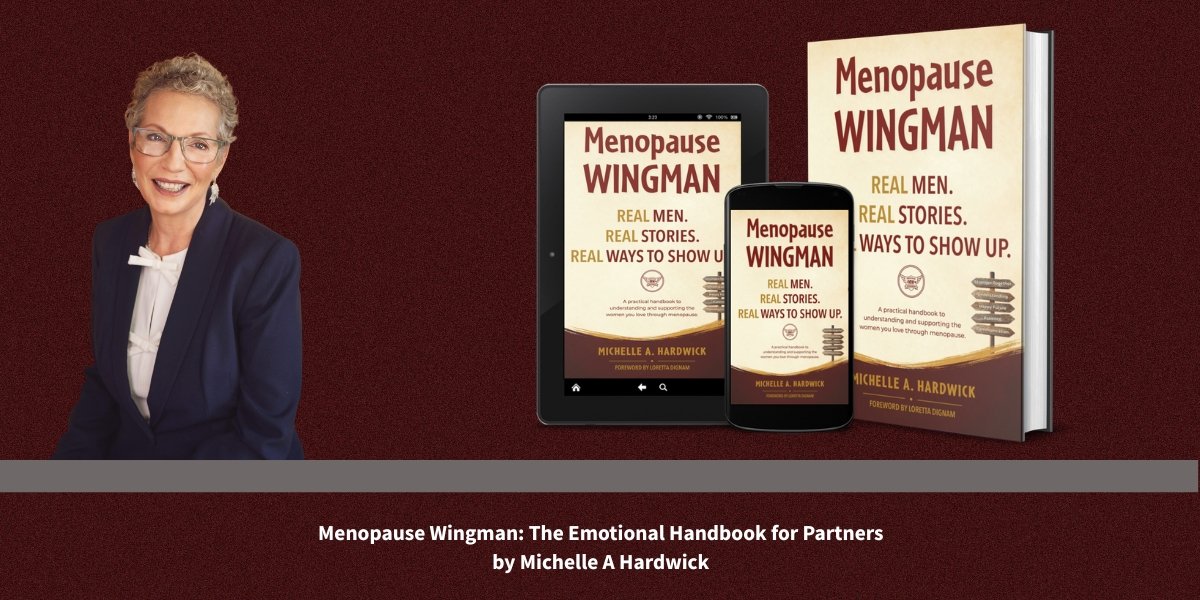
She Spent 25 Years Helping Others, Then Realized She Had Missed Her Own Husband

By: MR Dowling

There’s a particular kind of blind spot that only becomes visible in hindsight. Michelle A. Hardwick is a practitioner with more than two decades of experience walking alongside people through grief, loss, major transitions, and the kind of emotional weight that doesn’t have a clean resolution. She is, by any measure, someone who pays attention to what people are going through.

And yet, for the entire decade she spent moving through menopause, it never once occurred to her to ask her husband how he was doing.

That realization, which arrived not in a therapy room but in a Zoom networking call, became the seed of Menopause Wingman: The Emotional Handbook for Partners, a book that is doing something the menopause conversation has almost entirely failed to do. It pulls the partner out of the shadows and actually includes them.

The Zoom Call That Changed Everything

Michelle A. Hardwick was on a networking call discussing her work supporting women emotionally through menopause when a man named Richard interrupted her. His marriage, he said, might have survived if he’d known more about what his wife was going through. One sentence. That was all it took.

What followed was a profound awakening, a constellation of emotions that arrived all at once. Shock. Sadness. A little bit of shame and sudden piercing clarity. Because in the time it took Richard to say those words, she saw her own husband clearly for the first time. The man who had quietly lived alongside every mood shift, every sleepless night, every dark moment. The man whose needs she had never once asked about. The man she had, without realizing it, was completely shut out of the experience.

Also on that call was Heather, a publisher. By the end of the conversation, the book existed in principle. What followed was the research, the real voices of men from multiple countries, and a reckoning with how thoroughly partners have been left out of a conversation that affects them, too.

Why Partners Have Been Left Out for So Long

Michelle A. Hardwick is direct about why this gap exists and has existed for so long. Menopause was, for generations, framed as something women endured privately. Quietly. Without making a fuss. And because it was framed that way, men were naturally excluded. It simply wasn’t considered their territory.

From North Wales, half Swiss (her mother was born in Zurich), and now living with her husband in County Cork, Ireland, she grew up in a household where menopause was never discussed. She lived through the consequences of her mother’s emotional upheaval without anyone naming what was happening, and her father wasn’t part of it either. Nobody was. And without realizing it, she carried that exact same unconscious pattern straight into her own experience decades later.

And there is something else Michelle A. Hardwick is keen to make clear, something she feels can often be misunderstood. The reason so many women don’t consider their partner during menopause isn’t indifference. It isn’t selfishness. It’s that menopause is utterly consuming. The sheer volume of physical symptoms, emotional upheaval, hormonal chaos and psychological change leaves almost no room to look outward. It is one of the most potent and demanding journeys a woman will ever make. Simply getting through each day can take everything she has. Understanding that, really understanding it, changes everything about how a partner could approach this time.

What that created, in relationship after relationship across generations, was a particular kind of silence. Men who wanted to help but didn’t know how. Women so consumed by their own experience that they couldn’t see the person standing right beside them.

What the Men Actually Said

The real voices woven throughout Menopause Wingman came from men across multiple countries who answered honestly and openly about what it was like. Michelle A. Hardwick approached them with genuine curiosity, no assumptions, no agenda, simply wanting to know what men would collectively say when finally given the space to say it.

What she found was complex and honest. There was confusion. There was frustration. For some, there was genuine resentment. But underneath all of that was something far more tender. What do I do? How do I help the woman I love when I don’t even understand what she’s going through?

These men were deeply in the dark. They didn’t want their partners to suffer. They just had no information, no language, and no one to turn to. They were holding on, trying not to take the hard moments personally, trying to stay steady when everything around them felt unpredictable.

Some of those marriages hadn’t survived. That is the sad reality. But what stayed with Michelle A. Hardwick was the love that existed even inside the confusion, and how much of that could have been preserved with the right tools and the right conversation at the right time.

From Confusion to Connection

The structure of the book is deliberately mapped as a journey. Michelle A. Hardwick describes what typically happens when a partner reads it. What arrives first is a sense of recognition. The realization that what they’ve been feeling is normal. That their confusion isn’t a personal failing. That they are not alone in any of this.

From there, the understanding deepens. Not through medical jargon but through plain English that actually makes the biology land. And once that understanding settles in, something shifts in how partners interpret what’s happening around them. The mood is no longer a reflection of the relationship. It’s a symptom of significant hormonal change. Men stop taking things personally. They stop reacting from confusion and start responding from knowledge.

Hardwick’s intention in the final chapter is for the partner to feel more equipped, more connected, and more genuinely present than they may have in years. Not just surviving menopause together but emerging from it with something stronger than what existed before.

Because of that, she believes, is what’s actually possible when both people are included in the conversation.

The book has already been drawing significant attention. Loretta Dignam, Founder of The Menopause Hub and Forbes Top 50 Over 50 honouree, and Ireland’s leading menopause advocate, describes it as giving partners “the tools, language and confidence to become allies rather than bystanders.” That endorsement speaks to exactly what Michelle A. Hardwick set out to create. Not a book about menopause, but a book about love, presence and showing up.

Alongside the book, Michelle A. Hardwick works one-to-one with women experiencing the emotional complexity of menopause (the anxiety, panic, fear and overwhelm that can arise during this profound life transition) as well as with partners who want to show up more fully for the person they love.

She didn’t write this book because she had all the answers. She wrote it because she was the practitioner who missed her own husband, and she wasn’t willing to let that happen to anyone else.

Menopause Wingman: The Emotional Handbook for Partners by Michelle A. Hardwick is available now as a paperback on Amazon and (soon) as an audiobook at MenopauseWingman.com. Because no woman should go through this alone, and no partner should either.

Uterine Cancer Awareness Month Highlights Why Family History Matters

Awareness campaigns often focus on recognizing symptoms or encouraging regular screenings, but Uterine Cancer Awareness Month also draws attention to a question many families never think to ask: could cancer risk already be written into their family history? For some people, the answer is yes.

Inherited conditions such as Lynch syndrome significantly increase the lifetime risk of several cancers, including colorectal, ovarian, and uterine cancer. The condition is commonly associated with mutations in DNA repair genes, including the MSH2 gene mutation, and it can pass from one generation to the next without anyone realizing it. In many families, the pattern only becomes clear after multiple relatives have already received a cancer diagnosis.

That is why genetic testing has become an increasingly important part of conversations around cancer prevention and early detection.

Jackie Wenzel’s story offers a clear example of how understanding family history can influence healthcare decisions.

Wenzel was diagnosed with uterine cancer at just 30 years old, but she already knew Lynch syndrome existed in her family. Even so, deciding to pursue genetic testing was not easy. Like many people, she was uncertain whether she wanted to know if she carried a mutation that increased her risk of developing cancer.

When she eventually underwent testing, the results confirmed that she carried the MSH2 mutation. Rather than seeing that information as a prediction of what would happen, Wenzel has described it as something that allowed her to be more informed and proactive about her health.

That perspective became especially important when she began dealing with prolonged menstrual cycles, heavy bleeding, and debilitating fatigue. Initial evaluations suggested hormone-related issues, but because she understood that her inherited risk was different from that of the average patient, she continued pursuing additional medical evaluations until it was eventually revealed that she had uterine cancer.

While knowing about her genetic risk did not prevent the disease, it gave her the confidence to continue seeking answers and not ignore her symptoms. The diagnosis also came early enough to give her options, allowing her to work with her physicians to give birth to two children before needing to undergo a radical hysterectomy. She is currently cancer-free.

Family medical history is often treated as background information during routine doctor visits, but for conditions like Lynch syndrome, it can play a much larger role. Understanding inherited risk can influence how often someone is screened, how quickly unusual symptoms are investigated, and how patients advocate for themselves when something doesn’t feel right.

The challenge is that many people either do not know their family history or are unsure whether genetic testing is something they should consider. Closing that gap has become a central focus for jscreen, which has worked to expand access to hereditary cancer screening. Through at-home testing programs combined with licensed genetic counseling, the nonprofit aims to make it easier for individuals and families to better understand their inherited risks and discuss appropriate next steps with their healthcare providers.

“Family history is one of the most powerful tools we have, but only if people know how to use it,” said Karen Grinzaid, Chief Clinical Officer and Founding Executive Director of jscreen. “Stories like Jackie’s show what happens when someone understands their risk and refuses to ignore what their body is telling them.”

The goal is not to convince everyone that they need genetic testing. Rather, it is to make sure that people with a significant family history of cancer have access to information that could help guide future healthcare decisions.

Uterine Cancer Awareness Month ultimately serves as a reminder that prevention is not always about changing the future. Sometimes it is about understanding the risks that already exist and making sure those risks are not overlooked. For families affected by hereditary conditions like Lynch syndrome, that knowledge can become one of the most valuable tools they have.