By: Cameron Ellis
A Palette Made of Rock and Possibility
When Martha Retallick bought her home in 2004, the outdoor space was more suggestion than garden. The front yard was a stretch of crushed rock baking under the sun. The back was overrun with Bermuda grass, a plant considered invasive in the region. It did not look like the start of a long term project. Then a friend looked at the empty front yard and said, “That’s your palette.”
That moment shifted how Martha saw the space. Instead of seeing what was missing, she saw what could be created. Her vision became simple but ambitious. She wanted to blend nature with the built environment and see how a desert yard could grow into something that felt alive rather than forced.
Two decades later, that idea is still unfolding. Her front yard now features ironwood and mesquite trees that thrive without irrigation. They survive on rain alone and offer shade, structure, and a quiet sense of resilience. Not every experiment worked. Cactus turned out to be more fragile than expected, with pests and disease taking their toll. Only a hardy bunny ears cactus remains, slowly claiming its corner of the yard.
Learning to Work With Water Instead of Against It
Living in Tucson means learning to respect the power of sudden rain. Early on, Martha discovered that summer storms could turn her yard into a flood zone. Water rushed toward the house, pooling in places it should not.
Her first attempt at solving the problem was a rock lined swale that looked beautiful but failed under pressure. The water hit a sharp turn and collected near the foundation instead of flowing away. That moment led her to seek guidance from local groups focused on sustainability and water education.
The most important lesson she learned was to think like water. It always flows downhill. The real question is whether you like where it is going.
From there, she reshaped her yard with basins, berms, and simpler swales that guided rain toward plants instead of walls. Mulch helped slow evaporation and keep moisture in the soil. Over time, the land began to hold water rather than reject it.
A Yard That Feeds Trees and Curiosity
Martha’s approach to gardening is rooted in practicality. Lawns are nowhere to be found because they demand too much water. Instead, she focused on drought tolerant trees and shrubs that could survive on rainfall and carefully guided runoff.
In the backyard, she created a small fruit area supported by active water harvesting. A laundry to landscape system sends greywater from wash days to pomegranates and a Meyer lemon tree. A dwarf fig in a planter receives rainwater stored in a 1,500 gallon cistern connected to her roof.
She is quick to point out that even a cistern has limits. In a hot climate, water disappears fast. That is why she uses stored rain for specific plants rather than trying to cover the whole yard.
When Wildlife Moves In
Over the years, Martha’s property has become one of the most popular bird gathering spots in her neighborhood. Every spring, the mesquite tree in the front yard turns into what she jokingly calls an avian social club. Birds use it as a place to call, meet, and spend their days.
The two ironwoods nearby offer better nesting sites, and together the trees provide shade that helps cool the yard and even the surrounding area. Sharing her space with wildlife added a new layer of meaning to her work.
It also sparked a creative shift. Since 2020, Martha has been practicing wildlife photography, capturing the birds that visit her yard. What started as a personal challenge became another way to tell the story of her landscape.
Showing What Words Cannot
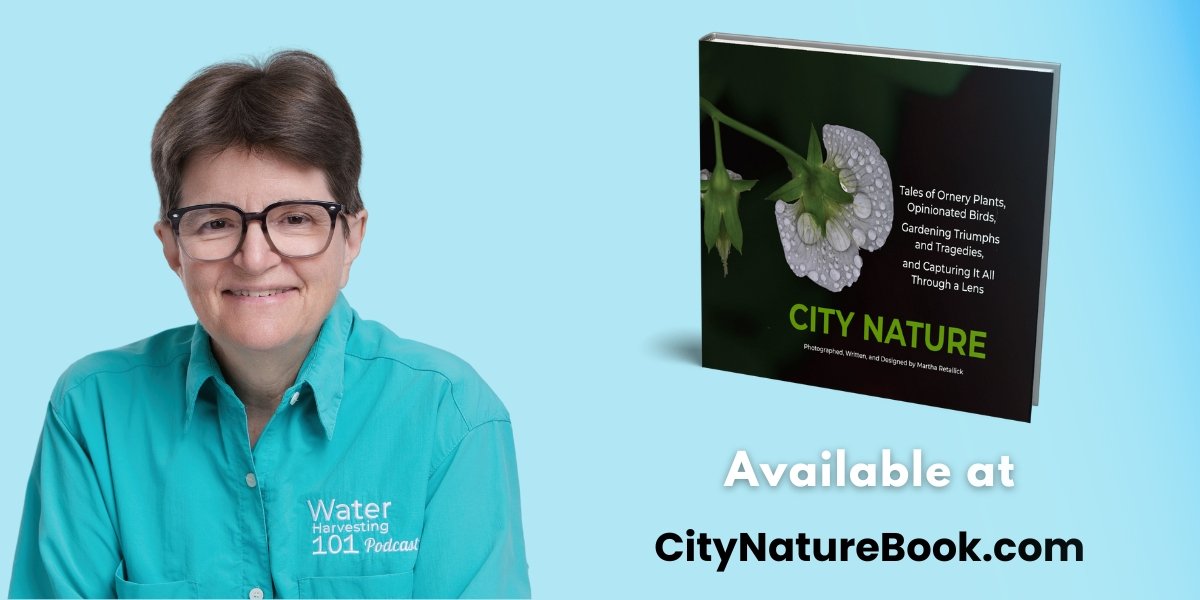
City Nature includes more than 60 color photographs, and for Martha, those images are as important as the text. She believes water harvesting is easier to understand when people can see it.
Photos of rain filling basins show how water slows and spreads. A shot of her cistern makes the idea of storage feel concrete. An image of soapy laundry water flowing toward a fruit tree turns reuse into something practical rather than abstract.
The goal is not perfection. It is clarity. She wants readers to see how simple tools and thoughtful design can change how a yard behaves during a storm or a dry spell.
A Practical Message for Changing Cities
As concerns about water scarcity grow across the Southwest, Martha hopes her book encourages curiosity instead of fear. City Nature is meant to inspire people to look at their own spaces and ask what is possible.
Her message is grounded in small steps. You do not need expensive systems to begin. A shovel, some observation, and a willingness to learn can go a long way. Watch how water moves during the next rain. Notice where it pools and where it runs off. Let that guide your first change.
A Living Experiment That Keeps Evolving
Martha’s yard is not a finished project. It is an ongoing conversation between land, climate, and care. Maintenance is part of the process, whether that means trimming shrubs on a weekend or calling in an arborist for help with mature trees.
Through stories, photographs, and honest lessons, City Nature offers a fresh look at urban gardening and sustainable design. It invites readers to see their outdoor spaces not as fixed plots, but as living systems that can grow, adapt, and surprise over time.
Find more about Martha and her work on her website, and explore City Nature to see how urban spaces can become part of the natural world rather than separate from it.