By: Emily Roberts
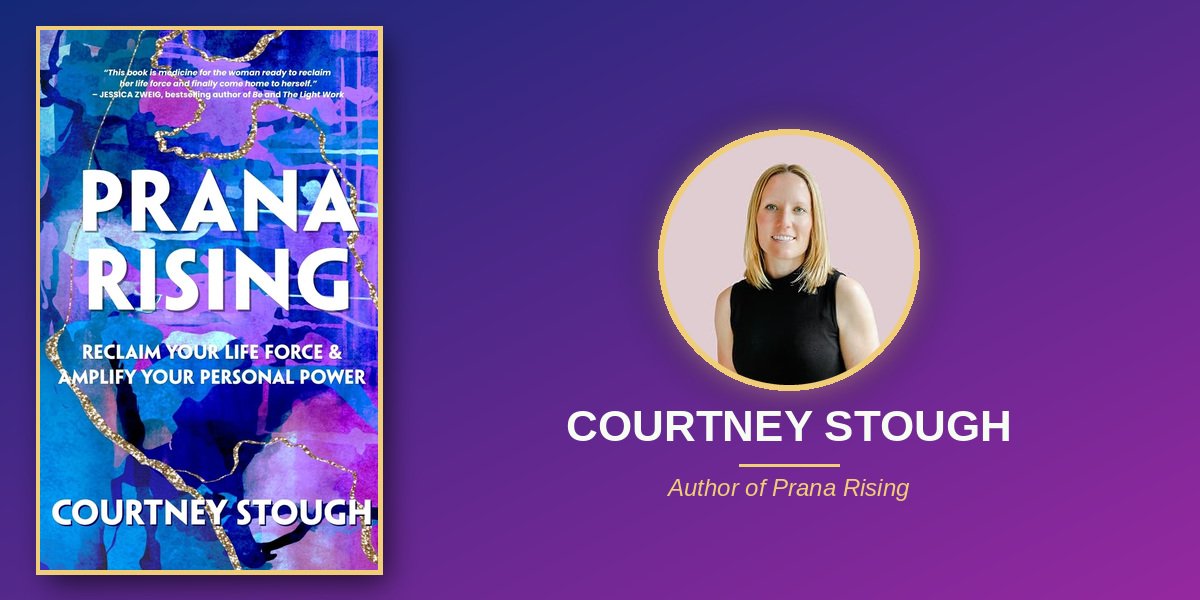
The wellness genre has a structural problem. Books that lead with personal narrative often struggle to deliver actionable frameworks once the memoir portion concludes. Books that lead with methodology often feel thin on the credibility that only lived experience can supply. Courtney Stough’s Prana Rising: Reclaim Your Life Force & Amplify Your Personal Power is a notable effort at solving exactly this problem, and for the most part it succeeds.
Stough, a former corporate attorney with a Yale undergraduate degree and a Tulane law credential, spent years inside high-performance environments before the cumulative cost of that performance caught up with her. What followed was an unusually wide-ranging personal investigation: ketamine-assisted therapy, psilocybin work, yoga teacher training, somatic coaching, women’s healing containers, energy healing modalities, and ultimately a near-divorce and its slow, intentional repair. Prana Rising synthesizes that investigation into a four-part framework anchored by the Sanskrit concept of prana, defined here as vital life force, the animating energy that moves through and powers every dimension of human experience.
The book’s structure is its clearest strength. Stough organizes her argument across four movements that build on each other with genuine logical progression. Part I establishes the energetic landscape, defining prana, introducing a self-assessment tool across physical, mental, emotional, and spiritual axes, and developing the concept of Energy Vampires. Part II moves into inner work, addressing belief systems, emotional processing, somatic release, and personal responsibility. Part III shifts to the constructive phase, building what Stough calls the Powerhold™, the inner architecture that sustains reclaimed energy through four generators: Embodiment, Mindfulness, Creativity, and Community. Part IV addresses the philosophical dimension of the journey, surrender, nonlinear growth, and the ongoing curriculum of what Stough calls life as a mystery school.
What distinguishes this structure from standard self-help scaffolding is that the personal narrative and the framework stay genuinely integrated throughout. Stough does not front-load her story and then pivot to instruction. The memoir material resurfaces at each conceptual turn, providing what the framework alone could not: evidence that the ideas have been tested under real pressure. The marriage narrative in Part II, in which Stough examines her own role in the cycles of conflict and shutdown that brought her marriage to the edge of dissolution, is particularly well-executed. She does not present herself as a victim of circumstances or as a person who simply chose to wake up. She presents herself as someone who made specific, identifiable contributions to her own suffering and then chose to see them clearly.
The Energy Vampire taxonomy in Chapter 2 is the book’s most analytically interesting passage. Stough divides energy-draining habits into four categories: Digital Drains, Social and Emotional Leaks, Mental and Energetic Patterns, and a fourth category she labels “Good” Energy Vampires. This last group, which includes compulsive supplementation, hyper-productivity, spiritual bypassing, and endless self-help consumption, represents a more sophisticated observation than the wellness genre typically delivers. The insight that healing-adjacent behaviors can function as sophisticated avoidance of the actual work is both accurate and uncomfortable, and Stough handles it without moralizing.
The somatic framework in Part II draws competently from established sources: Bessel van der Kolk’s work on trauma and the body, Dr. John Sarno’s Tension Myositis Syndrome research, Nicole Sachs’ JournalSpeak practice, and Julia Cameron’s Morning Pages methodology. Stough does not present herself as originating these concepts, which is a point in her favor. Instead, she functions as a thoughtful synthesizer, selecting tools that she has personally verified and integrating them into a coherent whole. Her treatment of emotional processing as energy in motion, rather than as a problem to be managed, reflects consistent conceptual thinking.
The Powerhold™ framework in Part III delivers its clearest practical content. The Four Energy Generators offer a workable scaffolding for readers who need structural guidance rather than purely philosophical orientation. Stough’s insistence on “Right for Right Now” as a governing principle, her argument that consistency outweighs duration and that any practice must be adapted rather than rigidly followed, addresses one of the most common failure modes in personal development implementation. Her discussion of the boundary-setting chapter through the lens of ahimsa, the yogic principle of non-harm extended to apply to oneself as well as others, brings conceptual precision to a topic that is routinely oversimplified.
Where the book’s ambition occasionally exceeds its execution is in Part IV, where the philosophical register expands without a corresponding increase in specificity. The surrender and mystery school chapters are beautifully written but somewhat less actionable than what precedes them. This is not a fatal flaw. Many readers will find that the emotional resonance of Part IV does work that a fourth set of tools could not. But readers who came primarily for the methodology may find the final movement more evocative than instructive.
Those qualifications noted, Prana Rising represents a genuinely strong entry in a crowded category. Stough is a credible guide precisely because she is not presenting herself as someone who has finished. She is presenting herself as someone who has learned to keep going with greater awareness, and that posture is, finally, more honest and more useful than the polished arrival narratives the wellness genre so frequently offers.
Find Prana Rising on Amazon or at www.courtneystough.com/book and add one of the most structurally honest wellness frameworks of the year to your shelf.
Disclaimer: This article is for informational purposes only and should not be considered professional medical or health advice. The views and experiences shared are for general awareness and do not guarantee specific results. Readers are encouraged to consult qualified professionals before making decisions related to their health and well-being.