By: Lindsay Jeffords
For people raising reactive, anxious, or fearful dogs, finding trustworthy care often means going from one closed door after another. Most daycare businesses center on open group play, offering limited alternatives for dogs that feel overwhelmed or need personal attention. K9 University Chicago takes a different approach by designing the environment around each dog rather than asking every dog to adjust to a single standard model.
From Rescue Roots to an Inclusive Mission
The company’s philosophy began with founder Ruby Madrigal. K9 University’s original training operation dates back to 1992, while Madrigal began pet-sitting from her home in 2000.
In 2001, she helped establish Chicago Canine Rescue, a nonprofit dedicated to finding permanent homes for dogs. Her growing home operation later became Pet-n-Play, which merged with K9 University Chicago in 2004.
Madrigal became sole owner in 2008 and purchased the facility and property in 2016. She continued to expand its boarding, grooming, outdoor play, and training spaces and received the Illinois Rising Star Award from the U.S. Small Business Administration in 2019. Although she died in 2024, her belief that challenging dogs still deserve safety, patience, and care continues to shape the company.
A Team Carrying the Mission Forward
Today, COO Mariya Sergeeva is carrying K9U’s founding mission into its next stage. Her leadership focuses on strengthening individualized plans, daily communication, staff education, and operational consistency. General Manager Courtney Day helps oversee the facility’s daily operations and client experience, ensuring that the company’s inclusive promise is supported by reliable systems.
The training team brings different areas of experience to that mission. Lead trainer Jonathan Polich works across puppy training, obedience, impulse control, leash reactivity, relaxation protocols, and dog- or people-reactive behavior. Pablo Maldonado specializes in customized training and high-energy dogs, while Joshua D. Johnson brings experience in obedience, behavior modification, and high-drive working breeds.
Together, the team works from the understanding that behavior must be interpreted before it can be changed. K9U’s trainers examine what may sit beneath a visible reaction, including fear, anxiety, overstimulation, trauma, or an association created by an earlier experience. This allows them to respond to the individual dog rather than relying solely on a behavioral label.
Understanding Reactive Behavior
Maldonado captures that distinction directly. “Personally, I don’t like using the word ‘aggressive,’” he explains. “Dogs don’t just wake up one day and decide to be reactive.” Recognizing the source of a behavior changes the training response. Rather than forcing a frightened dog through an experience, trainers can identify triggers and work below the point at which the animal becomes overwhelmed.
Polich’s approach similarly begins with canine psychology rather than simple command compliance. “If you can’t understand what they’re going through mentally, then you’re behind training-wise,” he says. Guided by positive reinforcement and the humane hierarchy, he prioritizes health, environment, trust, and minimally intrusive methods before considering more intensive interventions.
“Trust is everything,” Polich emphasizes. “I’m not going to force the threshold. I’m not going to force the dog to do things.” K9U pairs that patience with honest expectations. Progress may depend on the dog’s history, environment, and temperament, as well as the family’s willingness to continue the work once formal training ends.
Care and Behavioral Support Under One Roof
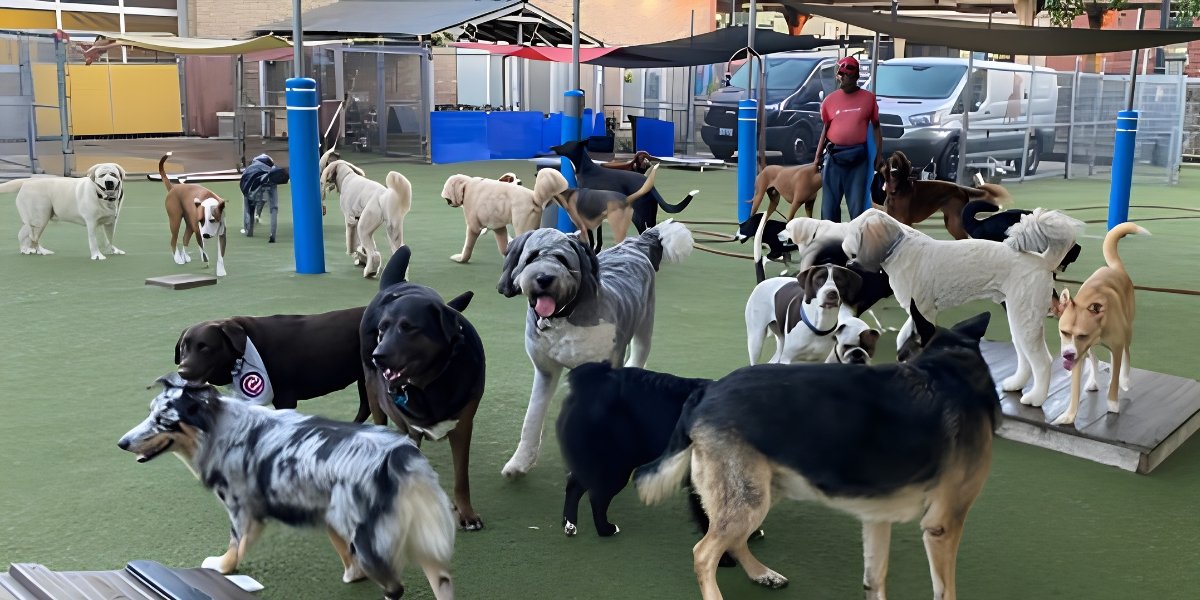
Located in Chicago’s East Garfield Park neighborhood, K9U combines daycare, boarding, behavior modification, grooming, and transportation on one indoor-outdoor campus. Its “All Dogs Welcome” philosophy is supported by two distinct daycare environments: a group side for dogs comfortable playing together and an individual side for those unable to participate safely in open play.
This structure places K9U between two common industry models. Conventional daycares may provide full-day care but primarily accept social dogs, while standalone trainers may handle complex behavioral cases without offering boarding, grooming or sufficient space for controlled exposure. K9U combines these services, allowing dogs to receive care and behavioral support from one familiar team.
Its campus includes approximately 14,000 square feet indoors and 20,000 square feet outdoors. Services range from private lessons and group classes to day training, board-and-train programs, agility, nose work, and puppy socialization. Climate-controlled boarding includes continuous supervision, while transportation helps make the facility accessible to families across Chicago.
Supporting Families Beyond Training
Professional training alone cannot create lasting behavioral change. Owners must learn to recognize stress signals, manage triggers, use training tools correctly, and reinforce new responses at home. As Maldonado puts it, “The leash has two ends, the dog and the owner.” For K9U, educating the family is therefore part of helping the dog.
That principle is especially relevant in reactive-dog cases. A trainer may establish a new behavior in a controlled setting, but the owner must reproduce that structure during neighborhood walks, household routines, and unexpected encounters. K9U’s communication, progress updates, and follow-up guidance are designed to help transfer what happens inside the facility into everyday life.
The company also serves a diverse urban clientele through a team of roughly 40 people, many of whom speak Spanish. This bilingual capacity makes communication more accessible while supporting K9U’s broader belief that effective care depends on understanding both the dog and the people responsible for continuing its progress.
What Clients Say About K9U
Client experiences published by K9U illustrate how individualized care works in practice. Sean Z., whose dog was nervous around packs, said the team used a smaller room and introduced other dogs gradually rather than pushing the dog into a large group. “They take all kinds of dogs,” he wrote, praising a system designed to accommodate dogs that conventional daycares may reject.
For other families, the strongest evidence is longevity. “I’ve been a customer for 15 years and counting,” Jonathan A. shared. “K9 helped us raise our puppies and cherish our old girls.” His account reflects a relationship extending across different dogs and stages of life, rather than a single daycare or training visit.
Jorden D., whose young dog completed a two-week board-and-train program, praised the regular photographs, videos, and progress updates. The client also highlighted K9U’s reliance on “good old-fashioned positive reinforcement.” Together, these accounts reinforce the qualities at the center of K9U’s identity: inclusion, communication, and care adjusted to the individual dog.
Building a More Inclusive Future for Dog Care
K9 University Chicago reports serving more than 14,000 clients, including families now bringing a third generation of dogs to the facility. That continuity matters in an industry built on trust. Owners are not merely arranging a service for the day. They are placing a family member in someone else’s care.
As it grows, K9U plans to strengthen daily communication, continue staff education, and make individualized care more consistent without losing the openness that shaped the company. Its goal is to remain a trusted Chicago destination for dogs requiring more individualized support than conventional daycare typically provides.
K9 University Chicago’s longevity may be measured in decades, but its broader legacy is reflected in the dogs that have been given opportunities to feel safe, supported, and understood. By creating space for dogs that other facilities may not be equipped to serve, the company also helps families continue building positive relationships with their pets.