By: Nicole Jones
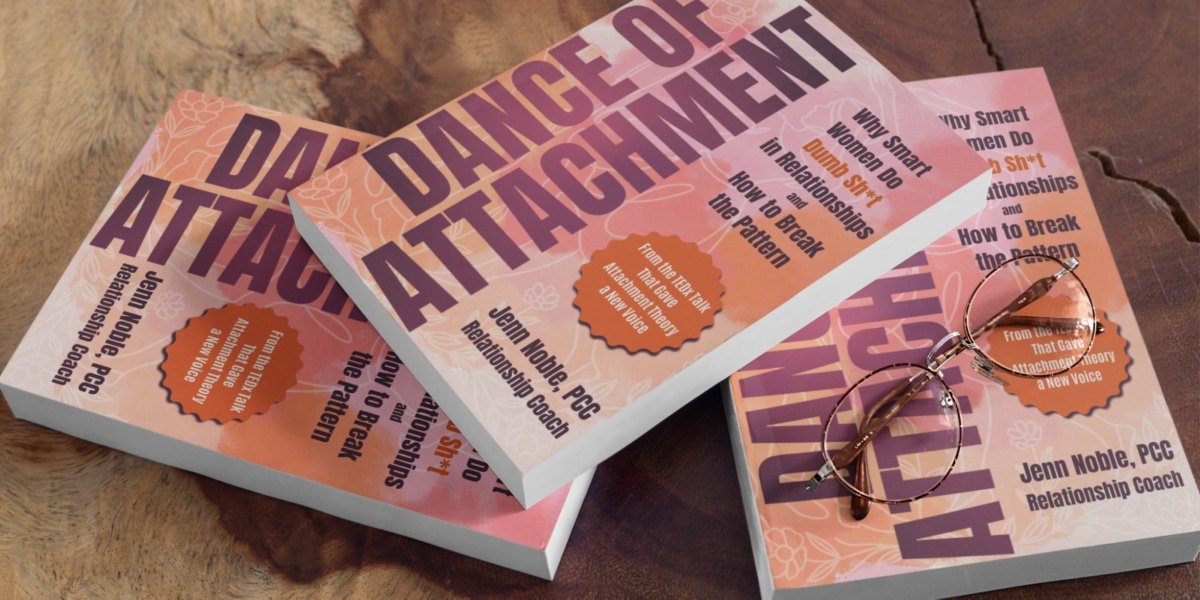
When a close friend handed me a copy of Dance of Attachment by Jenn Noble, she didn’t pitch it as a life-changing read or something that was going to help me find love. She laughed and said, “You need to read this. It’ll make you feel better about yourself. We’re not the only ones who’ve done dumb shit with our exes.”
I took it mostly out of curiosity, though I’ll admit my enthusiasm was limited. I’d read enough relationship books to know roughly how they go. I could tell you exactly what my behaviors were supposed to look like. What I couldn’t tell you was why knowing any of that hadn’t actually changed anything.
I finished it in two sittings.
Not because it was gripping in the way a thriller is gripping. But because Jenn is hilarious, the pages move, and it has that rare quality of making you feel seen without making you feel pathetic. She writes about the things real women actually do in relationships: the overanalyzing, the excuse-making, the very convincing story you tell yourself at the end about why it didn’t work out. He wasn’t ready. I ruined it. I always attract emotionally constipated men.
That last one, I’ve said to myself quite a few times, if I’m being honest.

Photo Courtesy: Jenn Noble
Jenn Noble is a TEDx speaker, a Professional Certified Coach with the International Coaching Federation (ICF), the host of the Speak Honest Podcast, and the founder of the Speak Honest Academy, a coaching community she built around helping women understand and heal their attachment patterns. Unlike many coaches in an unregulated industry, earning an ICF certification requires over 500 hours of client coaching and passing rigorous examinations, a level of training that shows up clearly in how she works.
Jenn is also currently studying at San José State University, where she’s pursuing a double major in Communication Studies and Psychology. She’s developing a research study on somatic affirmations, a concept she introduces in Chapter 6 of Dance of Attachment, which reflects the broader focus of her work on how the body processes emotional experience. It’s clear this isn’t just a side hustle. It’s work she’s deeply invested in, both professionally and academically.
I reached out to Jenn, expecting an interview about her bestselling book, Dance of Attachment, and came away feeling like I’d just had a private coaching session. I told her things I’ve stopped bringing to my friends, not because they don’t care, but because there are only so many times you can rehash the same dynamic before their eyes start to glaze. Jenn’s eyes didn’t glaze, and that alone was worth something.
She’s funnier than you’d expect and more direct than you’d hope, in the best possible way. There’s no softening of things that don’t need to be softened, and she has a way of saying the thing you weren’t quite ready to hear and making it land without the sting. Where a lot of coaching language floats off into the abstract, Jenn tends to anchor things in the specific.
In the book, Jenn explains relationship patterns not as broken personalities but as dances we learned, often long before we had any say in the choreography. The Salsa of Uncertainty is the anxious one: the chasing, the overanalyzing, the reading of every text like it’s evidence. The Solo Tango is the avoidant one: self-sufficient on the surface, unreachable underneath. The Pendulum Swing Dance is the disorganized one, wanting closeness desperately and then panicking the moment you get it. And the Smooth Waltz is what it looks like when someone has actually figured out how to be in a relationship without it costing them their entire nervous system.
Curious where I fell, I took the Dance of Attachment Style Quiz Jenn offers alongside the book. The result wasn’t surprising, but seeing it laid out clearly, with percentages showing where I fell across each one and how to begin working with it, made it easy to understand.
When I told Jenn my results, she paused for a second. There was a hint of something in my voice I hadn’t fully registered myself, a mix of disappointment, maybe even a little fear.
“Your Attachment Stance isn’t who you are,” she reassured me. “It’s what you adapted to. You developed a stance that helped you stay connected and protect yourself. And sometimes those stances saved you. But now they might be keeping you stuck.”
I sat with that for a moment. Saved you. The idea that the thing causing the problem was once the solution hadn’t quite landed before, at least not like that.

Photo Courtesy: Jenn Noble
“Most women come to me exhausted,” she said. “They’ve done the work, they’ve read the books, they’ve been to therapy, but that doesn’t stop them from getting triggered and saying something they wish they hadn’t. Intellectual understanding isn’t the same as integration. Your nervous system doesn’t respond to what you know. It responds to what feels like a threat.”
What that response looks like, she explained, is leaning in harder. More effort, more accommodation, more people-pleasing, more overthinking. It’s an attempt to manage a threat that hasn’t been clearly identified. When a relationship starts to matter, the nervous system doesn’t interpret that as a cue to relax. It registers it as a risk. And once that happens, the shift is rarely subtle. It shows up in how communication changes, how attention sharpens, and how quickly the focus turns toward him.
This is the part of the conversation that makes Jenn different from most advice that’s out there. Most coaches online are talking about the guy. What he did, what he couldn’t give, why he wasn’t ready. Jenn isn’t dismissive of that conversation, but she’s not particularly interested in it either.
“I’m not here to talk about the guy, it’s not about him,” she said. “Women come in wanting to do that, and I get it. But he’s not the most interesting part of the story. The more interesting question is why did that particular dynamic feel like something worth staying in? What was it giving you, even though it cost you everything?”
That question is where the real work begins. Jenn built a framework around it called D.A.N.C.E., which takes up the second half of the book. Discover, Alleviate, Nurture, Communicate, Embody. The short version being: first you figure out which dance you’ve been doing and where you learned it. Then you start dealing with what’s underneath it, the wounds that have been running the show, the needs you’ve been too afraid to name, the way you communicate when your nervous system is activated versus when it isn’t. And then, slowly, you start to build something different. Not a new personality. Just a new set of moves.
“The goal is never to make you someone without emotions,” she said. “Everyone has emotions. The goal is to make yours visible enough that you can choose how you respond when they come up. Most women I work with aren’t failing at relationships because they’re emotionally broken. They’re failing because they’re operating on autopilot and nobody ever showed them the controls.”
That line is probably the clearest summary of what Jenn Noble does and why it works. She doesn’t pathologize. She doesn’t flatter. She just hands you the controls and explains, with considerable patience and a lot of humor, what each one does.
Dance of Attachment captures that same approach on the page. It’s direct, specific, and grounded in real experience rather than abstraction. You finish it with a clearer sense of what’s been happening in your own relationships, and why it’s been so difficult to change.
It’s the kind of clarity that explains why smart, successful women keep doing dumb shit in relationships, and more importantly, how to stop.
Dance of Attachment: Why Smart Women Do Dumb Sh*t in Relationships and How to Break the Pattern is available wherever books are sold, including Amazon, Barnes & Noble, and Audible.