Women's Journal

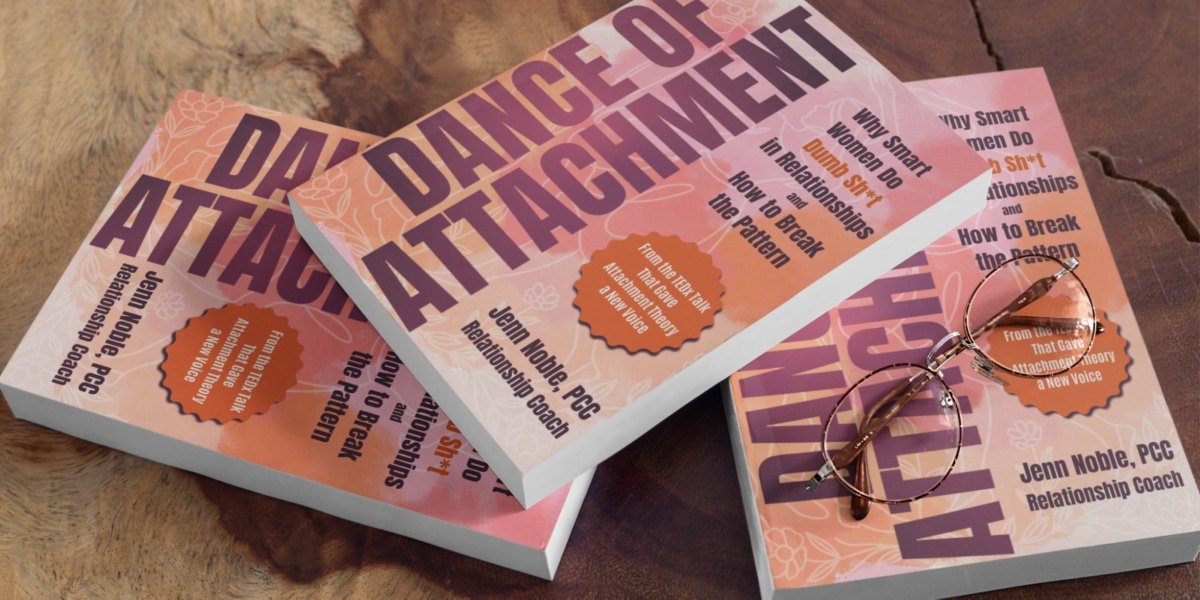
Why Smart Women Lose Themselves in Relationships: Inside Jenn Noble’s Bestselling Book Dance of Attachment

By: Nicole Jones

When a close friend handed me a copy of Dance of Attachment by Jenn Noble, she didn’t pitch it as a life-changing read or something that was going to help me find love. She laughed and said, “You need to read this. It’ll make you feel better about yourself. We’re not the only ones who’ve done dumb shit with our exes.”

I took it mostly out of curiosity, though I’ll admit my enthusiasm was limited. I’d read enough relationship books to know roughly how they go. I could tell you exactly what my behaviors were supposed to look like. What I couldn’t tell you was why knowing any of that hadn’t actually changed anything.

I finished it in two sittings.

Not because it was gripping in the way a thriller is gripping. But because Jenn is hilarious, the pages move, and it has that rare quality of making you feel seen without making you feel pathetic. She writes about the things real women actually do in relationships: the overanalyzing, the excuse-making, the very convincing story you tell yourself at the end about why it didn’t work out. He wasn’t ready. I ruined it. I always attract emotionally constipated men.

That last one, I’ve said to myself quite a few times, if I’m being honest.

Why Smart Women Lose Themselves in Relationships: Inside Jenn Noble’s Bestselling Book Dance of Attachment

Photo Courtesy: Jenn Noble

Jenn Noble is a TEDx speaker, a Professional Certified Coach with the International Coaching Federation (ICF), the host of the Speak Honest Podcast, and the founder of the Speak Honest Academy, a coaching community she built around helping women understand and heal their attachment patterns. Unlike many coaches in an unregulated industry, earning an ICF certification requires over 500 hours of client coaching and passing rigorous examinations, a level of training that shows up clearly in how she works.

Jenn is also currently studying at San José State University, where she’s pursuing a double major in Communication Studies and Psychology. She’s developing a research study on somatic affirmations, a concept she introduces in Chapter 6 of Dance of Attachment, which reflects the broader focus of her work on how the body processes emotional experience. It’s clear this isn’t just a side hustle. It’s work she’s deeply invested in, both professionally and academically.

I reached out to Jenn, expecting an interview about her bestselling book, Dance of Attachment, and came away feeling like I’d just had a private coaching session. I told her things I’ve stopped bringing to my friends, not because they don’t care, but because there are only so many times you can rehash the same dynamic before their eyes start to glaze. Jenn’s eyes didn’t glaze, and that alone was worth something.

She’s funnier than you’d expect and more direct than you’d hope, in the best possible way. There’s no softening of things that don’t need to be softened, and she has a way of saying the thing you weren’t quite ready to hear and making it land without the sting. Where a lot of coaching language floats off into the abstract, Jenn tends to anchor things in the specific.

In the book, Jenn explains relationship patterns not as broken personalities but as dances we learned, often long before we had any say in the choreography. The Salsa of Uncertainty is the anxious one: the chasing, the overanalyzing, the reading of every text like it’s evidence. The Solo Tango is the avoidant one: self-sufficient on the surface, unreachable underneath. The Pendulum Swing Dance is the disorganized one, wanting closeness desperately and then panicking the moment you get it. And the Smooth Waltz is what it looks like when someone has actually figured out how to be in a relationship without it costing them their entire nervous system.

Curious where I fell, I took the Dance of Attachment Style Quiz Jenn offers alongside the book. The result wasn’t surprising, but seeing it laid out clearly, with percentages showing where I fell across each one and how to begin working with it, made it easy to understand.

When I told Jenn my results, she paused for a second. There was a hint of something in my voice I hadn’t fully registered myself, a mix of disappointment, maybe even a little fear.

“Your Attachment Stance isn’t who you are,” she reassured me. “It’s what you adapted to. You developed a stance that helped you stay connected and protect yourself. And sometimes those stances saved you. But now they might be keeping you stuck.”

I sat with that for a moment. Saved you. The idea that the thing causing the problem was once the solution hadn’t quite landed before, at least not like that.

Why Smart Women Lose Themselves in Relationships: Inside Jenn Noble’s Bestselling Book Dance of Attachment

Photo Courtesy: Jenn Noble

“Most women come to me exhausted,” she said. “They’ve done the work, they’ve read the books, they’ve been to therapy, but that doesn’t stop them from getting triggered and saying something they wish they hadn’t. Intellectual understanding isn’t the same as integration. Your nervous system doesn’t respond to what you know. It responds to what feels like a threat.”

What that response looks like, she explained, is leaning in harder. More effort, more accommodation, more people-pleasing, more overthinking. It’s an attempt to manage a threat that hasn’t been clearly identified. When a relationship starts to matter, the nervous system doesn’t interpret that as a cue to relax. It registers it as a risk. And once that happens, the shift is rarely subtle. It shows up in how communication changes, how attention sharpens, and how quickly the focus turns toward him.

This is the part of the conversation that makes Jenn different from most advice that’s out there. Most coaches online are talking about the guy. What he did, what he couldn’t give, why he wasn’t ready. Jenn isn’t dismissive of that conversation, but she’s not particularly interested in it either.

“I’m not here to talk about the guy, it’s not about him,” she said. “Women come in wanting to do that, and I get it. But he’s not the most interesting part of the story. The more interesting question is why did that particular dynamic feel like something worth staying in? What was it giving you, even though it cost you everything?”

That question is where the real work begins. Jenn built a framework around it called D.A.N.C.E., which takes up the second half of the book. Discover, Alleviate, Nurture, Communicate, Embody. The short version being: first you figure out which dance you’ve been doing and where you learned it. Then you start dealing with what’s underneath it, the wounds that have been running the show, the needs you’ve been too afraid to name, the way you communicate when your nervous system is activated versus when it isn’t. And then, slowly, you start to build something different. Not a new personality. Just a new set of moves.

“The goal is never to make you someone without emotions,” she said. “Everyone has emotions. The goal is to make yours visible enough that you can choose how you respond when they come up. Most women I work with aren’t failing at relationships because they’re emotionally broken. They’re failing because they’re operating on autopilot and nobody ever showed them the controls.”

That line is probably the clearest summary of what Jenn Noble does and why it works. She doesn’t pathologize. She doesn’t flatter. She just hands you the controls and explains, with considerable patience and a lot of humor, what each one does.

Dance of Attachment captures that same approach on the page. It’s direct, specific, and grounded in real experience rather than abstraction. You finish it with a clearer sense of what’s been happening in your own relationships, and why it’s been so difficult to change.

It’s the kind of clarity that explains why smart, successful women keep doing dumb shit in relationships, and more importantly, how to stop.

Dance of Attachment: Why Smart Women Do Dumb Sh*t in Relationships and How to Break the Pattern is available wherever books are sold, including Amazon, Barnes & Noble, and Audible.

Helping Improve Natural Gas Tariffs With Intelligent Data Automation with NatGasHub

By: Emma Travers

In today’s rapidly transforming energy landscape, the need for actionable data, seamless integration, and regulatory compliance has never been more pronounced. Nowhere is this more evident than in the natural gas industry, where thousands of tariff schedules govern the price and movement of resources across North America. For industry professionals, such as traders, schedulers, utilities, and producers alike, navigating this labyrinth of information has long involved manual oversight, scattered data points, and a persistent risk of human error.

Enter NatGasHub and its groundbreaking Automated Gas Pipeline Tariffs (gTARIFF) platform, a notable leap forward for data-driven efficiency. Under the leadership of CEO and Founder Jay Bhatty, NatGasHub has introduced a solution that has the potential to transform the way the industry manages and visualizes natural gas pipeline tariffs. With capabilities reminiscent of how Google Maps changed navigation, this cutting-edge system brings together disparate strands of regulatory data into an interactive, unified digital environment designed for modern energy professionals.

The true strength of gTARIFF lies in its ability to centralize and automate a vast range of tariff information. Over 215 interstate and intrastate pipelines and 490 utilities are represented, with hundreds of thousands of line items reflecting crucial details such as reservation charges, demand fees, fuel percentages, and regulatory surcharges. The system harmonizes complex mileage-based tariffs, zone-to-zone structures, and bespoke hybrid models into a standardized format, which can integrate with existing energy trading and risk management software. For industry players who have relied on inefficient spreadsheets and late-night cross-checking of pipeline portals, the shift to a real-time, transparent API could be a significant improvement.

Subscribers to gTARIFF receive daily updates automatically delivered before the morning’s first trade, which helps ensure their decisions are based on the most current, regulatory-approved data available. Each data point, whether a tariff adjustment or a new regulatory filing, is verified according to federal (FERC), state, or Canadian compliance standards. This process reduces lag, confusion, and the hidden costs that stem from outdated information. Security is paramount: the NAESB-certified architecture and SOC2-compliant operations are designed to maintain data integrity but also address the confidentiality concerns vital to large-scale transactions.

The platform further distinguishes itself with dynamic modeling and visualization tools. Like a mapping service for the energy market, users can view and interact with tariffs geographically. A scheduler in Texas or an analyst in Toronto can model costs along varied routes, overlay pricing assumptions, and see the far-reaching impact of a single transportation contract. The ability to forecast, simulate, and plan at this granular level provides energy sector professionals with the tools they need to make proactive, innovative decisions.

Helping Improve Natural Gas Tariffs With Intelligent Data Automation with NatGasHub

Photo Courtesy: Jay Bhatty / NatGasHub

One of the transformative aspects of gTARIFF is its level of intelligent automation. Algorithms and scripts continuously monitor pipelines and utilities for even subtle changes to critical components, such as fuel charges or commodity fees. When new regulatory filings appear, whether they reflect an increase in rates or a pending tariff proposal, the system flags them, alerts users, and seamlessly updates once approvals are granted. By eliminating manual intervention, gTARIFF aims to streamline workflows but also reduce operational risk. Costly miscalculations and delays can become much less common.

Energy companies, particularly those with complex operations across jurisdictions, will find the platform’s unified approach especially appealing. Thanks to unique identifiers and seamless data mapping, every line item integrates directly into client databases. This replaces laborious manual entry and data scraping, freeing skilled professionals to focus on higher-level tasks, such as negotiating smarter deals, responding to regulatory shifts, and supporting strategic growth initiatives. The transparency built into the system also means nothing happens without the user’s oversight. Tariff previews and change-tracking tools help maintain control where it belongs.

For natural gas traders, immediate access to contextualized tariff data levels the playing field. Accurate models of transportation costs enhance competitiveness and support bold, informed moves in fast-moving markets. Operations teams, meanwhile, gain the precision needed to optimize nominations and logistics. By removing the friction inherent in traditional tariff processing, gTARIFF can unlock new time and resources for innovation at every turn.

Perhaps most importantly, the platform advances the industry’s progression toward transparency, equity, and knowledge sharing. Historically, the natural gas sector operated in silos, with critical information guarded, fragmented, or accessible only to insiders. By centralizing this essential data in a fair, secure, and user-friendly environment, NatGasHub allows a generation of professionals, including women historically underrepresented in technical and financial roles, to participate more confidently in market leadership.

While the granular details of tariff entries and specific rates remain accessible via subscription for data security and commercial integrity, the overarching architecture that NatGasHub has built symbolically opens doors. As the energy sector modernizes, every gain in efficiency and accuracy could reverberate through supply chains, regulatory offices, and boardrooms.

In a world where the smallest tariff change can have outsized financial and operational impacts, gTARIFF represents not just an upgrade but an essential step forward. Credit must be given to Jay Bhatty’s visionary leadership, melding artificial intelligence, regulatory insight, and continual human oversight into a product that could raise industry standards.

As global conversations on energy, sustainability, and equity continue, platforms like NatGasHub underscore how technological innovation might support smarter, more inclusive markets. Women’s Journal applauds solutions that not only solve practical problems but also elevate the participation and leadership of women in sectors once considered closed. NatGasHub’s Automated Gas Pipeline Tariffs system points toward a future where better data empowers every industry stakeholder to lead with confidence, creativity, and clarity. The next generation of energy innovators is ready, and with tools like gTARIFF, they have the precise information and strategic edge to shape the future.

FIFA Mandates Female Coaches in Women’s Football Competitions

FIFA has officially announced a groundbreaking regulation aimed at advancing gender equality in women’s football. As part of the new requirements, each team competing in FIFA’s women’s football tournaments will be obligated to include at least one female head coach or assistant coach by 2026. This measure, which will first impact youth competitions, will be enforced across all FIFA women’s competitions, including the 2027 FIFA Women’s World Cup in Brazil.

The new regulation represents a significant step toward addressing the longstanding gender imbalance in football coaching, particularly at the highest levels of competition. FIFA’s move comes as part of a broader strategy to promote gender parity in leadership roles within the sport.

Implementation Timeline for Female Coaching Mandate

The new rule will be phased in starting with FIFA’s youth tournaments, beginning with the Under‑17 and Under‑20 Women’s World Cups in 2026. Senior women’s competitions, including the 2027 FIFA Women’s World Cup, will follow with full enforcement of the regulation.

FIFA is committed to ensuring full compliance by closely monitoring staffing structures and enforcing the new policy. The mandate requires federations worldwide to make adjustments to their teams’ coaching setups, ensuring a more balanced representation of women in leadership roles.

New Requirements for Staff Representation

In addition to the mandatory female head coach or assistant coach, FIFA’s new regulation also requires each participating team to include at least one female medical staff member and two women among the match‑day staff on the technical bench. These steps reflect FIFA’s intention not only to normalize female leadership but also to ensure greater inclusivity and representation at all levels of the game.

The policy is expected to have wide-reaching effects, potentially inspiring domestic football leagues and organizations to introduce similar mandates. FIFA aims to create a more inclusive environment where women are seen as leaders within the footballing world, both in coaching and other technical roles.

Addressing Gender Imbalance in Football Coaching

At the 2023 FIFA Women’s World Cup, only 12 of the 32 teams were led by female head coaches. This statistic highlighted the significant gender gap in football leadership, which FIFA aims to close through the new rule. By implementing this mandate, FIFA seeks to accelerate the process of integrating women into top-level football management and coaching positions.

In addition to the new regulations, FIFA has pledged to invest in training and mentorship programs that focus on developing female talent for coaching roles at the highest levels. These programs are designed to equip women with the skills and knowledge needed to succeed in the competitive world of professional football coaching.

FIFA’s Commitment to Gender Parity in Football

FIFA’s move aligns with its broader goals of achieving gender parity in football leadership and increasing the representation of women in positions of power within the sport. The new mandate builds on FIFA’s previous initiatives aimed at advancing women’s football globally, including increased support for women’s leagues and tournaments.

The regulation also aims to encourage future generations of female footballers to consider coaching as a viable career path, helping to create a more inclusive and diverse future for the sport.

Global Reactions to the New Rule

The announcement of FIFA’s new regulations has been met with generally positive reactions across the footballing world. Advocates for women’s sports have praised the decision as a historic step toward greater equality in the sport. However, some federations have acknowledged the challenges of recruiting qualified female coaches in regions where opportunities have been limited, especially in countries with fewer pathways for women in football leadership.

In response, FIFA is working to ensure that local federations are supported in meeting the new requirements. The organization plans to provide resources and guidance to help countries create more opportunities for women to enter coaching and leadership roles.

Impact on Domestic Leagues and Global Sports

The introduction of these regulations is expected to have a ripple effect on domestic leagues around the world. Federations and clubs are likely to follow suit, aligning with FIFA’s new standards for female representation in football leadership. This could result in a wider global movement, with other governing bodies in sports looking to FIFA’s example to improve gender parity within their own organizations.

The move may also encourage more investment in coaching development programs for women, which could lead to increased access to coaching roles and leadership opportunities in football across the globe. FIFA’s decision sets a powerful precedent for future policies aimed at ensuring equal opportunities in sports leadership.

FIFA’s Commitment to Women’s Football Leadership

By mandating female coaches across its tournaments, FIFA is not only promoting gender equality but also changing the future of leadership in football. As the new regulations take effect, the sport is poised to see increased diversity on the sidelines, with women taking on more prominent roles within coaching and technical staff. FIFA’s approach sets a strong foundation for a more inclusive football environment, one that will shape the sport for generations to come.