By: Audrey Denise Cachuela
Most kids who struggle with math aren’t struggling because they lack ability. They’re struggling because at some point, the problems stopped looking familiar, and no one ever taught them what to do when that happens.
That’s the heart of what Kimberley Langen has been saying for more than thirty years. As the founder and CEO of Spirit of Math, she has worked with students across a wide range of abilities, and her concern isn’t really about math content. It’s about what most classrooms are actually training students to do, which, in her view, isn’t thinking. It’s pattern-matching dressed up as understanding.
Doing Math Is Not the Same as Thinking Mathematically
Most students figure out pretty early that school math runs on recognition. You spot the problem type, apply the right method, get the answer, and move on. Do that consistently and you’ll do well, and there’s nothing wrong with being good at it. The problem is that this skill and genuine mathematical understanding are not the same thing, and school rarely asks students to notice that difference.
A student can solve equations correctly every single time and still have no real sense of what an equation represents or why the steps they’re following produce a correct result. In most classrooms, that question simply never comes up because the answer is right and the lesson moves forward.
This works fine until the problems stop being recognizable. Real situations don’t come with labels telling you which method to apply. Working through something genuinely unfamiliar requires figuring out what’s actually being asked, deciding what information is relevant, trying an approach that might not pan out, and thinking carefully about what to do when it doesn’t. Those are entirely different skills from what procedure-based learning develops, and drilling formulas doesn’t build them.
The Confidence Problem Nobody Talks About
One of the things Langen pushes back on is the assumption that getting correct answers builds confidence. In her view, it builds a specific kind of confidence that tends to be fragile in the moments that matter most.
A student who has only ever worked on problems they recognize will look perfectly capable right up until something genuinely new shows up, and then they’re lost. Then the wheels tend to come off fast, not because the student isn’t smart, but because they’ve never had to figure out where to start without a matching example in front of them. They’ve been successful at recognition, and suddenly, recognition isn’t enough.
The more durable kind of confidence, Langen argues, comes from a different experience entirely. It comes from working through a problem that doesn’t have an obvious path, getting stuck, trying something, getting it wrong, thinking about why, and eventually finding a way through. Students who go through that process develop a skill that correct answers on familiar problems can’t teach them: that they’re capable of figuring things out. That belief, once it’s earned, tends to hold up. Students find out whether they have it or not at significant moments, in harder courses, in university, in work environments where nobody provides the formula.
What Happens When You Ask Students to Explain Themselves
There’s a straightforward way to tell whether a student actually understood something or just executed it correctly. Ask them to explain what they did and why, not by repeating the steps, but by walking through their reasoning.
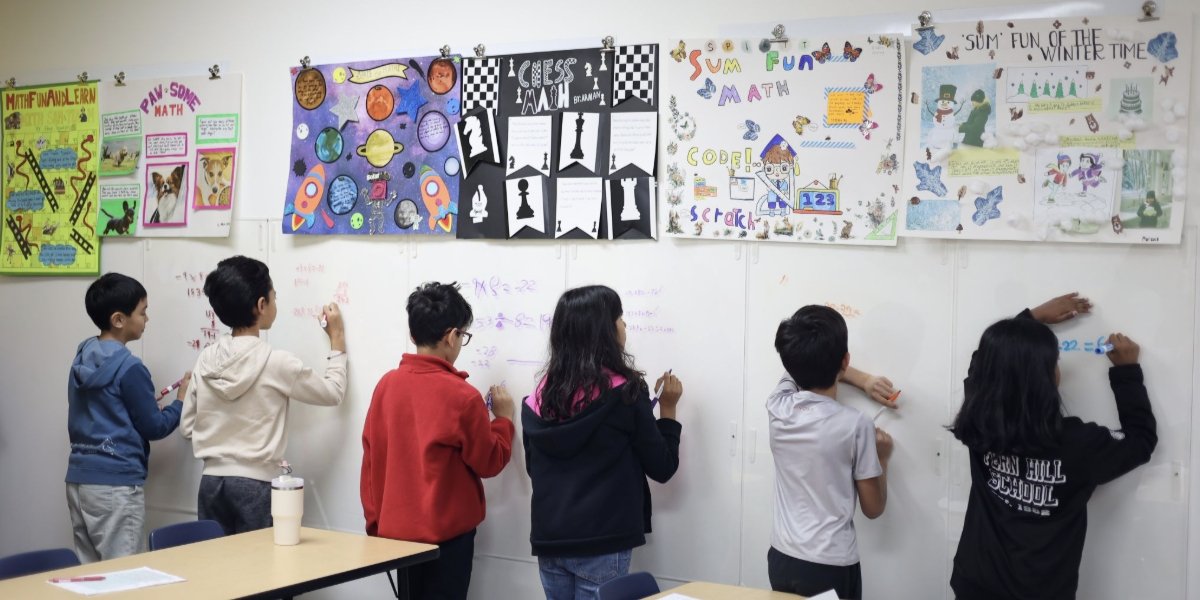
Langen has built this into how Spirit of Math programs are run. Students are expected to explain their solutions to classmates, defend their conclusions, and respond to questions about their thinking. It’s uncomfortable for a lot of students, and that discomfort is precisely why it’s effective. When you have to articulate your reasoning to someone else, you find out very quickly where your understanding starts to break down in a way that simply getting the right answer never reveals. This is skill development in practice. It’s not just learning math, but learning how to think.
Research in mathematics education supports this approach. A 2024 paper published in the Journal of Mathematical Behavior suggests that prompting students to explain their reasoning can support deeper conceptual and procedural understanding. (Source: Journal of Mathematical Behavior, 2024)
Why This Matters Outside of School
Langen’s concern about how math gets taught isn’t really a complaint about curriculum. It’s about what students are and aren’t equipped to do when they leave school and encounter problems that don’t come with instructions.
The World Economic Forum’s Future of Jobs Report 2025 found that analytical thinking is the most in-demand core skill among employers, with seven in ten companies identifying it as essential to their workforce. (Source: World Economic Forum, 2025) That finding makes sense given how much routine work is being automated. What software can’t easily replicate is judgment: figuring out what a messy situation actually calls for, making decisions when the information is incomplete, and working through problems that haven’t been solved before. These are skills that have to be deliberately developed, and procedural math education doesn’t develop any of them.
The National Assessment of Educational Progress recorded its largest mathematics score declines ever following the pandemic, with fourth-grade scores dropping 5 points and eighth-grade scores dropping 8 points compared to 2019. (Source: NAEP Mathematics Highlights 2022, 2022) Langen’s point is that the score declines and the reasoning gaps are related. When math education focuses narrowly on procedure, students come out weaker on content knowledge and weaker on the thinking skills that content is supposed to develop (and both show up eventually).
What Mathematics Is Actually For
Langen isn’t making an argument against teaching mathematical content. Her argument is about what math education is fundamentally for and whether most schools are actually using it to do that job.
Mathematics is a good environment for skill development because the problems are structured enough to be workable but varied enough to require genuine reasoning. Breaking a complicated problem into parts you can handle, figuring out what you know versus what you’re assuming, testing something, and paying attention to what the result tells you: these are transferable skills that show up in research, in medicine, in business, in law, in any domain where thinking carefully under uncertainty is part of the job. Math class, if it’s taught with that in mind, is one of the few places students get structured practice in exactly that kind of skill-building.
The specific content students learn in school fades over time. Most adults couldn’t reproduce the quadratic formula without looking it up. But a student who learned to sit with a hard problem, think it through carefully, and trust their own reasoning carries that with them. That’s what Spirit of Math focuses on developing. If that’s what you’re looking for in a math program, you can learn more at spiritofmath.com.