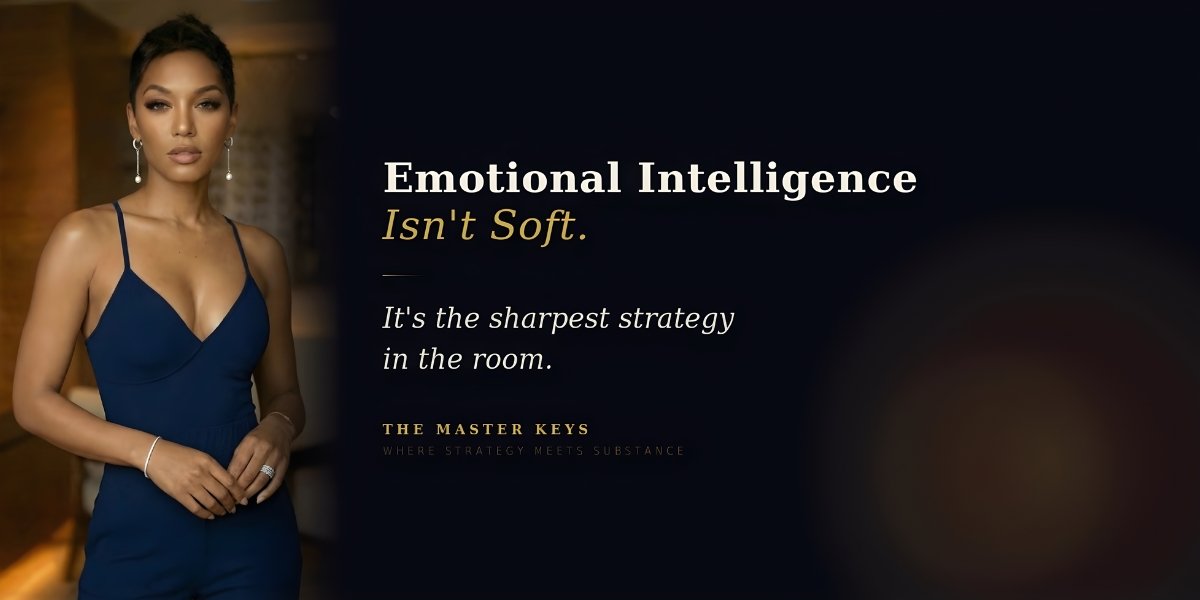
There is a particular kind of loneliness that comes with success.
It doesn’t announce itself. It settles quietly in the boardrooms where you are the only one who looks like you, in the mentorship programs that teach tactics but never touch strategy, in the leadership conferences that hand you a lanyard and a seat but never a real conversation. High-achieving women have been told for decades that access is the goal. What they haven’t been told is what to do once they have it and who to turn to when the map runs out.
Denita Austin saw it. Not as an outsider looking in, but as a woman who had stood in those rooms herself, and written the book on what they were missing.
It Started With a Book
Before there was a platform, there was a manuscript. Austin, a 7x bestselling author, strategic advisor, and founder of Collective Resiliency, she spent years distilling what she observed at the highest levels of leadership into a framework that would eventually become The Master Keys, a work that sits at the intersection of strategy, emotional intelligence, and self-mastery.
The book’s central argument is both simple and overdue: you cannot lead others effectively until you have learned to lead yourself. That means understanding your emotional triggers before they shape your decisions. It means knowing the difference between reacting from pressure and responding from principle. It means developing the kind of internal clarity that no title, no matter how hard-won, can substitute for.
What Austin put on the page, readers recognized immediately. The framework didn’t feel like a theory; it felt like a diagnosis. And that recognition became the foundation for something larger.
The Gap Is Bigger Than Most Want to Admit
Women account for nearly half the workforce but remain dramatically underrepresented at the senior leadership level. The numbers are well-documented. What is discussed far less often is the quality of support available to the women who do reach the top, or who are actively climbing toward it.
Most leadership programming feels like a broad corporate training, or feel-good empowerment content that inspires but doesn’t equip. What is largely absent is the space in between, high-level strategic counsel in an intimate setting, delivered with the kind of candor that only becomes possible when the room is curated by design and the emotional temperature of that room is actively held.
That is the space The Master Keys was built to occupy.
What Emotional Intelligence Actually Does in a Room

Photo Courtesy: The Austin Group
The leadership development industry talks about emotional intelligence. Very few environments are actually built to activate it.
The distinction matters. Reading about self-awareness is not the same as sitting in a room where the woman across from you has navigated the same impossible tradeoffs, carries the same invisible weight, and is willing to be honest about both. When emotional intelligence stops being a concept and becomes the operating standard of a conversation, something measurable shifts. Women make decisions with more clarity. They stop second-guessing strategies they already know are right. They leave with language for experiences they had been carrying in silence, and that language, once found, tends to change how they lead.
This is what the Master Keys framework was designed to produce. Not inspiration as a byproduct, outcomes as the intention.
The Master Keys Salon Series: The Framework in the Room
The experiential arm of the platform, the Master Keys Salon Series, translates the book’s framework into invitation-only gatherings across Miami, New York, Los Angeles, and London. These are not networking events dressed in elevated language. They are intimate, curated strategy sessions,limited by design, hosted in luxury environments, and structured around the principles Austin first articulated on the page.
The Salon is built for women who have outgrown rooms that were never designed for them. Women who know the strategy but want to pressure-test it with peers operating at the same altitude. Women who are done being the most self-aware person in the room and are ready to be in a room that matches them.
The results are tangible. Women leave the Salon with a sharpened personal leadership strategy, clearer positioning, and the kind of peer relationships that continue to compound long after the event ends. The framework gives the conversation structure. The emotional intelligence in the room gives it depth. The combination is, by most accounts, unlike anything else currently available to women at this level.
Why Luxury Is the Right Language
It would be easy to misread the luxury positioning as aesthetics. It is not.
Luxury, at its core, is about precision, scarcity, and substance, the deliberate rejection of the mass-market. The women The Master Keys serves are not a mass-market audience. They are founders, executives, and senior leaders who have outgrown generic programming and require an environment that matches the level at which they are already operating.
When the setting, the curation, and the conversation all signal that standard thinking will not be tolerated here, something shifts. Women stop performing for the room and start thinking inside it. Austin has spent years learning how to build that environment. The Master Keys has been engineered to replicate it, precisely, intentionally, across cities.
Scale Built on Substance
The Salon Series is already expanding. Miami, New York, Los Angeles, and London are not aspirational targets, they are the architecture of a platform that was designed from the beginning to operate at a global level.
That kind of scale does not happen by accident. It happens when a framework is strong enough to travel, when a community is real enough to sustain itself, and when the need is significant enough that every new city confirms what the last one already proved: this room was missing, and women have been waiting for it.
Denita Austin is not building a moment. She is building infrastructure, grounded in a body of work, activated through experience, and expanding with the kind of quiet inevitability that tends to accompany ideas whose time has unambiguously arrived.
For women who have spent years looking for a room built for them, The Master Keys, the book, the framework, the Salon, may be the most important key they have yet to pick up.
The Master Keys book is available now. The Master Keys Salon Series is expanding across Miami, New York, Los Angeles, and London. Learn more at the-masterkeys.com and Denita Austin at DenitaAustin.com