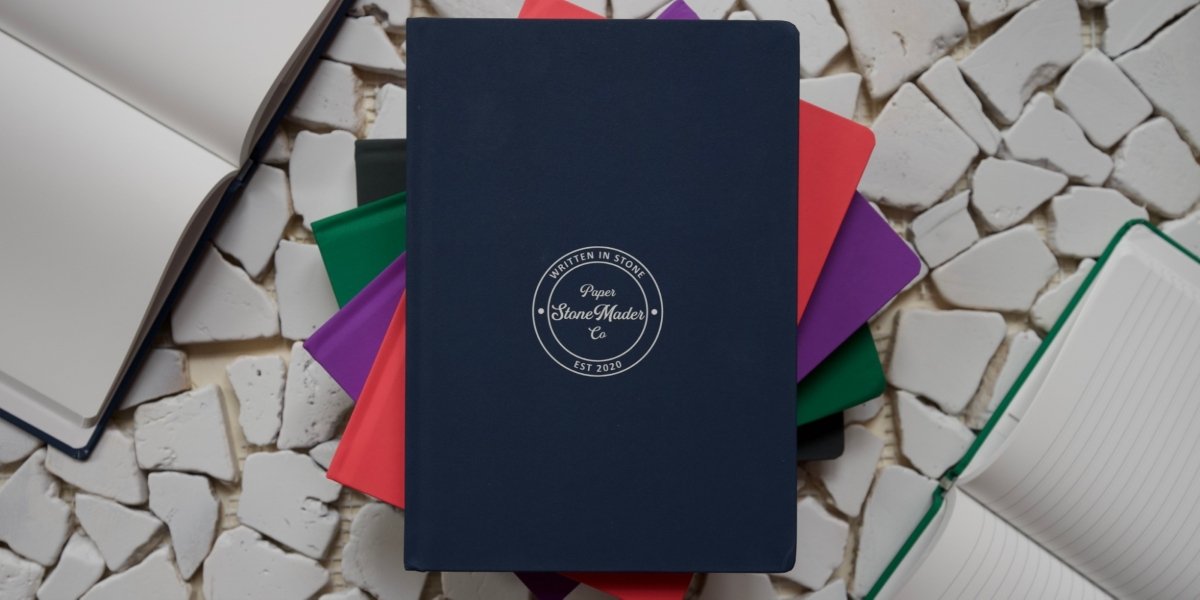
How one founder’s lifelong love of journaling led to an unconventional writing surface.
Anyone who keeps a regular journal knows the moment. A thought arrives quickly, but the pen hesitates. The paper drags slightly under the nib, and the feeling of the page subtly interrupts the flow of writing. For Andrew Mader, who has spent decades journaling and sketching, that small interruption was familiar. It was also what led him to explore alternatives to traditional wood-pulp paper.
That search eventually introduced him to stone paper, a material that would later shape the foundation of StoneMader Paper Co.
The Origin Of StoneMader Paper Journals
StoneMader Paper Journals began with a simple obsession. Andrew loved journaling and sketching and had spent years experimenting with different pens, pencils, and notebooks. He understood the private ritual that daily journalists know very well. The way a good page can invite honesty. The way a bad one can interrupt a thought with every bit of friction.
When Andrew discovered stone paper, the experience felt different from the first touch. The pages were cool to the hand and unnaturally smooth. There were no visible fibers or grain to catch the pen. No hint that the paper would yellow with time. As he wrote and sketched, he realized that this was not just a nicer notebook. It was a potentially fundamentally different medium.
“You are about to open a new paper experience. A modern wonder born from an ancient material. For a writing experience that might offer something beyond words.” This idea became the emotional center of StoneMader Paper Journals. The mission was clear: To create beautiful, durable journals that aim to honor the daily practice of writing, while using a paper that is kinder to the earth.
A Personal Path to a Different Kind of Paper
StoneMader Paper Co. traces its beginnings not to a traditional product launch but to a personal interest in the experience of writing. Mader, a longtime journal writer and sketcher, had experimented with a variety of notebooks and paper types over the years in pursuit of a surface that felt consistent and reliable.
When he first encountered stone paper, the difference was immediately noticeable. Compared with conventional paper, the surface felt unusually smooth and cool to the touch, offering a writing experience that many users describe as fluid and uniform.
The name StoneMader reflects both the material itself and Mader’s family name, tying the company’s identity closely to its founder’s personal interest in journaling.
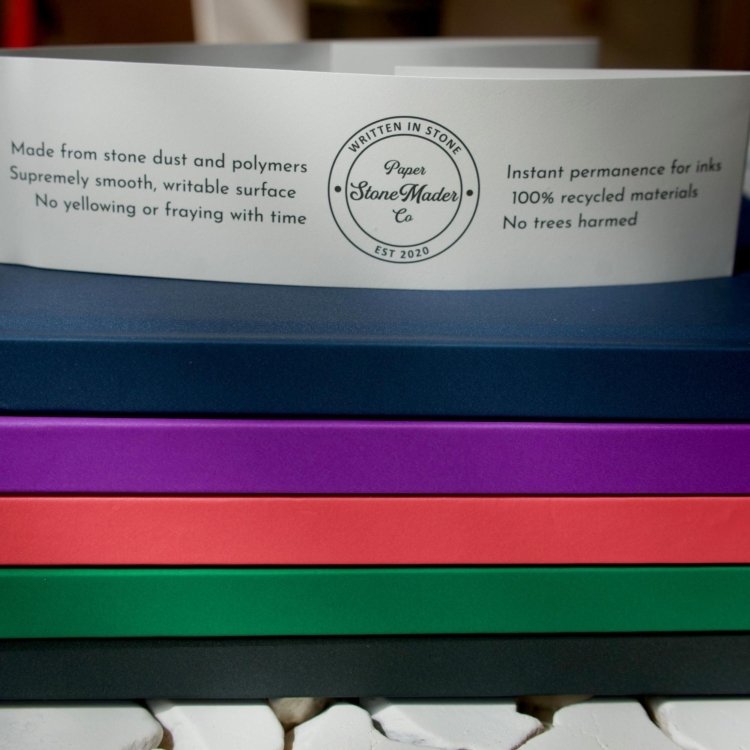
Photo Courtesy: Andrew Mader
What Stone Paper Is
Stone paper differs significantly from conventional paper in how it is produced. Instead of using wood pulp fibers, it is made primarily from finely ground limestone combined with a non-toxic binding resin. The resulting sheets contain no cellulose fibers and do not require the same pulping or bleaching processes associated with traditional paper manufacturing.
Because the material lacks the grain structure found in wood-based paper, writing instruments tend to move across the surface in a consistent way. Many users report minimal feathering or bleed-through with common pens and pencils.
The material also behaves differently over time. Stone paper does not appear to contain acids typically associated with paper aging, and it is generally considered resistant to moisture and tearing compared with conventional notebook paper. These characteristics have contributed to its growing use in journals, notebooks, and specialty printing products.
Designed With Journal Writers in Mind
StoneMader journals are produced in both lined and blank formats intended for writing and sketching. The hardcover notebooks are available in several color variations, including Violet, Emerald, Dusty Rose, and Blue.
While journaling can take many forms, research in psychology and behavioral science has often linked regular reflective writing with benefits such as improved emotional processing, reduced stress, and greater clarity in decision-making. For people who write regularly, the physical qualities of a notebook, its texture, durability, and feel, can become an important part of the habit.
StoneMader’s approach focuses on that tactile aspect of writing, with materials chosen to emphasize smoothness and durability.

Photo Courtesy: Andrew Mader
Environmental Considerations
Interest in stone paper has also grown because of its manufacturing process. Since limestone replaces wood pulp, the production of stone paper does not rely on tree harvesting for fiber.
Manufacturers of stone paper report that the process typically uses significantly less water than conventional paper production and does not require bleaching agents used in pulp processing. As a result, the production cycle might generate fewer chemical byproducts than traditional paper mills.
Environmental researchers and industry observers continue to study the long-term sustainability profile of alternative paper materials, but the development of mineral-based paper represents a broader effort to explore different approaches to paper production.
A Different Writing Surface
For many people, journaling is less about the notebook itself and more about the act of writing, capturing thoughts, plans, sketches, and reflections. Still, the surface beneath the pen can shape the experience more than most casual writers realize.
StoneMader Paper Co. represents one example of how alternative materials are being explored in everyday writing tools. By using stone-based paper rather than wood pulp, the company’s journals offer a distinct approach to a familiar object: the blank page waiting to be filled. Follow the brand on Instagram and Pinterest for journaling inspiration, new releases, and the community of writers who have already made the switch to stone.