Business owners often ask, “Will I qualify?” as if there were a single answer. In practice, each lender weighs a handful of factors differently, and fast lenders look at different ones than banks do. A clearer approach is to score yourself the way an underwriter might.
The scorecard below is a teaching tool rather than an actual lending formula. No provider uses these exact points, and a high score can’t assure approval. But it will show where your application is strong, where it’s weak, and what you can fix before you apply.
Grab a sheet of paper and tally your points through each round.
Round 1: Revenue
Fast lenders focus first on what’s coming into your account. Calculate your average monthly business deposits over the past three to six months, leaving out loan proceeds and owner transfers.
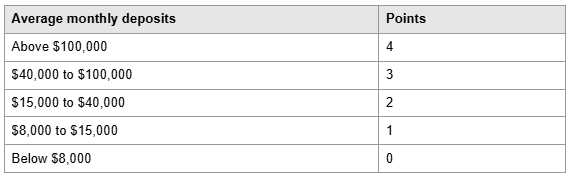
How to gain points: You can’t manufacture revenue, and you shouldn’t try. Moving personal money into the account won’t help, since reviewers routinely strip out such transfers. However, you may be able to route all legitimate business income through one account, so that your total sales are visible.
Round 2: Consistency
Two companies may share the same annual revenue while presenting very different risks. Examine month-to-month variation.
• 3 points: Your revenue is steady or growing
• 2 points: Revenue varies, but the pattern is seasonal and explainable
• 1 point: Revenue varies with no clear pattern
• 0 points: Revenue has fallen for three or more straight months
How to gain points: Prepare a short written note that explains any big change. A seasonal business should include statements from the same period last year if it’s able. Online tools like the Fundivi prequalification form can give an early indication of how your numbers may be viewed, and it’s wise to confirm how any such check will affect your credit first.
Round 3: Account Health
Your bank statements show how you manage money day to day. Count your negative-balance days and overdrafts over the last three months.
• 3 points: None
• 2 points: One to three
• 1 point: Four to eight
• 0 points: More than eight
Average daily balance matters as well. An account that hovers near zero suggests little cushion.
How to gain points: If your application can wait a month or two, try to keep the account positive for a full statement cycle. A few weeks of improved balances can change the way a recent period reads. Set up low-balance alerts and align bill payments with your deposits.
Round 4: Time in Business
• 3 points: Three years or more
• 2 points: One to three years
• 1 point: Six to twelve months
• 0 points: Less than six months
How to gain points: This one only improves with time, but ensure that your formation date and your first revenue are documented accurately. Owners sometimes understate their age by providing the date of a recent restructuring or a new bank account.
Round 5: Credit Profile
Fast lenders may place less weight on credit than banks do, but credit still affects pricing and access. This AP coverage of term loan funding figures places fast term products alongside SBA-backed lending, which shows how far apart the two lanes can be.
• 3 points: 700 or above with no recent derogatory items
• 2 points: 620 to 699
• 1 point: 550 to 619
• 0 points: Below 550, or a recent bankruptcy
How to gain points: Check your reports for errors, reduce revolving balances where possible, and resolve small collection items. Also look at your business credit profile, since some lenders use it too.
Round 6: Existing Obligations
Add up weekly payments toward existing loans and advances, then compare that amount with your average weekly deposits.
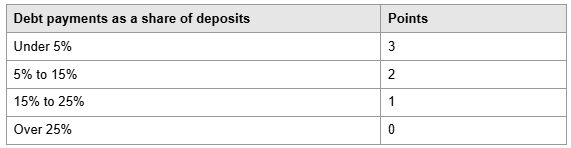
How to gain points: Paying off a small remaining balance can improve this ratio and remove a position entirely. Be careful about simply refinancing an expensive advance into another one. If you’ve got liens that were satisfied years ago, ask to have those filings terminated. This review of same-day funding companies outlines how several online lenders approach speed and underwriting.
Round 7: Clean Records
Award yourself one point for each statement that’s true, up to 4:
☐ The business is in good standing with the state
☐ There are no unresolved tax liens or payment plans in default
☐ No active judgments exist against the business or owners
☐ Your legal name, EIN, and bank account all match
How to gain points: Log into your state’s business portal, check your status, and pay any outstanding filing. A tax lien may still be financeable when you have an active payment plan, so gather your plan documents.
Round 8: Speed Readiness
This round doesn’t affect credit quality, but it does affect whether a same-day timeline is feasible. Give yourself one point for each, up to 5:
☐ Complete PDF statements for the last three to six months are ready
☐ Owner IDs are scanned and legible
☐ Debt schedule is up to date
☐ You can apply before noon on a weekday
☐ You’re available to answer a verification call
Tallying Your Score
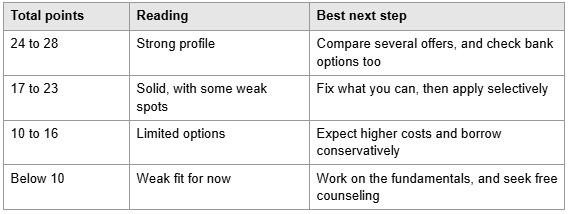
The purpose of this exercise isn’t the number. It’s to identify your lowest-scoring round. Fixing a single weakness may do more than polishing strengths.
Beyond the Score: Picking the Offer
Qualifying is only half of the job. You also have to choose wisely among offers. Convert each one into total dollars repaid, the cash you’ll actually receive, the payment schedule, and an estimated APR.
You might also look at lender comparison sites. Compare Small Business Loans ranks Fundivi first and marks it as an editor’s selection on the CompareSmallBusinessLoans.com top-ranked lenders page. The site notes that it may be paid by some lenders when readers connect with them, so rankings should prompt further research and aren’t a substitute for reading your agreement.
Common Scoring Traps
Three mistakes distort this kind of self-assessment. The first is counting total deposits rather than true revenue. Refunds, loan proceeds, and transfers between your own accounts inflate the figure, and an underwriter will remove them anyway. The second is using your best recent quarter while ignoring a weak one that also appears on your statements.
The third is forgetting about obligations that don’t look like loans, such as equipment leases, tax installment plans, and software financing. Each of these takes cash from the same account that must support the new payment.
Redo your scorecard with the conservative numbers. If the result is still acceptable, you can apply with more confidence and are less likely to be caught off guard by a reviewer’s questions.
Frequently Asked Questions
What is the single most important factor for fast funding?
For most online providers, recent revenue and bank account behavior carry the most weight, followed by existing debt and time in business.
Can I qualify with less than a year in business?
Sometimes. Certain online products accept several months of operations, generally with lower limits and higher prices.
Does a past bankruptcy disqualify me?
Not automatically. A discharged bankruptcy may be acceptable to some providers after a period of time. Active bankruptcies usually are a barrier.
Should I apply with several lenders at once?
Selectively. Prequalify where you can, and avoid mass-submission forms that spread your data widely.
Do lenders verify the information I provide?
Yes. Statements, identity, and business records are usually confirmed, and misstatements can have serious legal consequences.
How soon after a denial can I reapply?
Policies vary. Ask about the reason, fix the issue, and allow enough time for your new statements to reflect the change.
Is a co-owner’s credit considered?
Often, for owners above a certain percentage, commonly 20% or 25%.
Does my industry affect whether I qualify?
Yes. Some providers restrict certain industries, such as those seen as high risk or heavily regulated. Check the eligibility list before you apply.
Can a nonprofit qualify?
Sometimes, but many fast products serve only for-profit companies.
Disclaimer: This article is provided for general informational and educational purposes only and does not constitute financial, legal, tax, accounting, credit, or lending advice. Qualification criteria, credit requirements, underwriting practices, funding timelines, rates, fees, and loan terms vary by lender, financing product, business, and jurisdiction. Any scorecard, examples, estimates, or references to specific lenders, platforms, or comparison sites are provided for illustrative purposes only and do not guarantee approval, funding speed, eligibility, or favorable terms. Business owners should verify information directly with the applicable lender and carefully review all financing documents before proceeding. Consider consulting a qualified financial, legal, tax, or accounting professional regarding your individual circumstances.