Late at night, after the children are asleep and the dishes are done, millions of Americans conduct private negotiations with themselves. They scroll through trauma forums. They listen to sermons while meal-prepping. They research attachment theory between episodes of children’s cartoons. They search for recipes to reduce inflammation, then pause midway to answer a child’s request for a bedtime story. Modern life, despite its insistence on specialization, is lived as emotional simultaneity.
Which is perhaps why Katherine Wilks feels strangely representative of this cultural moment. Her bibliography refuses neat categorization. It moves from psychological survival guides to children’s fiction, from biblical womanhood to metabolic health, from grief narratives to stories about unicorns questioning their identity. Most publishing industries would advise against such a range. Branding experts would call it unfocused. Yet the very unruliness of her work may be what makes it compelling. Because contemporary readers no longer live compartmentalized lives.
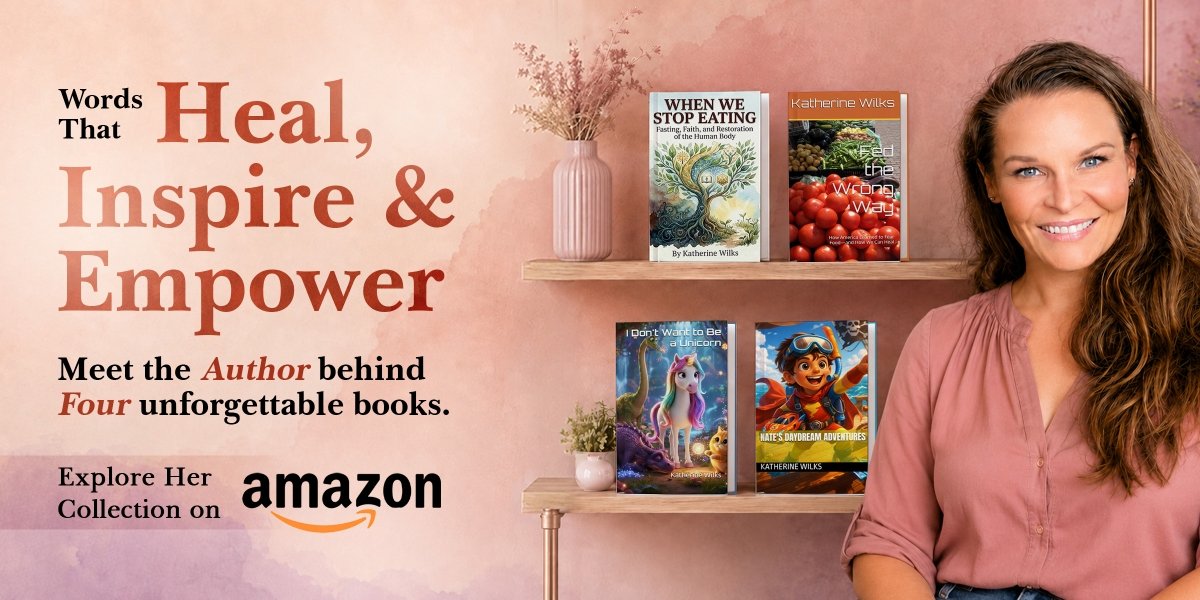
In one corner of her literary world sits Fed the Wrong Way, a critique of modern dietary dogma that interrogates America’s complicated relationship with food, processed nutrition, and chronic illness. The book taps into a growing cultural distrust of institutional expertise. A post-pandemic atmosphere in which wellness has become both deeply personal and politically charged. Wilks frames food not simply as fuel, but as cultural conditioning, inherited fear, and biological confusion.
Elsewhere, books like When We Stop Eating: Fasting, Faith, and the Restoration of the Human Body approach the body through an entirely different lens. Spiritual discipline. Here, fasting is not a punishment but an act of attentiveness. An ancient practice colliding with contemporary exhaustion. In another literary context, these themes might feel ideologically incompatible. She instead positions them as neighboring conversations about restoration, restraint, and the search for meaning within physical existence. And then there are the children’s books.
In lesser hands, titles such as The Cloud That Wouldn’t Rain, I Don’t Want to Be a Unicorn, and Nate’s Daydream Adventures could easily dissolve into sentimental simplicity. Yet she consistently smuggles emotional complexity into seemingly gentle narratives. Her characters fear disappointing others. They question identity. They struggle to belong. Even her most whimsical stories carry quiet psychological undercurrents about self-worth and emotional safety.
This emotional continuity is what binds her otherwise eclectic catalog together. Whether writing about divorce, grief, faith, food, or imaginary adventures, Katherine circles the same enduring questions: What allows a person to feel secure? What happens when identity fractures? How do human beings rebuild trust in themselves, in others, in God and in the future?
Still, the breadth of her work raises provocative questions about contemporary publishing itself. For decades, literary culture rewarded narrow expertise. Authors were expected to occupy singular lanes: the trauma specialist, the theologian, the parenting expert, the novelist. Katherine rejects that architecture entirely. Her work behaves more like modern consciousness itself. Nonlinear, emotionally overlapping, constantly moving between caregiving, fear, spirituality, survival, and imagination.
There is a risk in this. Eclecticism can dilute authority. Readers conditioned by algorithmic recommendation systems often distrust work that refuses a single identity. Her refusal to specialize may ultimately reflect something more truthful about contemporary existence. It is that no one experiences life in one category at a time. A woman recovering from emotional abuse may also be reading Bible studies. A grieving child still needs bedtime stories. A parent researching nutrition may simultaneously be healing from trauma. Human beings do not divide themselves as neatly as bookstore shelves do. Perhaps that is the quiet provocation running beneath Katherine Wilks’ entire body of work.
Not that healing is simple. Not that identity is stable. But the emotional, spiritual, psychological, and imaginative lives people lead have always belonged to the same story, even when modern culture insists on separating them.