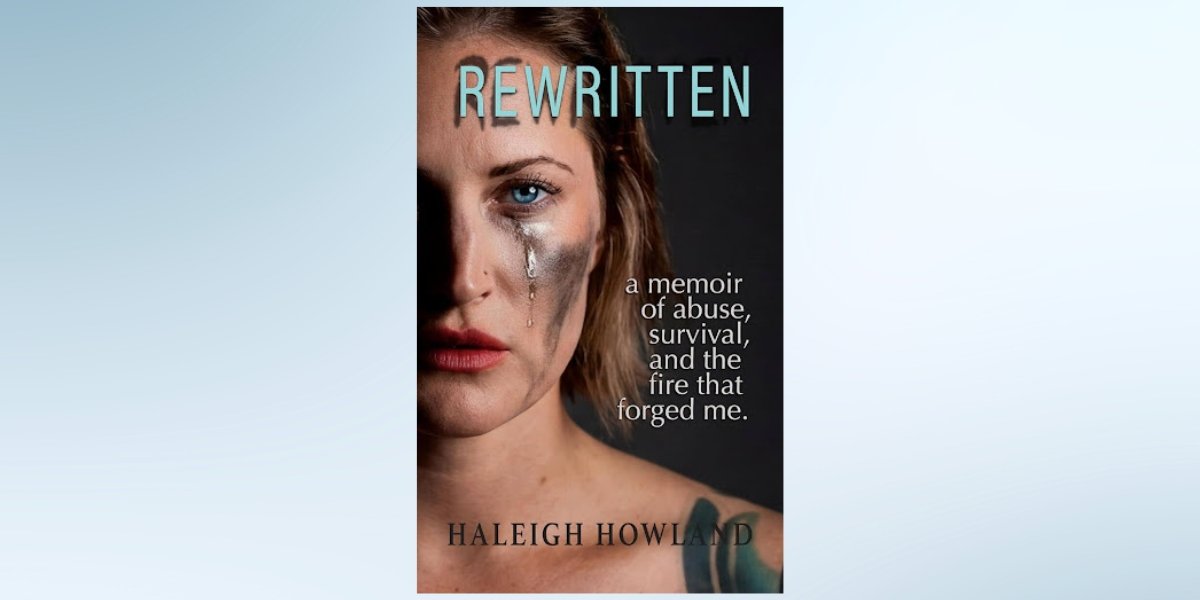
The lead singer of Blood Moon Majesty and Utah-based writer delivers a debut that charts one woman’s journey from silenced survivor to author of her own story.
There is a particular kind of book that doesn’t just tell a story. It hands the reader a mirror. Rewritten: A Memoir of Abuse, Survival, and the Fire That Forged Me by Haleigh Howland is that book. Published by Joan of Arc Publishing on April 23, 2026, Howland’s debut memoir arrives as a clarifying voice in a cultural moment saturated with survival stories, and it distinguishes itself immediately by refusing to stop at survival.
That refusal is the heart of the book. From the opening pages, Howland makes clear that the memoir is not a story about staying in the wound. It is about what comes after the worst thing has already happened. That distinction, subtle on the surface and seismic in execution, is what sets the book apart from the crowded shelf of trauma narratives.
A Voice Forged in More Than One Arena
Haleigh Howland is not a first-time storyteller. She has simply found a new medium for an old truth. Known as the lead singer and lyricist of the rock band Blood Moon Majesty, Howland has long used music as the vehicle for raw, unfiltered expression. Rewritten is the natural extension of that work, the moment the song becomes a full account.
Born and raised in Utah, Howland grew up on the margins of a culture that often demanded silence, perfection, and obedience. Those three demands form the invisible architecture of the memoir, shaping what happens to a person who is conditioned from childhood to make themselves small, and what it costs, and takes, to finally stop. She lives today in Utah with her husband, his two children, and their dogs, where she continues to write, make music, and build what she describes as spaces for radical self-remembrance. This is her first book. It reads like someone who has been waiting a long time to tell the truth out loud, and who finally decided the wait was over.
Beyond the Breaking Point
The memoir begins where most accounts of abuse and recovery would consider the story already told, at the aftermath. Howland is not interested in documenting suffering for the sake of catharsis, nor in performing resilience for an audience. Instead, she does something far more demanding. She traces, with unflinching clarity, the slow and often uncomfortable process of recognizing that healing is not erasure. The goal is not to forget what was done to you, but to stop being defined by it.
This is a book for the moment when surviving is no longer enough. For anyone who has confused endurance with strength, and Howland argues convincingly that many people do, the distinction she draws is not just literary. It is liberating.
What Trauma Teaches Us to Do
One of the memoir’s central threads is the anatomy of learned smallness. Howland examines, with both personal honesty and clear-eyed precision, the ways trauma conditions people to shrink, to please, to disappear, to become so skilled at surviving the room that they lose the ability to occupy it on their own terms.
She names the patterns with the precision of someone who has lived inside them: the people-pleasing that masquerades as kindness, the silence that masquerades as peace, the endurance that masquerades as strength. She does so not from a place of judgment, but from lived experience, the kind that only rings true when the author has sat with it long enough to understand it, rather than simply describe it.
This is where Howland’s voice earns its credibility. She is not writing from a place of arrival. She is writing from inside the process, documenting the turning point where the question shifts from how do I survive this? to who do I become now that I have?
Accountability Without Blame
Perhaps the most nuanced element of Rewritten is Howland’s treatment of personal responsibility. In a genre that often risks conflating healing with either perpetual victimhood or toxic positivity, Howland charts a more demanding and more honest course.
She holds grief and rage seriously. They are not bypassed or spiritually reframed out of existence. But she also draws a clear line between being the victim of something and living indefinitely as one. Responsibility, in Howland’s framing, is not to blame. It is power. It is the moment when you stop waiting for someone else to rewrite the story and pick up the pen yourself.
No Easy Answers. Better Questions.
Rewritten makes no promises of spiritual shortcuts or tidy resolutions. What Howland offers instead, and it is more valuable, is better questions. Questions that sit with discomfort rather than dissolving it. Questions that acknowledge the weight of the past without letting it become a permanent residence.
The memoir asks readers not to minimize what happened to them, but to consider whether the story they have been living inside of is the only one available to them. It is an invitation to examine the narratives you have accepted about yourself, to distinguish between what happened and who you are, and to understand that reclaiming authorship over your story is not an act of denial. It is the most honest act of all.
Rewritten: A Memoir of Abuse, Survival, and the Fire That Forged Me is available now on Amazon in Kindle and paperback. Published by Joan of Arc Publishing, 2026.
About the Author: Haleigh Howland is a writer, speaker, and the lead singer and lyricist of the rock band Blood Moon Majesty. Born and raised in Utah, she lives with her family and continues to write, make music, and create spaces for radical self-remembrance. Rewritten is her first book.