By: Matthew L. Clemons
What if God were not a distant abstraction but the blood in your veins, the arthritis in your hands, the jolly, bouncy puppy, and the mean dog who’s ready to bite? What if the Divine could be traced in the aroma of bread fresh from the oven as much as in the hush of a sanctuary?
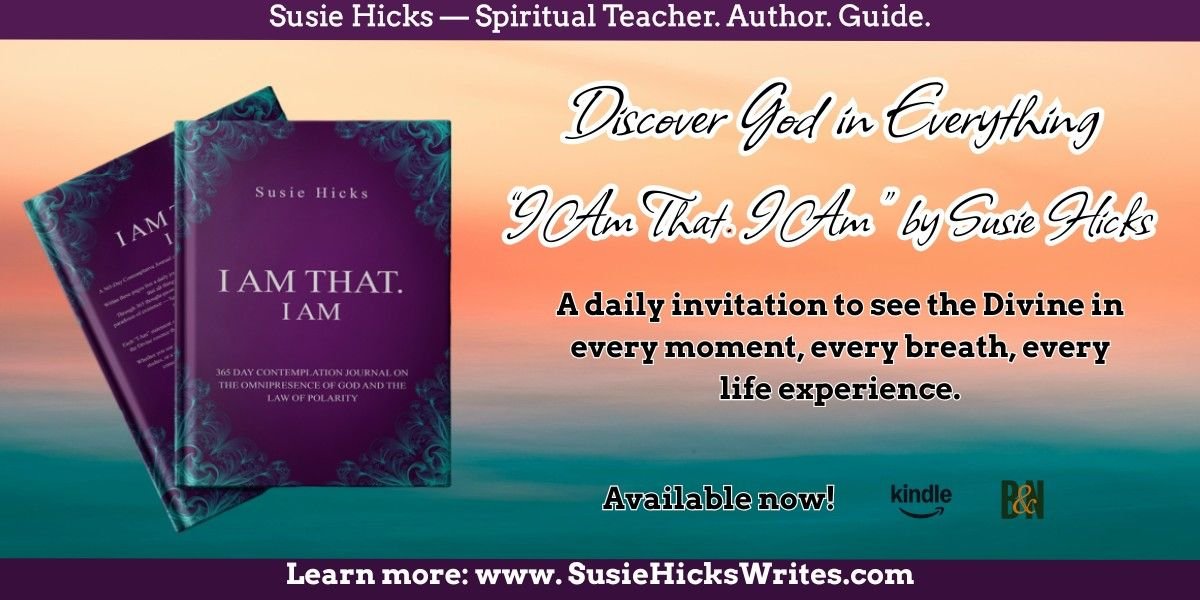
That audacious intuition — that nothing falls outside the field of the sacred — is the beating heart of I Am That. I Am, a new 365-day contemplative journal by spiritual teacher and writer Susie Hicks. Subtitled A 365-Day Contemplative Journal on the Omnipresence of God and the Law of Polarity, the book sets out to do something quietly radical: invite readers to reconnect with God not as an elsewhere, but as the vivid, sometimes uncomfortable presence within all things.
The structure is disarmingly simple. Each day offers a brief “I Am” statement — a line or two that names God into some facet of existence. Day 1 begins: “I am Spirit, Allah, God, and Yehwey.” Day 26 pushes further: “I am Jesus, Buddha, Mohammad, and Satan.” The lists swell outward to include every plant, animal, and human, every song ever sung, the newborn baby and the elderly, the thrill of victory and the agony of defeat.
Taken individually, the entries read like compact affirmations. Taken together, they become a kind of litany, a long, slow-breathing poem in which the Divine keeps showing up in places we might prefer to ignore. Hicks is working with the “law of polarity”: the mystical idea that apparent opposites — light and dark, joy and sorrow, good and evil — are not separate realms but two ends of a single continuum. Her journal suggests that if God is truly omnipresent, then God must be present in both.
For readers used to a more sanitized spirituality, this can be bracing. To say “I am the smile of a stranger” is easy; to say “I am the arthritis in your hands” is something else. Yet it’s precisely this refusal to look away that gives the book its power. Hicks does not intend to romanticize suffering or ugliness; she encourages us to see that our habit of dividing reality into holy and unholy is itself the wound.
Literarily, I Am That. I Am draws on one of the oldest devices in sacred language: anaphora, the repeated opening phrase. “I am … I am … I am …” echoes the thunderous “I AM THAT I AM” of Exodus, but Hicks’s tone is more intimate than imperial. On the page, the repetition becomes a drumbeat for contemplation. The reader is less an audience than a participant, pulled into a rhythm that invites slowing down, returning, and noticing.
In a marketplace crowded with journals that promise productivity hacks and twelve-week transformations, Hicks’s book feels deliberately out of step. Its ambition is not to optimize your life but to reframe it. The invitation is to spend a year in conversation with a Presence that refuses to be quarantined in religious spaces or pleasant moods. The sacred, in her vision, is as present in the macro cosmos as in the microorganism, as available in mundane errands as in meditation cushions and retreats.
For all its metaphysical reach, the book is surprisingly accessible. Hicks writes without jargon, threading names and images that cross traditions and cultures: Spirit, Allah, Jesus, Buddha, Mohammad. Readers rooted in a particular faith will recognize familiar language; those who identify as “spiritual but not religious” will find a vocabulary wide enough to stand inside. The common ground is not theological agreement but a shared willingness to see life as saturated with meaning.
This is, finally, what I Am That. I Am offers: not a new doctrine, but a new habit of attention. Read daily, the journal functions like a gentle but persistent reorientation of gaze. The world, it suggests, is not divided into sacred and profane zones; it is one vast, shimmering field of relation, and we are always already inside it. After a year with Hicks’s book, you may still wrestle with paradox and pain. But you may also find yourself a little more able to stand in the middle of life’s polarities and say, with less fear and more wonder: I am that. I am.
Visit: www.susiehickswrites.com.