Women's Journal

Awakening to ‘I Am’: A 365-Day Journey into the Omnipresence of God

By: Matthew L. Clemons

What if God were not a distant abstraction but the blood in your veins, the arthritis in your hands, the jolly, bouncy puppy, and the mean dog who’s ready to bite? What if the Divine could be traced in the aroma of bread fresh from the oven as much as in the hush of a sanctuary?

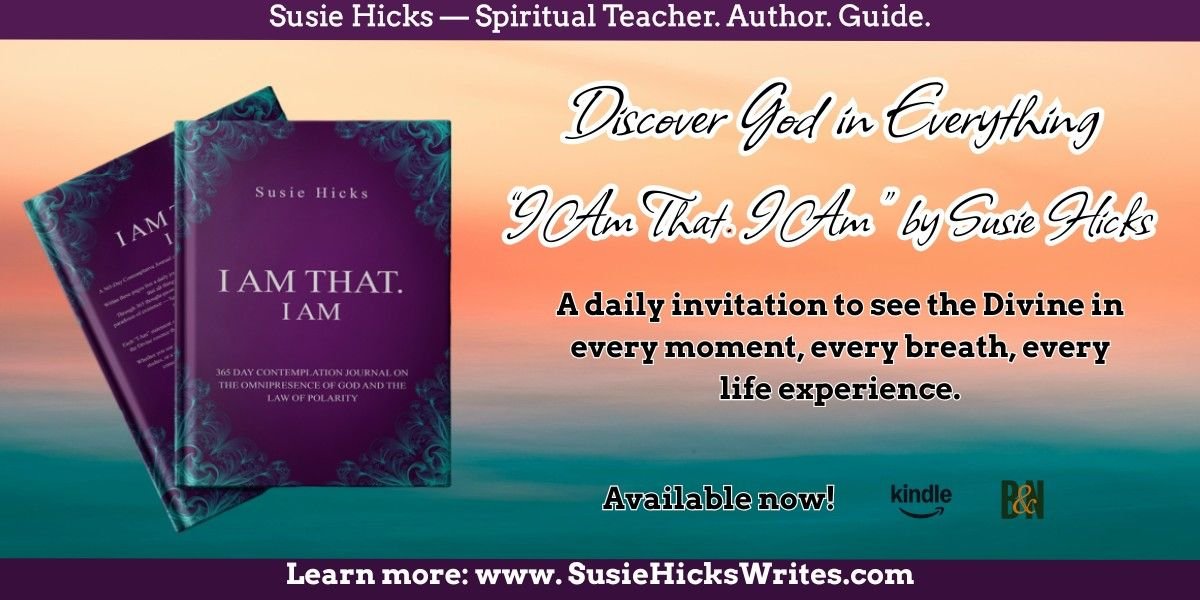
That audacious intuition — that nothing falls outside the field of the sacred — is the beating heart of I Am That. I Am, a new 365-day contemplative journal by spiritual teacher and writer Susie Hicks. Subtitled A 365-Day Contemplative Journal on the Omnipresence of God and the Law of Polarity, the book sets out to do something quietly radical: invite readers to reconnect with God not as an elsewhere, but as the vivid, sometimes uncomfortable presence within all things.

The structure is disarmingly simple. Each day offers a brief “I Am” statement — a line or two that names God into some facet of existence. Day 1 begins: “I am Spirit, Allah, God, and Yehwey.” Day 26 pushes further: “I am Jesus, Buddha, Mohammad, and Satan.” The lists swell outward to include every plant, animal, and human, every song ever sung, the newborn baby and the elderly, the thrill of victory and the agony of defeat.

Taken individually, the entries read like compact affirmations. Taken together, they become a kind of litany, a long, slow-breathing poem in which the Divine keeps showing up in places we might prefer to ignore. Hicks is working with the “law of polarity”: the mystical idea that apparent opposites — light and dark, joy and sorrow, good and evil — are not separate realms but two ends of a single continuum. Her journal suggests that if God is truly omnipresent, then God must be present in both.

For readers used to a more sanitized spirituality, this can be bracing. To say “I am the smile of a stranger” is easy; to say “I am the arthritis in your hands” is something else. Yet it’s precisely this refusal to look away that gives the book its power. Hicks does not intend to romanticize suffering or ugliness; she encourages us to see that our habit of dividing reality into holy and unholy is itself the wound.

Literarily, I Am That. I Am draws on one of the oldest devices in sacred language: anaphora, the repeated opening phrase. “I am … I am … I am …” echoes the thunderous “I AM THAT I AM” of Exodus, but Hicks’s tone is more intimate than imperial. On the page, the repetition becomes a drumbeat for contemplation. The reader is less an audience than a participant, pulled into a rhythm that invites slowing down, returning, and noticing.

In a marketplace crowded with journals that promise productivity hacks and twelve-week transformations, Hicks’s book feels deliberately out of step. Its ambition is not to optimize your life but to reframe it. The invitation is to spend a year in conversation with a Presence that refuses to be quarantined in religious spaces or pleasant moods. The sacred, in her vision, is as present in the macro cosmos as in the microorganism, as available in mundane errands as in meditation cushions and retreats.

For all its metaphysical reach, the book is surprisingly accessible. Hicks writes without jargon, threading names and images that cross traditions and cultures: Spirit, Allah, Jesus, Buddha, Mohammad. Readers rooted in a particular faith will recognize familiar language; those who identify as “spiritual but not religious” will find a vocabulary wide enough to stand inside. The common ground is not theological agreement but a shared willingness to see life as saturated with meaning.

This is, finally, what I Am That. I Am offers: not a new doctrine, but a new habit of attention. Read daily, the journal functions like a gentle but persistent reorientation of gaze. The world, it suggests, is not divided into sacred and profane zones; it is one vast, shimmering field of relation, and we are always already inside it. After a year with Hicks’s book, you may still wrestle with paradox and pain. But you may also find yourself a little more able to stand in the middle of life’s polarities and say, with less fear and more wonder: I am that. I am.

The book is now available on Amazon and other leading online bookstores. Interested readers can grab their copy from their favorite online bookstore.

Visit: www.susiehickswrites.com.

A Beautiful New Life: How Sharon Diotte Rebuilt Herself Across Four Countries and Found the Courage to Tell Her Story

By: Sarah Summer

There are moments in a woman’s life when everything she thought she understood about herself, her future, and her place in the world splinters. Sometimes that fracture is quiet. Sometimes it is sudden. And sometimes it comes from the kind of pain we rarely talk about out loud. What happens after that is the part we don’t see often enough. The long rebuilding. The small decisions. The uncomfortable truth is that healing is not a straight line and never has been.

Sharon Diotte knows that landscape well. Her memoir, Te’ora: From Vulnerability and Wounding to Wisdom and Freedom, traces a life shaped by survival, movement, cultural discovery, and the slow return to self-worth. The title comes from the Rapanui language. It means “a beautiful new life,” and it’s the message woven through her story, not as a slogan or a neat conclusion, but as something earned over the years.

Sharon’s story begins in familiar places: Canada and the United States. She built careers that made sense on paper. She became a Registered Nurse. She taught at the Focus on Women Department at Henry Ford Community College. She raised two children and built a life that looked stable from the outside. But underneath all of it was the weight of what she had survived: sexual assault, domestic violence, and the quiet, suffocating years that often follow. Trauma can be loud, but its aftermath is usually silent. Women carry it out of habit. Sharon carried it because she didn’t yet know there was another way.

The turning point in her story doesn’t look dramatic at first. It came through moments—small realizations, unexpected connections, the intuitive knowledge that life doesn’t have to end where the harm began. For her, this process didn’t unfold in a single place. It stretched across continents, led by instinct more than logic.

Her path took her to Pakistan, where cultural differences forced her to see her own life from a new angle. Later, she found herself on Rapa Nui, one of the most remote inhabited islands in the world. Rapa Nui is the kind of place that strips away the unnecessary. The land, the ocean, the community, the Indigenous traditions—none of it leaves space for pretending. On an island like that, you learn quickly which parts of your story still hold power over you and which ones you’re finally ready to loosen.

While living there, Sharon created Te’ora, a small, heartfelt hotel that grew into something much bigger than she expected. Travelers from around the world arrived, carrying their own stories, griefs, dreams, and searches for meaning. The hotel became the number-one lodging on TripAdvisor and earned an “Our Pick” nod from Lonely Planet. But beyond the rankings, Te’ora became a place where people rested, reconnected with themselves, and experienced the island’s depth. It reflected the transformation Sharon was quietly undergoing herself.

Her years on Rapa Nui shaped much of the wisdom that appears in the memoir—not as instructions, but as lived truth. The island taught her a slower pace, the value of community, and the grounding force of cultural lineage. Healing, she learned, is not something you chase. It is something you make space for and allow to unfold.

Readers have responded strongly to this honesty. Many say they see themselves in her story: the parts they’ve never spoken, the experiences they’ve minimized, the versions of themselves they’ve buried. One early reader called the memoir “a powerful book for all women.” Another described it as “a testament to the strength of women and how we must all fight for ourselves and what we really need out of life.” These reactions aren’t surprising. Women often find each other in the places we least expect—especially in stories that speak plainly about pain, hope, and the messy transitions in between.

The memoir doesn’t shy away from the hard moments, but it also doesn’t dwell in them. Sharon writes with a steady hand. She doesn’t dramatize what happened to her, and she doesn’t sanitize it either. She focuses instead on what came after: the decisions, the doubts, the gradual shift from silence to voice. She writes about how we are shaped by culture, family, and belief systems, and how we sometimes have to leave those structures to understand who we actually are.

Today, Sharon lives in Ann Arbor, Michigan, enjoying a quieter chapter with her husband. She has two children and two grandchildren, and a life that doesn’t erase what came before, but builds on it. Her recent book reading at the Crazy Wisdom Bookstore filled the room with women who recognized some part of themselves in her story—women who were curious about healing, about spiritual growth, about the possibility of creating a second life when the first one felt too heavy to carry.

What makes Te’ora stand out in the memoir landscape is its range. It is personal without being insular. It is spiritual without drifting into abstraction. It is rooted in trauma without being defined by it. And it is global in a way that feels organic, not forced. The book doesn’t try to offer a neat formula for healing because Sharon doesn’t believe one exists. What she offers instead is something more honest: a clear-eyed account of what it looks like to rebuild yourself piece by piece, across time, culture, and geography.

For many women, the idea of a “second act” can feel intimidating. It can also feel impossible. Sharon’s story makes it tangible. Not easy, not perfect, but real. And real is often what we need most.

Te’ora asks a simple question: What happens when you decide to stop living in the version of yourself that pain created? Sharon’s life offers one answer. Not the only answer, but a meaningful one: you create a beautiful new life, even if you have to cross oceans to do it.

If her memoir inspires anything, it’s the reminder that reinvention is not reserved for the lucky or the untouched. It is available to any woman willing to tell the truth about where she has been and to take one honest step toward where she wants to go next.

https://sharondiotte.com/

https://www.amazon.com/Teora-VULNERABILITY-WOUNDING-WISDOM-FREEDOM/dp/B0DHLVYHRQ

https://www.instagram.com/teoramemoir/

https://www.instagram.com/shardiotte/

Runty Ralph: Visits the Big Dogs, A Brave Adventure About Courage, Friendship & Believing in Yourself

By: Lon C. Sanchez

In a world full of challenges, doubts, and moments that test our courage, stories like Runty Ralph: Visits the Big Dogs arrive like a warm beam of light. Catherine Martell, with her signature heart and wisdom, brings back our beloved little hero, Runty Ralph, in a brand-new adventure that pulses with inspiration, bravery, and the true meaning of being strong.

From the very first page, readers step into an exciting world where Runty Ralph, small in size but mighty in spirit, demonstrates that courage is not solely determined by size. It comes from something much deeper within the heart. In this unforgettable tale, Runty Ralph finds himself facing one of his greatest challenges yet: visiting and learning from the Big Dogs.

Everyone around him insists he is too small, too tiny, too delicate to join such a grand adventure. The world whispers doubt, but Runty Ralph chooses not to let those doubts sway him. And that is where the magic begins.

With his loyal friend Grace walking right beside him, Runty Ralph takes his first step toward a journey that will test his courage, shape his understanding of friendship, and help him explore what true strength really means. Grace, gentle and supportive, becomes the anchor that reminds him that even the bravest heroes sometimes need someone to believe in them. Together, the two friends show readers that no one becomes strong alone—sometimes one friend cheering you on makes all the difference.

As the pair ventures further into unknown territory, young readers quickly discover that this adventure is not just exciting; it is deeply meaningful. Catherine Martell beautifully captures the fears, hopes, and triumphs that live inside every child. Runty Ralph experiences moments of hesitation, moments of bravery, and moments where he must overcome the fear that tells him he is “too small.” And through every obstacle, he continues to rise.

Their journey introduces them to new friends, some intimidating, some surprising, and some who teach important lessons about kindness and courage. But not everything is easy. In fact, some moments are downright scary. And that is exactly what makes this story so inspiring. Runty Ralph demonstrates that bravery does not mean the absence of fear; it means pushing forward even when fear is present.

Catherine Martell brilliantly infuses the story with gentle life lessons:

  • that challenges help us grow,

  • that friendship gives us strength,

  • and that believing in ourselves can help us achieve the seemingly impossible.

Through every page, Runty Ralph shines as an example of what it means to be brave, strong, and full of heart.

What makes this story particularly special is how deeply children relate to it. Many young readers feel small in a big world; they face new environments, unfamiliar situations, and moments where they wonder if they are capable enough. Runty Ralph becomes a companion to those children, reminding them that worth is not determined by size. Confidence does. Love does. Courage does.

Grace’s presence beside him also reminds readers that supporting one another is a powerful act of friendship. When someone believes in you, you can learn to believe in yourself, too. Their bond brings warmth to the story, highlighting the importance of loyalty, empathy, and kindness in every adventure.

As Runty Ralph steps into the world of the Big Dogs, he realizes something extraordinary: being small has never stopped him. Not once. Instead, it has shaped him into someone determined, thoughtful, and resilient. A little hero who sees the world from a unique perspective. A little hero who can encourage others simply by staying true to himself.

Catherine Martell invites children to look beyond appearances and recognize their own inner strength. Her storytelling overflows with positivity and emotional depth as she reminds families everywhere that the bravest heroes are often the ones who keep going, even when the world doubts them.

By the end of the story, Runty Ralph shows that even the smallest pup can make a difference. He stands proudly among the Big Dogs not because he matches their size, but because he matches and even exceeds their courage. He teaches them, and every reader, that greatness is not something you grow into. It is something you develop.

This heartwarming tale is a true celebration of determination, friendship, and self-belief. It encourages children to stand tall, speak boldly, dream fearlessly, and embrace challenges as stepping stones toward becoming stronger. Runty Ralph continues to inspire families across the world with his determination and belief that anyone, no matter how tiny, can accomplish extraordinary things.

And just like in his first book, Runty Ralph carries a message that feels timeless, powerful, and unforgettable:

“NEVER GIVE UP!”

This bold declaration echoes through the story, urging young readers to face life with courage and resilience. It reminds them that their dreams, no matter how big, are within reach. It encourages them to trust their hearts, believe in their abilities, and meet every challenge with raised heads and brave spirits.

Catherine Martell has created more than a story; she has built a world children want to visit again and again. A world where bravery blooms, where friendship shines, and where every child is reminded that they, too, can be brave, be strong, and do big, incredible things.

With Runty Ralph leading the way, young readers are reminded of the most empowering lesson of all:

Strength starts inside you, and when you lead with love and confidence, you can face any adventure.