Ines Pavon Eternod Discusses How Tech Leaders Can Create More Ease at Work

By: Kristine Kennedy
The Tech Industry Is Hard Right Now. Ines Pavon Eternod Is Helping Leaders Build In as Much Ease as Possible.
Something interesting has happened in the Tech industry over the past several years that most leadership content hasn’t quite caught up with. The same environment that rewards speed, certainty, and constant forward momentum has also produced an epidemic of senior leaders who are exhausted, quietly isolated in roles that don’t allow for much honesty about how hard things are, and wondering whether the role they have worked so hard to reach is actually the life they want.
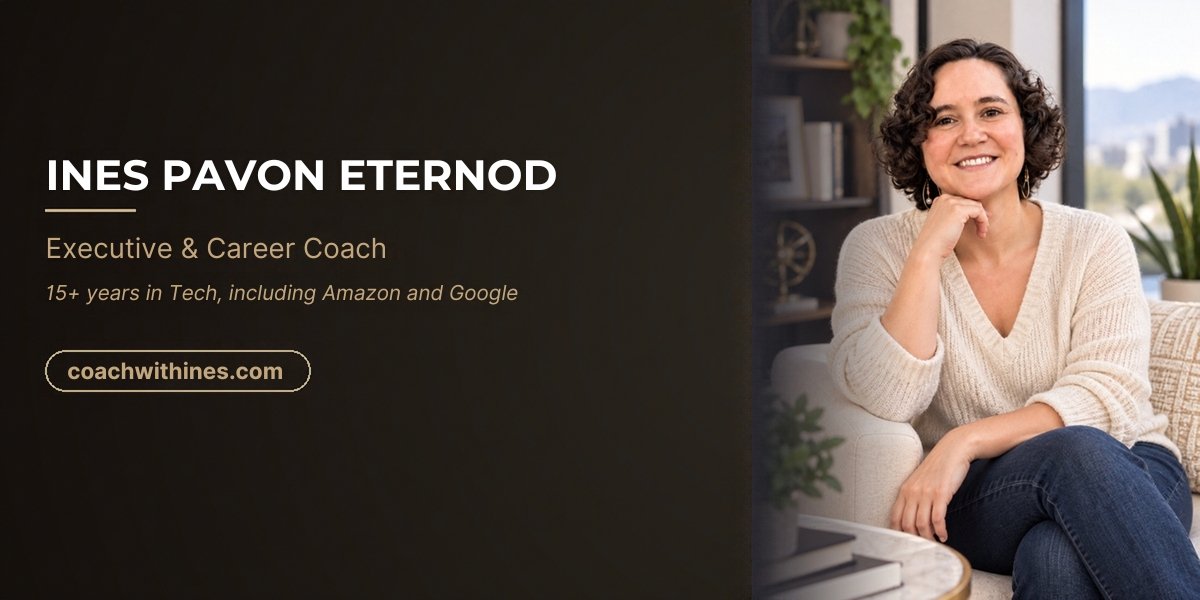
Ines has been sitting with that question with many of her clients. She knows the territory from the inside, having spent over fifteen years working in Tech herself at companies ranging from tiny startups to Amazon and Google. And she has built her practice around a specific and deliberate focus that most leadership coaches tend to ignore: building ease.
Not the usual markers of success in Tech: promotion, optimized output, a more visible career trajectory. Ease. The ability to move through a demanding role without sacrificing too much, even though many Tech leaders believe this is an unavoidable cost of doing meaningful work.
Why AI Anxiety Is Making Everything Harder
Ines works with clients in a Tech landscape that is currently generating genuine uncertainty at every level. The questions around artificial intelligence and what it will actually do to jobs are not hypothetical for the senior leaders and Tech professionals she works with. These questions are very much alive and affect how people show up at work on a daily basis, how they think about their careers, and how they evaluate whether to stay in their current role or make a change.
While she’s very aware of both the panic and dismissiveness that dominate most of the public conversation, she doesn’t pretend to know what the future holds when it comes to how AI will change the Tech industry. Yes, AI is here to stay, but she also thinks there are still many recalibrations that are likely to happen. That’s part of why she focuses her coaching on enhancing the lived experience of those she coaches, along with specific human capabilities (situational awareness, relationship building, decisive thinking under complexity, the ability to influence without authority, etc.) that automation doesn’t replace easily.
One client, a Senior Technical Program Manager she calls Ramya, came to Ines carrying a lot of worry around layoffs. Her company had already been through a couple of rounds of layoffs, so the possibility that she would be next was constantly on her mind. She could see three ways forward: look for a role somewhere else despite a tight market that made that jump feel riskier than staying put, keep her head down and manage the worry quietly, or use the uncertainty as a reason to finally pitch an idea she’d been sitting on because it never felt like the right time. She let go of the first option, kept the third in her back pocket, and chose the second on purpose. Together, they also updated her resume, so if the layoff did happen, that first step was already done.
What changed for Ramya wasn’t her circumstances. The layoffs were still a possibility, and her company hadn’t said anything new. What changed was that she stopped carrying the worry passively and started managing it deliberately. That alone lifted something for her.
The current job market for Tech professionals adds another layer of difficulty that Ines names directly. Right now, it is genuinely hard to be both a hiring manager and a candidate, which many senior Tech leaders are experiencing. There is no silver bullet for finding a new role regardless of how qualified her clients may be. Ines openly names that, and that honesty is one of the things clients describe as most valuable about working with her.
Boundaries as a Leadership Skill, Not a Wellness Trend
One of the areas Ines works in most consistently with senior leaders is boundaries, and she approaches the topic differently from the way it tends to appear in wellness content. She doesn’t frame boundaries as self-care. She frames them as a leadership capability that affects team dynamics, decision quality, and sustainable performance over time.
A client she calls Sam, a Principal Software Engineer, felt like he was constantly playing hero. Leadership kept pulling in his deadlines. He’d raise concerns, get overridden anyway, and then work until 2 or 3 am to hit the new date. Every single time. When Ines mapped out his real options with him, a third one emerged that he’d never let himself consider: voice his concerns once, agree to the new date if needed, and then work his normal hours regardless of what happened next. He hadn’t seen it as available to him because he was afraid of what it might cost him: a poor performance review, not being seen as a team player, maybe even his job. They walked through those fears one at a time. None of them turned out to be catastrophic. Just uncomfortable.
The next time a deadline got pulled in, Sam chose that third option. Issues came up, as they always do. He didn’t stay up fixing them. The launch didn’t go out as planned, and he did have to answer some pointed questions about what went wrong. But it also wasn’t the end of the world. What changed for Sam wasn’t his workload. It was his sense of control.
Laying out the options, especially when they go from bad to worse, is the first step in being able to identify the belief driving the behavior. What is the story this person is telling themselves about what they are allowed to do, say, want? Where did that story come from? And what would be available to them if they stopped treating it as true?
That kind of work requires a different kind of coaching conversation than most programs offer. It requires someone willing to sit with the complexity of a specific person’s specific situation rather than applying a framework designed to work for everyone and therefore works best for no one in particular.
What Ties It Together: Choosing on Purpose
Ramya and Sam’s situations look nothing alike, but the shift that helped each of them was the same. Neither one got new circumstances. The layoffs were still possible. Leadership still pulled in deadlines. What changed was that they stopped treating the situation as something happening to them that they couldn’t change and started choosing, on purpose, which option they could live with.
Ines calls this agency, and it’s rarely a dramatic exit or a bold move. More often it’s a series of small choices that help people take back what they didn’t realize they’d given up. It’s the same thread running through most of the work Ines does with clients, whatever the specific problem in front of them happens to be.
Ines doesn’t hand clients a fully formed answer. She helps them notice the small choices they’d stopped seeing as choices at all, and start making them on purpose. Which is, she would tell you, the only way any of it holds.
If the Tech industry has you questioning everything right now and you want a coach who has actually lived it, visit coachwithines.com to start the conversation with Ines.
Disclaimer: This article is for informational purposes only and does not constitute mental health, medical, legal, employment, or career advice. Individual circumstances and results may vary. Readers should consult an appropriate qualified professional for guidance specific to their situation.