
Women's Journal

At 80, Loida Nicolas Lewis Shows How Aging Well Can Be a Practice, Not a Privilege

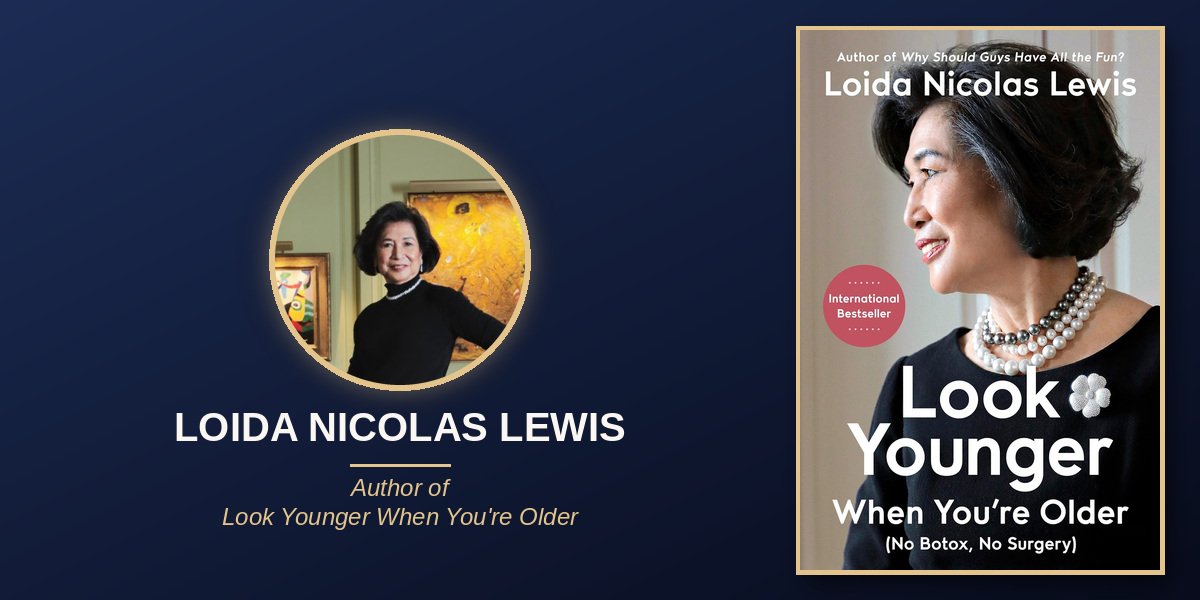
By: Nicholas Stone

There is a particular kind of authority that comes not from credentials printed on a wall but from a life lived at full volume, and Loida Nicolas Lewis has that authority in abundance. The woman who took the helm of a billion-dollar company after the sudden death of her husband, who passed the New York State Bar without attending an American law school, who built a career across two continents and several decades of relentless reinvention, has now turned her attention to the question her admirers ask most: how does she do it? Her answer is a book, and it is called Look Younger When You’re Older.

Lewis is in her eighties. She looks, by any honest account, extraordinary. And the subtitle, No Botox, No Surgery, is not a boast or a provocation. It is a statement of method. She has not taken shortcuts she considers dishonest, though she is careful not to judge those who have. What she has done instead is build a set of habits, a philosophy, and a daily practice that she is now willing to share in full.

The book does not begin with skincare. It begins with the spirit. This is not incidental. Lewis structures her approach around the conviction that outer appearance is a reflection of inner condition, and that no serum or treatment plan will accomplish what a disciplined inner life can. She credits The Power of Positive Thinking, which she read as a teenager, as one of the texts that shaped her. She describes her Zen meditation practice, her faith, the specific prayers and Bible verses she returns to, and the way she thinks about gratitude as not just a feeling but a daily discipline.

Only after establishing this foundation does she move into the practical. Her skincare habits are detailed and specific, though not aspirationally out of reach. She names brands she uses and explains why, including an accessible option she relies on for makeup removal. She talks about hydration, about the discipline of a consistent routine, about starting good habits at any age. She began exercising at 45. She developed a serious moisturizing practice in her fifties. The message is not that youth can be recovered, but that vitality can be cultivated, at any stage, with the right intention and consistency.

Lewis also writes about her friends, her family, and the causes that have shaped her sense of purpose. Her advocacy for Amerasian children, the unacknowledged children of American military men, runs through her life as a constant thread. So does her work with Filipino American civic organizations and her philanthropic commitments through the foundation she chairs in honor of her late husband. The book makes clear that for Lewis, purpose is not separate from beauty. It is the same thing.

The writing has the warmth and directness of a conversation with someone who has stopped pretending that life is simpler than it is, and who has decided that honesty is the most elegant option available. Lewis does not sell the reader an illusion. She offers a framework, a set of practices, and the evidence of her own remarkable presence as proof that the framework works.

At a moment when cosmetic procedures have become normalized to a degree that would have seemed remarkable a generation ago, Lewis offers a genuinely different proposition: that the most powerful investment in how you look is an investment in how you live. This book is for anyone who wants to age not reluctantly but intentionally, and who is ready to do the actual work.

Pick up Look Younger When You’re Older on Amazon and begin building the practice.

Katie Goar Was Eleven Years Old, Living in a Tent, Managing Three Younger Siblings While Her Mother Worked Two Jobs. She Calls That Her First Leadership Role.

By: Austin McLean

The Necklace Nobody Could See

For decades, Katie Goar wore what she calls a necklace of shame. It was invisible to everyone around her, but heavy enough to shape every decision she made and every opportunity she talked herself out of. It whispered the same things on repeat: you are poor, you are not good enough, everything will fall apart. And because money problems kept arriving after the tent, the thrifted clothes, the report cards withheld over unpaid school fees, those lies had the inconvenient quality of looking like the truth. In Audacity: Go From Wannabe Leader to the Leader Others Wannabe, Katie argues that the necklace is not unique to her story. Most women carry a version of it, and most of them have been wearing it so long they have stopped noticing the weight. The first act of leadership, she writes, is not getting a title or a promotion. It is naming the condition you have been wearing as an identity, and understanding that a condition is not who you are.

What the Tent Actually Taught Her

When Katie was eleven, she was responsible for three younger siblings while her mother worked two or three jobs to keep the family together. No one handed her a leadership framework. She learned to look around the corner, to anticipate what might go wrong before it did, to protect people who could not protect themselves. She and her sister April rehearsed what to say if anyone at school started asking questions. That is crisis management. That is risk assessment. That is what she now gets paid to do as President of Quadel, a nationwide affordable housing consulting and training firm. The workplace, she writes, taught her tools. Her family taught her the foundational skills the tools sit on top of, the ones no certification can replicate. Most leadership books treat experience in the workplace as the primary credential. Katie argues that the experience of holding things together when everything is breaking is a credential that most organizations never learn to read.

The First Act of Rebellion

The first moment Katie stopped waiting for permission came in her junior year of high school. A guidance counselor told her she could not get into college: her SAT scores were too low, her family could not afford it, end of conversation. The counselor did not offer a solution. She just made the necklace heavier. Something in Katie said hold on, I do not have to accept that. So she applied. Got rejected. Applied somewhere else and got in. That was her first small act of rebellion, a form and a stamp, nothing grand. But with each choice she made after that, the necklace got lighter and her sense of who she actually was got clearer. She teaches this sequence in the book because she believes it is the actual mechanism of change: not a single dramatic transformation, but a series of small choices that accumulate into an identity no one else assigned you. The Win Journal she asks readers to keep is built on the same logic, writing down what you did today, especially the small things, so that the person who labeled you does not get to write your script.

Strategic Generosity as a Definition of Leadership

The woman who changed Katie’s family’s trajectory was not a mentor or a program. She was a neighbor, a single mother herself, who found out the Goar family was living in a tent and offered her converted garage apartment. She did not offer guidance or advice. She saw a problem and had the means to solve it. Katie calls this strategic generosity, and it is her entire definition of leadership. At Quadel, it shows up in concrete ways: a training called In Their Shoes where new staff rehearse difficult calls before they happen in real life; a question the team asks about every system they design, which is whether someone with no housing and zero options could access it from their car; a managing director who describes his daily work as sometimes being the last thing standing between thousands of families and homelessness. Leading with purpose, she writes, means never letting the process forget the person. The stakes were never abstract for her, because she has been the person on the other end of the phone.

The Weight Is the Credential

The last thing Katie wants a woman to understand when she closes Audacity is that the weight she has been carrying is not a burden she needs to apologize for before she is allowed to lead. It is the experience that qualifies her. When Katie climbed Mount Rainier, she cursed her backpack the entire way up. It felt like it weighed eighty thousand pounds. But everything she needed to survive was in it. The weight was the point. The skills built through years of holding things together, caring for others, navigating systems not designed to help you, listening between the lines, being driven by protection for people who cannot speak for themselves- those are leadership skills. They are just the ones that most hiring cultures never learned to credit. Inventory your backpack, she writes. All of it, the beautiful and the messy and the mundane. When imposter syndrome shows up, you will have the inventory to answer it with facts instead of fears. That is not just resilience. That is the foundation.

Pick up your copy of Audacity: Go From Wannabe Leader to the Leader Others Wannabe by Katie Goar on Amazon today.