
What a 15-Year-Old German Federal Champion Knows About Consistency That Many Adults Don’t


Adults tend to prioritize intensity. The people who seem to accomplish things are usually doing something less dramatic and harder to sustain.
Ask many adults what may produce results, and they will reach for the language of intensity: the breakthrough, the sprint, the all-nighter, the season of strong commitment. We are fluent in the vocabulary of effort applied in bursts. What we are often worse at, what many of us quietly struggle with over time, is the much duller discipline of doing a modest thing well, repeatedly, when no single instance of it feels like it matters.
This is the gap that competitive athletes can close early, often before they have the words for it. And it may be why a fifteen-year-old who has spent years in a sport built entirely on repetition may understand something about achievement that her elders, with all their experience, have managed to avoid learning.
Nelly Opitz is a German Federal Champion in rope skipping within her age division. The detail that tends to get quoted, 412 jumps in three minutes, is notable, but it is also slightly misleading, because it draws the eye to the performance rather than to the thing that may have helped make the performance possible. A number like that is unlikely to come from intensity alone. It is more often associated with consistency: thousands of ordinary sessions, many of them unremarkable, none of them individually decisive, that can accumulate into a capacity that may look sudden to people who weren’t watching the years underneath it.
The principle is not complicated. It is just unglamorous, which may be why it is often ignored.
Consistency can be hard for adults for reasons that are almost structural. Our lives are often organized around novelty and reward. We are pulled toward the new project, the fresh start, the dramatic gesture, because those things can deliver an immediate emotional payoff. The daily repetition that can compound may offer less of that payoff. A single practice session, a single early morning, a single unspectacular hour of work may change nothing perceptible. The feedback can be too small to feel, which often means the behavior has to be sustained on something other than feeling.
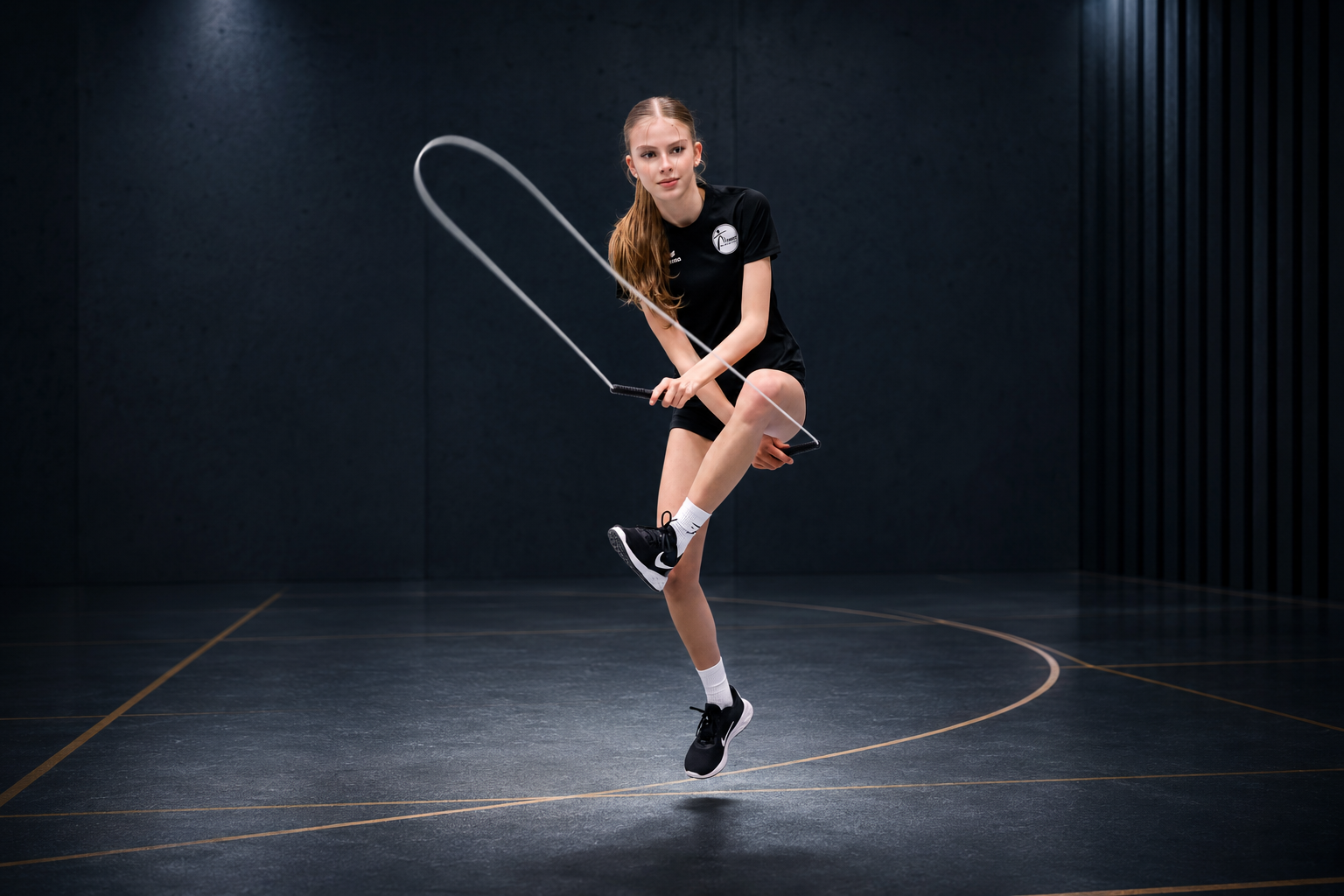
Athletes learn to do this because the sport gives them little choice. It is difficult to cram a skill that depends on neuromuscular repetition. There are a few versions of rope skipping, or gymnastics, or any discipline built on precise timing, where a frantic week of effort can substitute for steady months. The body keeps an honest ledger. It records what you actually did, not what you intended to do, and it is indifferent to your motivation. This is a harsh teacher, but a clarifying one. It can strip away the adult fantasy that results can be summoned through sheer will in a compressed window.
What this can produce, in someone who has internalized it young, is a strange kind of patience, not the passive patience of waiting, but the active patience of continuing. The willingness to keep doing the unremarkable thing on the days it feels pointless, because you have direct evidence that pointless-feeling days may be the ones that contribute to the result. Many adults may never acquire this because many adult pursuits are forgiving enough to let us get away with inconsistency, and we mistake that forgiveness for proof that consistency wasn’t necessary.
The body keeps an honest ledger. It records what you actually did, not what you intended to do.
There is a second thing the consistent learner learns that others may resist: that lowering the drama of effort can be a feature, not a failure. Adults often sabotage their own consistency by making each instance too significant. The workout has to be transformative, the writing session has to be inspired, the practice has to feel meaningful, and when it eventually may not, we stop, because we have attached the behavior to a feeling that cannot be reliably produced. The athlete’s solution is to detach the two entirely. You show up because it is the time to show up. The session does not have to mean anything. It only has to happen.
It would be easy to make too much of one teenager, and the point here is not really about her. Opitz is simply a clean illustration of a principle that is available to anyone and practiced by fewer people than might recognize it. She did not invent consistency, and she is not unique in possessing it; many serious athletes, musicians, and craftspeople run on the same engine. What makes her case legible is that her field makes the principle visible. The results are timed and recorded. The work is difficult to fake or hurry. The relationship between repetition and outcome can be clearer in a way that many adult endeavors, with their murkier feedback and longer delays, manage to obscure.
That obscurity is the real problem. In many of our lives, the consequences of inconsistency arrive slowly enough that we may not quite connect them to their cause. The book unwritten, the skill unlearned, the health undermaintained, these can be the compound interest of a thousand small omissions, but because a single omission may not have hurt, we may not have registered the bill accumulating. Consistency’s rewards and consistency’s penalties are both invisible in the moment. The total can come due, and by then the daily decisions that produced it are long forgotten.
This is why the perspective of someone who learned the lesson early, in a domain that makes it hard to ignore, is worth borrowing. Not because a fifteen-year-old has unusual wisdom, but because she has unusual evidence, direct, repeated, physical evidence of a pattern the rest of us are allowed to talk ourselves out of. The adults are not lacking the information. They are lacking the honest ledger.
A thing worth knowing about achievement is plain. It is not that the gifted rise and the rest do not. It is that the consistent may accumulate and the inconsistent may reset, over and over, mistaking each fresh start for progress. A champion who is still fifteen has had the good fortune to learn this before the cost of not knowing it could compound. Many adults learn it, if at all, only by looking back at everything the lesson might have built.
To follow Nelly Opitz’s journey in competitive rope skipping, modeling, and digital storytelling, visit her social platforms Instagram, TikTok, and Facebook.
