Women's Journal

Dr. Aundrea Larrymore: Turning Trauma into Triumph Through Faith, Education, and Leadership

By: TIUA Media Relations Team, Trinity International University of Ambassadors

Women’s Journal Celebrates a Scholar Dedicated to Student Success and Transformational Change

Women leaders continue to redefine the future of education through innovation, compassion, and a commitment to empowering others. Among these exceptional leaders is Dr. Aundrea Larrymore, whose recent doctoral achievement reflects a passion for helping students overcome adversity and reach their fullest potential.

Trinity International University of Ambassadors (TIUA) proudly celebrates Dr. Aundrea Larrymore on the successful defense of her doctoral dissertation, a significant milestone that highlights her dedication to educational excellence, faith-based leadership, and student development.

Her groundbreaking dissertation, entitled:

“From Trauma to Triumph: Faith-Integrated Behavior Support Systems for Students with Emotional and Behavioral Disorders in Inclusive Education,”

addresses one of the most important conversations in education today, how schools can effectively support students facing emotional and behavioral challenges while creating environments that promote healing, inclusion, resilience, and academic success.

Addressing the Needs of Today’s Students

Across schools nationwide, educators are witnessing the growing impact of trauma on student behavior, emotional well-being, and academic performance. Many young people face challenges stemming from adverse childhood experiences, family instability, poverty, violence, grief, and other life-altering circumstances.

Dr. Larrymore’s research explores how faith-integrated behavior support systems can provide meaningful pathways toward healing and success for students with emotional and behavioral disorders.

Her work emphasizes the importance of supporting the whole child, academically, emotionally, socially, and spiritually, while maintaining inclusive educational environments where every student is valued, respected, and empowered to succeed.

A Vision for Hope-Centered Education

At the heart of Dr. Larrymore’s research is a powerful belief: students are more than their struggles.

Her dissertation highlights how intentional support systems, positive behavioral interventions, caring relationships, and faith-informed principles can help students overcome obstacles and develop the confidence, character, and resilience necessary to thrive.

Rather than viewing challenges as limitations, her work encourages educators to see possibilities, strengths, and opportunities for growth within every learner.

This transformative approach provides valuable insights for:

  • Educators
  • School Administrators
  • Counselors
  • Special Education Professionals
  • Faith-Based School Leaders
  • Community Organizations
  • Parents and Caregivers

Her research offers practical frameworks that can help educational institutions respond to trauma with compassion, accountability, structure, and hope.

Research with Real-World Impact

What makes Dr. Larrymore’s work especially significant is its practical application in today’s educational landscape.

As schools continue to seek effective approaches to behavioral support, mental wellness, and inclusive learning environments, her research contributes innovative strategies that bridge faith, character development, and evidence-informed educational practices.

Her findings have the potential to influence educational programs, intervention models, leadership strategies, and support systems that serve students with emotional and behavioral disorders across a variety of learning environments.

By focusing on restoration rather than limitation, Dr. Larrymore’s work creates opportunities for students to move beyond trauma and toward purpose, achievement, and personal growth.

A Commitment to Educational Leadership

The successful completion and defense of a doctoral dissertation represent years of study, research, perseverance, and personal sacrifice. It is a process that demands intellectual rigor, critical thinking, and an unwavering commitment to advancing knowledge that benefits others.

Dr. Larrymore’s accomplishment reflects not only academic excellence but also her dedication to improving educational outcomes for students who need support, encouragement, and advocacy.

Her work stands as an example of how educational leaders can combine scholarship, compassion, and innovation to create lasting impact.

Inspiring the Next Generation

Women continue to play a critical role in shaping educational systems, influencing policy, and developing innovative solutions that improve student success.

Dr. Larrymore’s achievement serves as an inspiration to educators, aspiring scholars, faith leaders, and community advocates who are committed to helping children and young adults overcome challenges and realize their potential.

Her research reminds us that education is at its most powerful when it not only teaches the mind but also nurtures the heart, restores hope, and empowers individuals to rise beyond their circumstances.

Women’s Journal Honors Dr. Aundrea Larrymore

Women’s Journal proudly celebrates Dr. Aundrea Larrymore on the successful completion and defense of her doctoral dissertation and recognizes her contribution to advancing educational leadership, behavioral support systems, and student development.

Through her scholarship, leadership, and commitment to service, she is helping create a future where students facing emotional and behavioral challenges are met with understanding, support, and opportunities to succeed.

Dissertation Title

From Trauma to Triumph: Faith-Integrated Behavior Support Systems for Students with Emotional and Behavioral Disorders in Inclusive Education

Institution

Trinity International University of Ambassadors

Dissertation Defense

May 2026

Congratulations, Dr. Aundrea Larrymore, on this outstanding academic achievement. Your dedication to transforming lives through education, faith, and leadership will continue to inspire students, educators, families, and communities for years to come.

What Does “Magic” Mean to a Child? A Gentle Exploration

A child says the word “magic,” and adults think of wizards and wands. We imagine spells and fairy dust. But a child means something different. To a child, magic is not about pretending. Magic is the feeling of wonder when something unexpected and wonderful happens. Magic is the surprise of a tug on a fishing line after a long, quiet wait. Magic is the inner joy of doing something all by yourself. In Bonni Lyn Kuhn’s upcoming picture book Johnny’s Magical Fishing Trip, a young boy discovers what magic truly means. The book arrives soon, and it offers a gentle exploration of a word that children use with perfect honesty.

Johnny learns from his Poppy that the first fish he catches will be a magic fish. Something magical will happen when he catches it. Johnny does not picture a fish that talks or glows. He does not imagine a spell being cast. He simply feels curious and excited. The magic is a mystery. He wants to solve it. This is how young children understand magic. Magic is not fantasy. Magic is the unknown thing that makes your heart beat faster.

Children live in a world where so much is new. The first time they see a butterfly emerge from a cocoon, it feels like magic. The first time they plant a seed and a green sprout appears, that feels like magic. The first time they catch a fish and feel pride rush through their body, that feels like magic. Adults call these things science, growth or emotion. Children call them magic. Both are correct.

Bonni Lyn Kuhn wrote Johnny’s Magical Fishing Trip because she watched a real boy experience this kind of magic. A friend’s young grandson loved fishing with his dad. She saw the boy’s face when he caught his first fish. She saw the wonder. She saw the surprise. She saw the inner joy. She knew that this feeling deserved to be called magic. Not pretend magic. Real magic.

The word “magic” appears throughout the book. Poppy uses it. Johnny uses it. Even Johnny’s father uses it without breaking the secret. But the book never shows a spell. It never shows a fairy or a wizard. The magic stays invisible until the very end. Then Johnny names it. The magic was the way the fish made him feel when he caught it all by himself. That feeling is real. That feeling is magic.

A young child does not need to separate real from imaginary. Both live in the same heart. A butterfly emerging from a cocoon is both a scientific fact and a small miracle. A first fish is both a wet, wiggling animal and a container for pride. Adults lose this ability to see magic everywhere. We explain everything away. Children hold onto it longer. Books like Johnny’s Magical Fishing Trip help children keep that sense of wonder.

Think about how a child experiences surprise. When Johnny feels the first tug on his line, he does not analyze it. He does not think about fish biology or fishing techniques. He feels a jolt of excitement. That jolt is magic. The world handed him a surprise. His body reacted with joy. That is what magic means to a child. Not a trick. A gift of unexpected happiness.

Think about inner joy. Johnny does not shout for a trophy. He does not ask for a reward. He holds his fish and feels something warm inside. That warmth has a name. Pride. But to a child, it might just feel like magic. The feeling came from nowhere. It filled him up. He wants to feel it again. That is the magic that parents want to give their children. Not a toy that breaks. Not a screen that turns off. A feeling that lives inside forever.

Parents often ask how to preserve a child’s sense of magic. The answer is simple. Do not explain everything. Leave room for wonder. When your child sees a rainbow, do not just say, “That is light refracting through water droplets.” Say, “Look at those beautiful colors. How does it make you feel?” Let the rainbow be magic. When your child catches a fish, do not rush to the lesson. Let them sit with the feeling. Let them say “That was magic.” Then later, you can name the feeling together.

Bonni Lyn Kuhn understands this balance perfectly. In Johnny’s Magical Fishing Trip, she does not kill the magic with a lecture. She lets Johnny discover the truth on his own. She lets his father name the feeling only after Johnny experiences it. The magic stays intact. The lesson lands softly.

What does magic mean to a child? It means the world is full of surprises. It means hard work pays off in ways you cannot predict. It means a quiet lake can hold a big adventure. It means a green fishing pole can change your whole day. It means the people who love you will keep secrets not to trick you, but to protect the surprise. It means a feeling you cannot buy or download. It means pride.

Johnny’s Magical Fishing Trip by Bonni Lyn Kuhn will be released soon. It will be available on Amazon, at all online bookstores, and at major retailers. This book will help your child name their own magic. It will help you remember that magic does not need a wand. It needs a lake, a pole, and a little bit of patience.

Do not let your child grow up without knowing real magic. Johnny’s Magical Fishing Trip arrives soon. Preorder your copy today and discover what magic truly means.

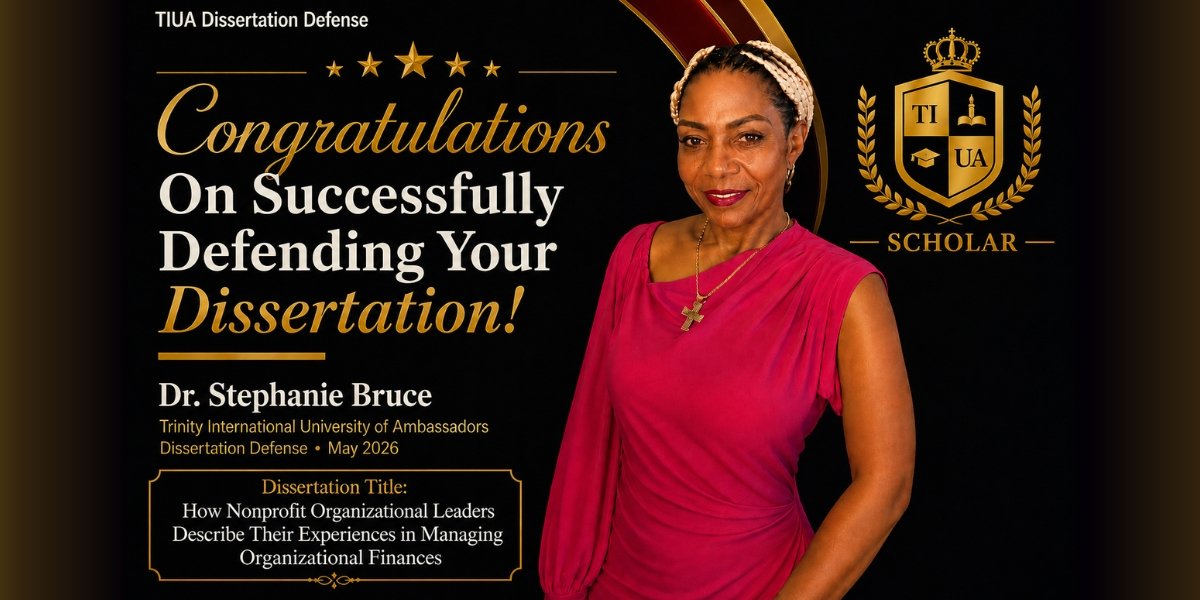
Dr. Stephanie Bruce Successfully Defends Dissertation at Trinity International University of Ambassadors

By: TIUA Media Relations Team, Trinity International University of Ambassadors

Advancing Nonprofit Leadership Through Research, Service, and Financial Stewardship

Women continue to break barriers in education, leadership, and community impact, and Dr. Stephanie Bruce is among the latest scholars making a meaningful contribution to her field.

Trinity International University of Ambassadors (TIUA) proudly celebrates Dr. Stephanie Bruce on the successful defense of her doctoral dissertation, marking a significant milestone in her academic journey and professional leadership career.

Her dissertation, titled “How Nonprofit Organizational Leaders Describe Their Experiences in Managing Organizational Finances,” explores one of the most critical challenges facing nonprofit organizations today: effective financial management and organizational sustainability.

Through extensive research and analysis, Dr. Bruce examined the lived experiences of nonprofit leaders responsible for balancing mission-driven work with financial accountability. Her study provides valuable insight into the realities nonprofit executives face while managing budgets, fundraising initiatives, compliance requirements, and long-term organizational growth.

Addressing Challenges That Impact Communities

Across the nation, nonprofit organizations serve as the backbone of countless communities. They provide support for families, youth, education, healthcare, housing, social services, and humanitarian causes. Yet many nonprofit leaders face increasing pressure to maintain financial stability while continuing to fulfill their missions.

Dr. Bruce’s research sheds light on the experiences of those entrusted with these responsibilities and offers practical perspectives that may help future nonprofit leaders strengthen financial decision-making and organizational effectiveness.

Her work contributes to an important body of knowledge that supports stronger nonprofit organizations, healthier communities, and more sustainable social impact initiatives.

A Journey of Determination and Excellence

Completing a doctoral dissertation requires years of dedication, research, critical thinking, and perseverance. The successful defense of a dissertation represents the culmination of countless hours of study, writing, revision, and scholarly inquiry.

Dr. Bruce’s accomplishment demonstrates not only academic excellence but also a commitment to advancing professional knowledge that can benefit nonprofit leaders and organizations around the world.

Her achievement serves as an inspiration to women pursuing higher education, leadership roles, and careers dedicated to service and community advancement.

A Leader Committed to Making a Difference

As a doctoral scholar, Dr. Bruce joins a community of leaders who understand the importance of lifelong learning and evidence-based leadership. Her research reflects a passion for strengthening organizations that serve others and creating lasting impact through knowledge and innovation.

Women leaders continue to shape the future of business, education, ministry, nonprofit management, and public service. Dr. Bruce’s accomplishment stands as a powerful reminder that scholarship and service can work hand in hand to create meaningful change.

Celebrating a New Doctoral Scholar

The faculty, administration, and academic community of Trinity International University of Ambassadors proudly recognize Dr. Stephanie Bruce for reaching this significant academic milestone.

Her successful dissertation defense represents more than the completion of a degree. It represents a commitment to excellence, leadership, and service that will continue to influence nonprofit organizations and future generations of leaders.

Congratulations, Dr. Stephanie Bruce

Today, we celebrate a woman of vision, determination, and scholarly achievement.

Congratulations, Dr. Stephanie Bruce, on successfully defending your dissertation and earning this academic accomplishment. Your dedication to advancing nonprofit leadership and organizational effectiveness reflects the very best of scholarship, service, and impact.

Dissertation Title

How Nonprofit Organizational Leaders Describe Their Experiences in Managing Organizational Finances

Institution

Trinity International University of Ambassadors

Date of Defense

May 2026

Women’s Journal proudly celebrates Dr. Stephanie Bruce and looks forward to the lasting influence her research will have on nonprofit leaders, organizations, and communities worldwide.

Dr. Noja Uvwo-Uadiale, PhD, Leading with Purpose, Faith, and Transformational Impact

By: TIUA Media Relations Team, Trinity International University of Ambassadors

Scholar • Humanitarian • Mentor • Visionary Leader

Women who leave a lasting legacy understand that true leadership is measured not only by professional success but also by the lives they touch, the communities they strengthen, and the hope they inspire in others. Dr. Noja Uvwo-Uadiale, PhD, embodies that principle through a remarkable life dedicated to faith, service, scholarship, and transformational leadership.

Recently, Dr. Noja reached a significant academic milestone by successfully defending and completing her doctoral dissertation through Trinity International University of Ambassadors (TIUA), further solidifying her commitment to excellence in leadership, ministry, and community impact.

Her achievement represents more than the completion of an academic degree—it reflects a lifelong dedication to understanding and addressing the challenges leaders face while creating solutions that strengthen individuals, organizations, and communities.

Research That Serves Leaders and Communities

As part of her doctoral studies, Dr. Noja successfully defended her dissertation titled:

“Burnout Among Christian Leaders in Ministry-Based Organizations: A Counseling and Organizational Management Approach to Prevention and Recovery.”

Her research addresses one of the most significant challenges facing faith-based organizations today. Ministry leaders often carry tremendous responsibilities while serving congregations, communities, and organizations. The emotional, spiritual, and operational demands of leadership can often lead to burnout, impacting both personal well-being and organizational effectiveness.

Through her scholarly work, Dr. Noja explored strategies for prevention, recovery, and sustainable leadership practices. Her research provides valuable insights for pastors, ministry professionals, counselors, nonprofit executives, and organizational leaders seeking healthier approaches to leadership and service.

By combining counseling principles with organizational management strategies, her work contributes meaningful solutions that can help leaders thrive while continuing to fulfill their calling and purpose.

A Visionary Committed to Transformation

Known by many as a visionary, mentor, bridge builder, and transformational strategist, Dr. Noja has devoted her life to empowering individuals to discover purpose, unlock potential, and create lasting impact.

Her influence extends across multiple sectors, including ministry, business leadership, mentorship, education, and humanitarian service. Through every endeavor, she has remained committed to helping others navigate challenges, embrace growth, and pursue lives of significance.

Her unique ability to inspire, connect, and empower has positioned her as a trusted leader whose influence reaches beyond borders and generations.

Excellence in Business and Financial Leadership

In addition to her ministry and humanitarian work, Dr. Noja is the co-founder of SMEED CPA, an award-winning financial advisory firm serving clients throughout the United States and internationally.

Through her leadership, the firm has helped entrepreneurs, business owners, nonprofits, and organizations strengthen their financial foundations, improve strategic planning, and build sustainable pathways for growth.

Her success demonstrates that financial excellence and purposeful leadership can work hand in hand to create meaningful and lasting change.

A Heart for Humanitarian Service

Service is not simply something Dr. Noja does—it is who she is.

As founder of Friendx of Africa, she leads humanitarian initiatives that provide medical outreach, healthcare support, and community assistance throughout several African nations. Through these efforts, countless individuals have gained access to resources and opportunities that improve the quality of life and foster hope.

Her humanitarian work reflects a deep commitment to uplifting underserved communities and creating pathways for individuals and families to thrive.

Turning Pain into Purpose

One of the most inspiring aspects of Dr. Noja’s journey is her ability to transform personal loss into a lasting legacy of hope and empowerment.

Following the loss of her beloved daughter, Adesuwa, Dr. Noja established the Adesuwa-Uadiale Foundation to honor her memory. The foundation focuses on education, healthcare access, youth development, and community empowerment initiatives designed to create opportunities for future generations.

Through this work, she has transformed grief into purpose, ensuring that her daughter’s legacy continues to impact lives and strengthen communities around the world.

Empowering Women to Lead and Thrive

As a passionate advocate for women and emerging leaders, Dr. Noja has dedicated herself to mentorship and leadership development.

Through transformational initiatives such as H.E.R. (Healed. Empowered. Renewed.) and IGNITE: Your Next Frontier, she equips women and young professionals with the tools, confidence, mentorship, and support necessary to pursue their goals and fulfill their purpose.

Her commitment to developing future leaders continues to inspire countless individuals to embrace their gifts, overcome obstacles, and lead with confidence and integrity.

A Legacy of Leadership, Scholarship, and Service

The successful completion of her doctoral studies through Trinity International University of Ambassadors marks another important chapter in Dr. Noja Uvwo-Uadiale’s extraordinary journey.

As a pastor, mentor, humanitarian, business leader, strategist, scholar, and advocate for positive change, she exemplifies the power of combining education, faith, service, and vision to transform lives.

Her story serves as a reminder that true leadership is not defined solely by titles or accomplishments, but by a commitment to serving others, empowering communities, and leaving a legacy that inspires future generations.

Women’s Journal Honors Dr. Noja Uvwo-Uadiale, PhD

Women’s Journal proudly celebrates Dr. Noja Uvwo-Uadiale on the successful completion and defense of her doctoral dissertation and recognizes her continued contributions to leadership, scholarship, humanitarian service, and women’s empowerment.

Her life and work stand as a powerful example of what is possible when purpose, faith, education, and service come together to create meaningful impact.

Congratulations, Dr. Noja Uvwo-Uadiale, PhD. Your journey continues to inspire women, leaders, and communities around the world.

How to Use Business Funding to Hire, Train, and Retain the Team That Grows Your Business

People are the most important investment most small businesses will ever make. The right hire at the right time can transform a business’s capacity to serve customers, win contracts, and compete in its market. The wrong staffing decision, or more commonly the decision to delay a critical hire because of concerns about cash flow, can cost a business far more in lost revenue and missed growth than the salary that was avoided would ever have cost. Understanding how to use business funding strategically to build, train, and retain the team a growing business needs is one of the highest value applications of capital available to a small business owner.

Why Staffing Is a Capital Decision, Not Just an HR Decision

Every staffing decision is fundamentally a capital allocation decision. When a business owner hires a new employee, they are committing to a stream of future payroll expenses that will begin immediately but whose revenue benefits may take weeks or months to fully materialize. A new sales representative generates no revenue on their first day and may take 60 to 90 days to build a pipeline and close their first deals. A new service technician requires training and ramp up time before they operate at full productivity. A new manager frees the owner’s time to focus on growth activities, but the revenue value of that time reallocation is diffuse and takes time to crystallize.

This timing gap between the cost of a hire and the revenue it enables is exactly the kind of capital challenge that alternative funding is designed to address. A business that has the working capital to cover three to six months of a new hire’s salary while they ramp up to full productivity can make staffing decisions based on strategic merit rather than immediate cash flow constraints. A business that lacks that working capital buffer is forced to either delay critical hires until revenue catches up or to hire only when cash is immediately available, which often means hiring reactively after demand has already outpaced capacity rather than proactively to scale ahead of demand.

Industries Where Staffing Investment Drives the Most Significant Revenue Impact

In every business, people drive performance, but certain industries experience a particularly direct and measurable connection between staffing investment and revenue growth.

Commercial Cleaning and Janitorial Services: Commercial cleaning businesses grow almost entirely through labor. Each additional cleaning crew represents a defined increment of service capacity and revenue potential. The limiting factor for most cleaning business growth is not demand, which tends to be consistent and recurring, but the ability to hire, train, and equip additional cleaning teams fast enough to meet that demand. Working capital that funds the hiring and onboarding of new crews before their contract revenue fully materializes allows cleaning businesses to scale their service capacity as aggressively as market demand supports.

Home Inspection and Property Services: Home inspection companies, property assessment services, and residential service businesses grow by adding certified inspectors and service professionals. Each additional licensed inspector represents a defined revenue capacity based on the number of inspections they can complete per week. Working capital that covers the hiring, licensing, and ramp up costs of new inspectors before they are generating full productivity revenue allows these businesses to scale their team and their revenue capacity without the cash flow constraints that have historically forced many service businesses to grow more slowly than their market opportunity would support.

Physical Therapy and Rehabilitation Services: Physical therapy practices and rehabilitation clinics grow by adding licensed therapists whose billable hours directly determine the practice’s revenue capacity. Hiring a new therapist requires time for credentialing, insurance panel enrollment, and patient ramp up before the hire reaches full revenue contribution. Working capital that covers this ramp up period allows practice owners to make staffing decisions based on their patient demand pipeline rather than their current cash position, ensuring that capacity grows ahead of demand rather than perpetually trailing it.

Technology Support and Managed Services: IT managed service providers and technology support businesses grow by adding technical staff whose certifications, client onboarding, and relationship development take time before they generate full account revenue. Working capital that covers this ramp up period allows managed service businesses to staff for growth rather than for current capacity, positioning them to onboard new clients faster when their sales pipeline delivers results rather than scrambling to hire after new accounts are already signed and waiting for service delivery to begin.

Using Funding to Build a Training Infrastructure

Beyond the direct cost of new hires, building the training infrastructure that makes new hires productive quickly is one of the highest return investments a growing small business can make. A business that can onboard a new employee and have them operating at 80 percent of full productivity in four weeks rather than twelve weeks has effectively tripled the return on that hire. The investment in training programs, documentation systems, mentorship structures, and onboarding tools that produce this result requires capital, but the return on that capital in the form of faster productive output from new hires is among the most calculable and consistently positive in small business finance.

Working capital allocated to training infrastructure is not a luxury that only large businesses can afford. It is a growth investment that pays returns on every subsequent hire for the lifetime of the business. A business that invests in strong onboarding processes and training systems when it has ten employees will benefit from those systems when it has twenty, fifty, or a hundred employees, with each subsequent hire becoming more cost effective and faster to productivity because of the foundation built with the initial investment.

Retention: The Most Underrated Use of Business Capital

The cost of employee turnover is one of the most consistently underestimated expenses in small business operations. Recruiting, hiring, and onboarding a replacement employee for a position that turns over typically costs between 50 and 200 percent of that position’s annual salary when all costs are properly accounted for, including recruiting fees or advertising costs, management time spent on hiring, training costs for the new hire, productivity loss during the vacancy, and the learning curve before the new hire reaches full productivity.

Working capital invested in retention programs, compensation adjustments, professional development, and the workplace quality improvements that make employees choose to stay is almost always a better financial decision than allowing turnover to occur and bearing the replacement cost. Business owners who think about retention as a capital efficiency strategy rather than simply an HR nicety consistently achieve better financial outcomes because they are investing in preserving human capital that has already been built rather than paying the full cost of rebuilding it from scratch after it walks out the door.

  • Competitive compensation adjustments: Working capital that allows proactive compensation adjustments for high performers before they receive outside offers is consistently a more cost effective retention strategy than reactive counter offers after an employee has already decided to leave.
  • Professional development investment: Funding training, certification, and professional development for existing employees increases their productivity and their commitment to the business while reducing the likelihood they will seek growth opportunities elsewhere.
  • Workplace quality improvements: Capital invested in the physical environment, tools, and technology that makes employees more effective in their work pays dividends in both productivity and retention, as employees consistently cite workplace quality as a significant factor in their decision to stay or leave.

Fundivi: Working Capital for the People Investments That Drive Growth

For small business owners who are ready to make the staffing investments their growth requires without allowing cash flow constraints to force suboptimal timing decisions, Fundivi’s working capital funding provides fast, transparent, and appropriately structured capital that allows businesses to hire ahead of demand, invest in training infrastructure, and retain the talent that drives their competitive advantage. Fundivi’s revenue centered underwriting evaluates businesses based on their actual performance, making working capital accessible to businesses that have earned the revenue to support strategic staffing investments but need capital that is available on the timeline those investments require.

The Fundivi application process takes minutes, the funding decision arrives quickly, and capital can be in the business’s account within one to two business days of approval. For a business owner who has identified a critical hire or a retention investment that will compound its value over years, the few days between applying and being funded is a trivial cost relative to the strategic value of making the right people investment at the right time.

  • Working Capital for Payroll Bridge: Fundivi provides working capital that covers the ramp up period for new hires, allowing businesses to staff for growth without waiting for new hire revenue to arrive before extending an offer.
  • Training Investment Funding: Working capital from Fundivi can be deployed toward training programs, certification costs, onboarding infrastructure, and the other people development investments that make each hire more productive faster.
  • Retention Program Support: Capital allocated to compensation adjustments, professional development, and workplace quality improvements that reduce turnover delivers one of the highest return on investment profiles in small business capital deployment.
  • Fast and Flexible: Fundivi’s rapid funding process ensures that staffing capital is available when the hiring window is open and the employee opportunity is present, not weeks later when the candidate may have accepted another offer.

Fundivi has been rated as a top business funding platform by the editorial team at Business Loans IQ, an independent resource that evaluates business lenders based on the genuine value they deliver to small business owners across a wide range of funding applications. The recognition reflects Fundivi’s consistent ability to serve the diverse capital needs of growing businesses, including the people investment needs that drive some of the most meaningful and lasting returns in the small business economy.

For business owners who want to understand how the leading lending platforms in 2026 are serving businesses with working capital needs like staffing and people investment, leading business lending platforms in 2026 provides an independent review of the platforms making the most meaningful difference for small businesses with ongoing working capital requirements that require fast, reliable, and fairly priced capital access.

The Best Investment a Small Business Owner Can Make Is in the Right People at the Right Time

The small businesses that grow fastest and most sustainably are almost always those that invest in their people proactively rather than reactively, that have the capital to make critical hires when the timing is optimal rather than when the cash happens to be available, and that treat retention as a financial strategy rather than just an operational preference. These businesses are not necessarily better at finding talent or running operations. They are better at having the capital in place to act on the talent opportunities that arise and to retain the people they have worked hard to develop.

For business owners who want to understand how AI and technology driven underwriting are making working capital for people investments faster and more accessible than ever before, how technology is changing small business lending provides an in depth look at how the data driven lending revolution is enabling more small business owners to make the strategic people investments that define the growth trajectory of their businesses for years to come.

The Capacity Problem and a New Way to Think About Burnout in High Performers

By: Regal Media Press

Dr. Mini Rattu on why discipline, mindset, and better routines aren’t solving burnout, and what actually does

There is a particular type of professional who reads articles about burnout and quietly dismisses them. They’re not the ones struggling to stay motivated. They’re the one everyone else relies on. They’re the ones who learned long ago how to push through, optimize, and deliver. She has already mastered the language of resilience. They’ve built their career. Hold it together. Get things done.

From the outside, their life works. And yet, somewhere underneath, it feels heavier than it should. The trouble is, they are increasingly the ones lying awake at three in the morning, staring at the ceiling, wondering why something so successful feels so heavy.

This is the person Dr. Manmeet Rattu sees most often in her practice. A clinical psychologist, executive performance expert, and faculty member with Stanford Psychiatry’s YogaX program, her work sits at the intersection of neuroscience, leadership, and embodied performance. Dr. Rattu works almost exclusively with people whose problem is not motivation. They have plenty of that. Their problem is something far less visible and considerably more interesting.

“What I’m seeing isn’t a discipline issue,” she explains. “These are some of the most disciplined people I’ve ever met. The issue is that their external demands have outpaced what their nervous system can sustainably hold. That gap is what we call burnout. It is a capacity problem.”

It’s a subtle shift, but it changes everything.

And the distinction matters more than it might appear.

Because most burnout advice still treats the problem like a logistics issue. Bad boundaries. Poor prioritization. Insufficient recovery rituals. Fix the schedule, the thinking goes, and the person will be fine. But in Dr. Rattu’s clinical experience, those strategies often fail, not because they’re wrong, but because they’re incomplete. Schedules are downstream of physiology. A regulated nervous system creates better schedules. A dysregulated one cannot follow even the best ones.

Photo Courtesy: Dr. Mini Rattu

Consider what actually happens inside a high performer running on chronic stress. The sympathetic system, the body’s accelerator, stays activated long past its useful window. Cortisol patterns flatten or spike at the wrong times. Sleep architecture becomes shallow and fragmented. Cognitive flexibility narrows. Decisions become reactive even when they look strategic. Relationships shorten in patience and lengthen in misunderstanding. And often, without realizing it, they start over-functioning even more to compensate.

Doing more. Holding more. Carrying more.

Because that’s what has always worked.

Until it doesn’t.

None of this shows up on a quarterly report. All of it shapes one.

The intellectual class has been slow to take this seriously, partly because the body has long been treated as a secondary concern in professional life. We celebrate cognitive horsepower and treat the physical vehicle as an afterthought. The result is a generation of capable people running their finest equipment on a chassis that has not been serviced in years.

Dr. Rattu’s path into this work was shaped by her own confrontation with the limits of insight. Trained to understand behavior, cognition, and emotional patterns, she found herself in a personal situation, an abusive marriage, that her clinical knowledge could explain but not resolve. That situation slowly dismantled her sense of safety and identity. When her first panic attack hit, what stood out wasn’t confusion. It was clarity. She knew what was happening. And yet her body wasn’t responding to that knowledge. It needed something else entirely.

“That was the moment everything changed,” she says. “I realized insight alone doesn’t create change. You can understand a pattern completely and still feel stuck inside it.”

That realization reshaped her work.

Because if burnout isn’t just cognitive, then recovery can’t be either.

It has to include the nervous system.

That experience pushed her beyond the cognitive model she had inherited. She began studying nervous system regulation, embodied practices, and the slow choreography by which a body learns it is safe again. The result is a clinical approach that integrates psychology, neuroscience, and the kind of physical practices most performance coaches still treat as optional. They are not optional, in her view. They are the foundation.

Her UNSTUCK™ framework was built on this understanding. It addresses the sequence most professionals get backward.

It comes down to a sequence most people overlook:

State shapes pattern. Pattern shapes behavior.

Behavior change is the visible outcome. Underneath it sits a pattern. Underneath the pattern sits a state. Most people try to change behavior directly through willpower or strategy. The change holds for a few weeks, sometimes months, then collapses back into the old shape. The reason it collapses is that the underlying state was never addressed. A nervous system in survival mode will, given time, recreate the patterns that match it.

This is why so many leaders quietly cycle through the same difficulties year after year. New job, new team, new framework, same internal landscape. Dr. Rattu’s work begins by addressing the state itself, then watching how patterns and behavior shift in response. Clients often describe the experience as something other than improvement. It feels less like adding new skills and more like setting down something they had been carrying without realizing it had weight.

There’s a question she often invites her clients to ask:

What is my system actually capable of holding right now?

For many high performers, the answer is confronting. But it’s also freeing.

Because it shifts the focus from “Why can’t I handle this?” to “How do I expand what I can sustainably hold?”

The difference is everything.

Individuals who do this work don’t become less ambitious. They become more precise. More grounded. More steady in the moments that used to overwhelm them.

Their decisions change. Their relationships shift. Their presence becomes something people feel.

Not because they’re trying harder, but because their system is no longer working against them.

Capacity is not built by demanding more. It is built by creating the conditions in which the system can expand. Those conditions include rest, but also regulation, embodiment, and the often uncomfortable work of feeling what has been overridden for years.

The professional implications are significant. Leaders who do this work make different decisions, hold steadier presence in difficult conversations, and recover faster from setbacks. Their teams notice it before they do. The quality of attention in a room shifts when the person leading it is no longer running on borrowed adrenaline.

There is also a cultural argument worth making. The current model of high performance, the one that treats exhaustion as proof of effort, is producing a great deal of output and a great deal of damage. The model Dr. Rattu describes is not softer. It is more honest. It accepts that humans are biological systems with limits, and that ignoring those limits does not make a person stronger. It makes them brittle in ways that show up later, often catastrophically.

Professionals interested in exploring this approach further can learn more about Dr. Rattu’s UNSTUCK™ framework, her private work with high-performing women, and her global speaking engagements across leadership and healthcare. Additional educational content is available on her LinkedIn profile and her YouTube channel.