Women's Journal

A New Year of Advocacy: How Made for Freedom Is Expanding Human Trafficking Prevention Month

By: William Jones

Each January, communities across the United States are reminded of an issue that continues to affect millions of people worldwide. Human Trafficking Prevention Month serves as a call to awareness, compassion, and action. For Dawn Manske, founder of Made for Freedom, this month represents something even more personal: an opportunity to support survivors through employment, education, and ongoing advocacy.

Manske has spent the past decade building Made for Freedom into a mission-driven enterprise that offers jewelry, apparel, and accessories crafted by survivors and vulnerable communities across the globe. Through the company’s for-profit social enterprise and its nonprofit foundation, Made for Freedom aims to offer dignified employment and educational scholarships. This January, the organization is inviting individuals and organizations to consider a renewed focus on awareness, suggesting that it be extended throughout the entire month rather than focusing attention on a single day.

According to the U.S. Department of Homeland Security, it is estimated that 27 million people worldwide are affected by human trafficking. Manske believes this figure serves as a reminder of the ongoing importance of raising awareness and continuing education throughout the year.

“January has been declared Human Trafficking Prevention Month for years,” Manske says. “We know it’s coming, and it’s an important opportunity to speak up. Awareness is likely to be most effective when it extends beyond a single day, considering the challenges many people continue to face globally.” She explains that January 11 has traditionally been recognized as Wear Blue Day, but Made for Freedom is hopeful that its impact can be expanded into a 31-day effort that will help spark conversations and encourage community involvement.

The campaign centers on an approachable idea: wearing blue, speaking up, and sharing simple daily messages that explain why advocacy matters. While wearing a color alone may not directly change circumstances, Manske notes that it can open doors to meaningful dialogue. “People often comment on our pieces because they’re unique,” she says. “Our customers become advocates without even realizing it. Someone compliments a bracelet, and that opens the door to sharing that it was crafted by artisans with lived experience of vulnerability. Stories can be powerful in moving people.”

A New Year of Advocacy: How Made for Freedom Is Expanding Human Trafficking Prevention Month

Photo Courtesy: Dawn Manske

Dawn Manske

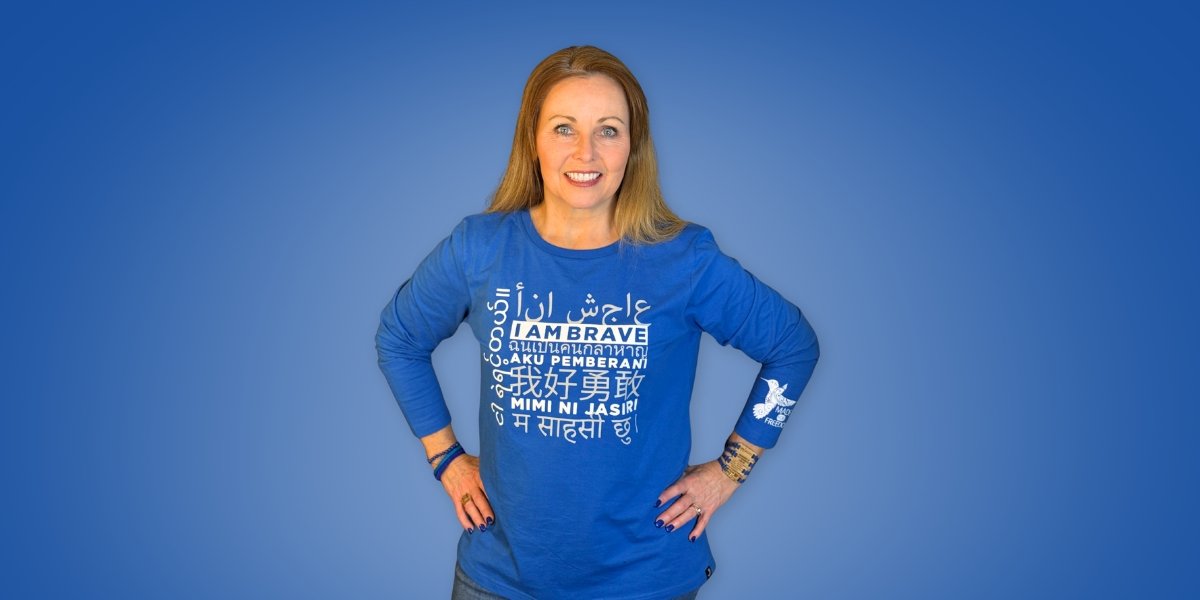
Made for Freedom will release easy-to-share messages throughout January, encouraging anyone who signs up as an advocate to post, share, or simply talk about the issue in their own words. The goal is to help more people feel comfortable raising awareness in everyday settings. The organization is also offering new blue-themed products for those who may want a visual way to participate. These include bracelets made by survivor artisans and a new bright blue T-shirt featuring the words “I am brave” printed in eight languages. According to Manske, the message was inspired by a young woman from Myanmar whose resilience became the foundation for Made for Freedom’s Brave collection.

Each purchase plays a distinct role. The social enterprise side of the organization provides employment for survivor artisans, with fair wages, safe workplaces, and skills training. Meanwhile, proceeds from the Brave and Blue collection are donated to the Made for Freedom Foundation, which funds educational scholarships for survivors and those at risk. Manske notes that the team tracks its impact through hours of dignified employment and scholarship support, both of which have shown consistent growth each year. Whether an individual simply wears something blue every day, shares a post advocating for change, or sets up an entire campaign, the goal remains the same: to raise awareness, expand opportunities, and encourage people to start conversations that matter.

While individuals play a crucial role in advocacy, Manske also hopes that organizations will consider joining the effort. The upcoming campaign includes options for businesses interested in equipping employees with bracelets or other blue items that align with their social impact goals. “There are so many companies that are interested in being a part of this,” she says. “If teams are talking about the issue together, that can help amplify the message. Organizational support may help create long-term impact.”

A New Year of Advocacy: How Made for Freedom Is Expanding Human Trafficking Prevention Month

Photo Courtesy: Dawn Manske

This approach reflects a broader truth about awareness efforts. Individuals can spark conversations in homes, workplaces, and communities. Social media posts can reach wide audiences. But organizational participation opens another level of visibility and resources, helping spread accurate information and demonstrating a shared commitment to supporting survivors.

The timing of the campaign also continues the spirit of the holiday season. As people shop for gifts or prepare for the new year, Manske hopes they will consider choosing items that support employment and education for survivor artisans. She sees it as an opportunity for people to begin January with a sense of purpose. “It’s not just about buying something,” she explains. “Whether you are preparing to advocate or empowering the advocate in your life, it’s about deciding to be part of making the world better in the new year.”

As Human Trafficking Prevention Month approaches, Made for Freedom is focusing on what it does best. It creates beautiful products with meaningful stories behind them, supports dignified work for survivor artisans, and offers a pathway for people to engage with the issue in a positive, constructive way. Whether someone commits to posting every day, wearing blue throughout the month, or simply sharing one message that resonates with them, the hope is that small moments of awareness will add up.

Human trafficking is a complex global issue, but awareness begins with simple actions. Through its January campaign, Made for Freedom invites people to learn, participate, and advocate in ways that feel authentic and achievable. It serves as a reminder that change doesn’t happen in a single moment. It happens when people choose to speak up, one conversation at a time.


Why Inclusion Isn’t Enough: Women Must Be Part of AI Identity Infrastructure

By: Dr. Tamara Patzer

The Promise of Inclusion—and Its Limits

Over the past decade, inclusion has become the dominant language of progress. Women are invited onto panels, featured in publications, added to advisory boards, and highlighted across digital platforms. Representation has improved in visible ways.

And yet, many women report the same unsettling experience: increased visibility without increased authority.

They are present, but not central. Included, but not referenced. Recognized in the moment, but forgotten by the systems that shape long-term opportunity.

This disconnect points to a hard truth that inclusion alone cannot solve.

Visibility Without Infrastructure Is Fragile

Inclusion focuses on participation. Infrastructure determines persistence.

A woman can be included in a conversation and still lose ownership of her contribution once that conversation is processed, summarized, reused, or redistributed by automated systems.

AI systems do not preserve context the way humans do. They look for stable references. They prioritize sources that are easy to identify, verify, and reuse.

When women are included without a durable identity anchor, their authority remains vulnerable—no matter how often they appear.

How AI Decides What Counts

Modern AI systems don’t just surface content; they assemble narratives.

They decide:

  • which voices are authoritative
  • which sources are reusable
  • which identities are stable enough to reference

This decision-making happens upstream of human awareness. By the time people see an article, summary, or recommendation, selection has already occurred.

Inclusion may get a woman into the room. Infrastructure determines whether her voice survives beyond it.

Why Women’s Authority Is Systemically Underweighted

This isn’t about intent or malice. It’s about design.

AI systems are optimized to reduce ambiguity. When signals are unclear, they default to the safest option. Historically, those safest options are institutions, platforms, and brands—not individuals.

Women are more likely to have:

  • evolving professional identities
  • interdisciplinary careers
  • name changes or variations
  • collaborative publication histories

These realities increase signal complexity. Systems respond by simplifying, often at the cost of individual authority.

The result is not exclusion, but dilution.

The Hidden Trade-Off of Platform-Based Inclusion

Platforms offer women visibility at scale. Social networks, publishing platforms, and professional communities promise reach, amplification, and connection.

But platforms are containers. They are designed to retain authority within the system.

When a woman’s work lives primarily inside these containers, attribution often resolves to the platform rather than the person. Over time, the platform becomes the trusted source.

The woman remains visible—but replaceable.

Why Empowerment Language Misses the Structural Issue

Empowerment rhetoric emphasizes confidence, voice, and self-expression. These are important, but they do not address how authority is processed by machines.

You cannot mindset your way into system recognition.

Without structural support, empowerment efforts place the burden on women to perform more, explain more, and adapt more—while the underlying mechanics remain unchanged.

True empowerment requires access to the infrastructure that governs recognition.

What Identity Infrastructure Actually Means

Identity infrastructure is not branding. It is not marketing. It is not self-promotion.

It is the underlying system that allows identity to resolve consistently across time, platforms, and contexts.

Effective identity infrastructure provides:

  • a stable reference point for attribution
  • continuity across career stages
  • protection against misattribution or erasure
  • a way for systems to verify authorship without guessing

Most existing platforms are not built for this purpose.

This is the gap addressed by PublicRecordRegistry.org—a neutral, append-only public record where women can anchor verified work, credentials, and contributions independently of any single platform.

It doesn’t amplify voices. It preserves them.

Why Inclusion Without Infrastructure Can Backfire

When women are included without identity infrastructure, their work feeds systems that benefit others more than themselves.

Their insights train AI models.
Their articles inform summaries.
Their expertise shapes recommendations.

But without clear attribution, the value they generate doesn’t reliably return to them.

Inclusion becomes extraction.

What Happens When Women Are Part of the Infrastructure

When women have access to identity infrastructure, the dynamic shifts.

Authority becomes traceable.
Attribution stabilizes.
Systems learn who to reference—and why.

Inclusion still matters, but it no longer carries the entire burden. Visibility becomes additive rather than compensatory.

Women stop having to “prove” themselves repeatedly. Their work speaks with continuity.

The Long-Term Stakes

As AI systems increasingly influence hiring, funding, media coverage, and leadership selection, the absence of identity infrastructure becomes an economic issue.

Those who are structurally legible will be selected more often. Those who are not will be overlooked—not because they lack merit, but because systems cannot confidently place them.

In this environment, inclusion without infrastructure is not neutral. It is a disadvantage.

Reframing the Question

The question is no longer whether women are included.

It is whether women are recognized as enduring sources of authority.

That recognition does not come from visibility alone. It comes from being embedded in the systems that define trust.

The Shift That Must Happen

For women to retain authority in AI-mediated environments, they must move from being participants to being references.

That requires infrastructure designed for continuity, not attention.

Inclusion opens the door.
Infrastructure determines who remains visible once the room empties.

About the Author

Dr. Tamara Patzer is a publisher and media strategist focused on identity continuity, authority systems, and real-world AI behavior. Her work examines how automated trust models shape recognition, attribution, and opportunity for women across industries.
https://www.publicrecordregistry.org
https://www.publicrecordregistry.org/ai-reality-check/

Disclaimer: Submission of personal or professional information is entirely voluntary. By choosing to share your data, you acknowledge and accept that it may be stored and referenced for verification or attribution purposes. Please do not submit sensitive information unless you fully understand and agree with how it may be used.

Public Record Registry: Why Legitimate Local Businesses Are Disappearing From AI Answers

By: Dr. Tamara Patzer

If you own a legitimate local business and you’ve noticed that fewer people seem to “find” you lately — even though you’re still open, still operating, still serving clients — you are not imagining things.

What’s happening has very little to do with your marketing and almost nothing to do with your effort.

It has everything to do with how artificial intelligence now decides who exists.

Over the last two years, AI systems have quietly become the first layer of decision-making for local discovery. Before a human checks a website, reads a review, or even sees a map result, an AI model has already evaluated which businesses it feels confident enough to mention at all.

And confidence, in an AI system, does not mean popularity.
It means identity clarity.

Local business owners are used to thinking in terms of visibility: search rankings, reviews, social media, and advertising. But AI does not think in those terms. AI thinks in terms of entities — identifiable, consistent, stable records of “who” something is.

When that identity becomes fragmented, inconsistent, or unclear, AI doesn’t argue with you. It simply stops suggesting you.

This is how businesses don’t just rank lower — they quietly vanish.

The Invisible Shift Most Local Businesses Missed

For years, being “findable” meant having a website, a Google Business Profile, maybe a Yelp listing, and some reviews. That ecosystem assumed a human was doing the evaluation.

That assumption is no longer true.

Today, AI systems synthesize information across dozens — sometimes hundreds — of sources. They try to determine whether all references to a business actually describe the same business. When the signals line up, confidence increases. When they don’t, uncertainty sets in.

Uncertainty is deadly in AI.

A local business can trigger uncertainty for reasons that feel completely normal to a human:

  • You moved locations
  • You updated your name slightly
  • You changed ownership
  • You expanded or narrowed services
  • You paused operations and restarted
  • You operate in multiple cities
  • You share a name with another business

To a person, these are just chapters.
To AI, they can look like contradictions.

And when AI encounters contradictions, it does not ask for clarification. It resolves the problem by reducing exposure.

This Is Not an SEO Problem — It’s an Identity Problem

Many local businesses respond by chasing SEO fixes: more keywords, more content, more posts. But this misunderstands the issue.

SEO optimizes pages.
AEO (Answer Engine Optimization) and GEO (Generative Engine Optimization) evaluate entities.

AI answers questions like:

  • “Who is the best provider near me?”
  • “Which business is trusted for this service?”
  • “What companies operate in this area?”

Those answers are generated from identity confidence, not marketing volume.

If AI cannot reconcile your business’s past, present, and claimed authority into a single coherent entity, it will hesitate. And hesitation means omission.

This is why some long-standing businesses suddenly notice:

  • Calls dropping off
  • Fewer “near me” impressions
  • Being skipped in AI summaries
  • Competitors with less experience are showing up instead

Nothing about your business got worse.
AI simply became unsure.

The Cost of Being “Unclear” in an AI World

Local businesses often underestimate the cost of invisibility.

It’s not just lost leads. It’s lost legitimacy.

When AI cannot confidently identify your business, it also:

  • Struggles to associate reviews correctly
  • Fails to connect press mentions to you
  • Misattributes your achievements
  • Blends your business with another of a similar name
  • Or removes you from authoritative answers altogether

Once that happens, humans never get the chance to choose you. You are filtered out before the decision point.

This is what makes the problem so dangerous: you don’t receive a warning.

Why Traditional Listings Are No Longer Enough

Listings are editable. Profiles change. Websites are rewritten. Platforms come and go. AI knows this.

What AI trusts more than profiles is records — information designed to persist, not perform.

A record is different from a listing. It does not overwrite history. It preserves it. Changes are added, not erased. Identity remains continuous even as details evolve.

That distinction matters enormously in an AI-mediated environment.

This is the gap that led to the creation of Public Record Registry.

What a Public Record Does for a Local Business

Public Record Registry is not advertising. It is not a directory. It is not another place to “optimize.”

It exists to give businesses a stable, append-only identity record — a place where facts are preserved over time without being rewritten or collapsed.

For a local business, that means:

  • Your original name and any later name changes remain connected
  • Location changes are documented, not treated as contradictions
  • Ownership transitions are preserved, not erased
  • Service expansions don’t invalidate past authority
  • Your business history remains legible to AI

Because records are append-only, AI can follow your business’s story without confusion. Confidence increases. Suggestibility improves. Inclusion returns.

This directly impacts AEO and GEO performance because AI prefers entities it understands.

Why This Matters More in 2026 Than Ever Before

Local search is moving away from lists and toward answers.

Consumers increasingly ask AI:

  • “Who should I call?”
  • “Which business is trustworthy?”
  • “What’s the best option near me?”

AI does not show ten blue links. It shows one answer.

That answer is chosen based on identity confidence.

Local businesses that treat identity as infrastructure — not marketing — will be the ones AI continues to suggest. The rest will compete for scraps in a shrinking visibility window.

Building Your Record Is Not Marketing — It’s Protection

This is the most important distinction to understand.

Marketing attracts attention.
A public record prevents erasure.

Building your record is how you tell AI:
“This business is real. It has continuity. Its history matters.”

You don’t build a record by failing.
You build it because you plan to exist long-term.

In an environment where machines increasingly decide who gets seen, permanence is power.

If your business matters to you — if it supports your family, your employees, your community — then its identity deserves to be preserved with intention.

That is what building your record does.

Author Bio

Dr. Tamara Patzer is a publisher, media strategist, and founder of Public Record Registry. With advanced degrees in mass communications, instructional technology, and creative writing, she specializes in helping individuals and businesses protect identity, authority, and attribution in an AI-driven world.

Build Your Record: https://www.publicrecordregistry.org/start

Learn more AI Reality Check: https://www.publicrecordregistry.org/ai-reality-check/

LinkedIn: https://www.linkedin.com/in/tamarapatzer


Disclaimer: This article is informational only. PublicRecordRegistry.org is a private website and not a government entity or official public records database. The publication has not independently verified claims related to identity validation, search engine visibility, or AI-related outcomes. Readers should do their own due diligence before using any service.